GENERALLY, when a man attains world-wide fame, it is expected that in his boyhood he will foreshadow his coming greatness; that he will, by some unusual actions, manifest those qualities that enabled him to stand head and shoulders above his countrymen. But in the boyhood of America’s great general, nothing can be found by which any one could possibly predict the great service he would render to his country. He was simply an energetic, honest-hearted, modest boy.
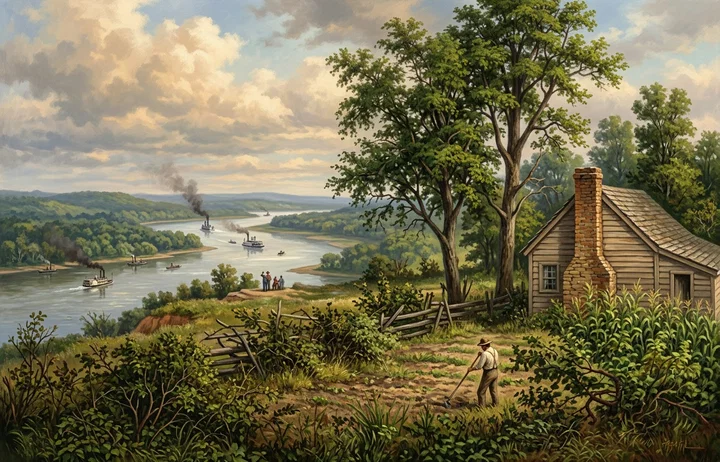
On the banks of the Ohio River, in a humble home, shown in the picture on this page, Grant passed his boyhood. Of these uneventful days, he says in his “Personal Memoirs: “My father was, from my earliest recollection, in comfortable circumstances, considering the times, his place of residence, and the community in which he lived. Mindful of his own lack of facilities for acquiring an education, his greatest desire in maturer years was for the education of his children. Consequently, as stated before, I never missed a quarter from school from the time I was old enough to attend till the time of leaving home. This did not exempt me from labor. In my early days every one labored more or less, in the region where my youth was spent, and more in proportion to their private means. It was only the very poor who were exempt.”
“While my father carried on the manufacture of leather, and carried on the trade himself, he owned and tilled considerable land. I detested the trade, preferring almost any other labor, but I was fond of agriculture and of all employment in which horses were used. We had, among other lands, fifty acres of forest within a mile of the village. In the fall of the year, choppers were employed to cut wood enough to last a twelvemonth. When I was seven or eight years of age, I began hauling all the wood used in the house and shops. I could not load it on the wagons, of course, at that time, but I could drive, and the choppers would load, and some one at the house unload. When about eleven years old, I was strong enough to hold a plow. From that age until seventeen I did all the work done with horses, such as breaking up the land, furrowing, plowing corn and potatoes, bringing in the crops when harvested, hauling all the wood, besides tending two or three horses, a cow or two, and sawing wood for stoves, etc., while still attending school. For this I was compensated by the fact that there was never any scolding or punishing by my parents; no objection to rational enjoyments, such as fishing, going to the creek a mile away to swim in summer, taking a horse and visiting my grandparents in the adjoining county, fifteen miles off, skating on the ice in the winter, or taking a horse and sleigh when there was snow on the ground.”
Perhaps his leading characteristic,—undaunted perseverance, manifested itself in his boyhood. When he made up his mind to do a thing, it was usually done, as is illustrated in a case of colt buying that took place when he was eight years old. “There was a Mr. Ralston living within a few miles of the village,” relates Grant, “who owned a colt which I very much wanted. My father had offered twenty dollars for it, but Ralston wanted twenty-five. I was so anxious to have the colt, that after Ralston left, I begged to be allowed to take him at the price demanded. My father yielded, but said twenty dollars was all the horse was worth, and told me to offer that price; if it was not accepted, to offer twenty-two and a half; and if that would not get him, to give the twenty-five. I at once mounted a horse and went for the colt. When I got to Mr. Ralston’s house, I said to him: ‘Papa says I am to offer you twenty dollars for the colt; but if you won’t take that, I am to offer twenty-two and a half; and if you won’t take that, to give you twenty-five.’ It would not require a Connecticut man to guess the price finally agreed upon. I certainly showed that I came for the colt, and meant to have him. I certainly could not have been over eight years old at the time. This transaction caused me great heart-burning. The story got out among the boys of the village, and it was a long time before I heard the last of it. Boys enjoy the misery of their companions, at least village boys in that day did, and in later life I have found that all adults are not free from the peculiarity.”
When Grant was seventeen, he entered the military academy at West Point, and in 1843 graduated at the middle of his class. He served in the army for fifteen years, but at length resigned and went to farming. Here he would doubtless have remained for the rest of his life, had not the war of the Rebellion called into action those latent talents which made him world-renowned. The history of the late war is perhaps so familiar to the readers of the INSTRUCTOR that it would not be necessary to enter in to the engagements under General Grant’s command. In the most trying and difficult circumstances under which he could be placed, no thought of defeat seems ever to have entered his mind. In the siege of Vicksburg, when some one asked him if he thought he could take the place, he replied, “Certainly. I cannot tell exactly when I shall take the town; but I mean to stay here till I do, if it takes me thirty years.” It was this dogged determination in the face of seemingly insurmountable difficulties that, more than anything else, gave him the victory.
“It is wonderful,” writes an army correspondent, “how entirely the army confides in General Grant. Every soldier’s tongue is full of his praises. They will tell you stories of his watchfulness and care; the fearlessness and intrepidity of this man whose plume they delight to follow; how he is everywhere, night and day, looking after the comfort of his men, and quietly prosecuting the strategic work of the campaign; how he rides unexpectedly to the remote outposts, speaking a pleasant word to the pickets if faithfully on duty, and administering reprimands if not vigilant and watchful; how he avoids fuss and show, going often about with only an orderly; how his staff, plain earnest men like himself, get down from their horses that sick and wounded men, struggling hospital-ward, may rest their weariness by riding to their destination; how, in a word, he is a thoughtful, resolute, kind man, sympathizing with the humblest soldier in his ranks, penetrated with a solemn appreciation of the work given him to do, and determined by Heaven’s help to do it right on the line he has occupied.”
Such was the man raised up by a kind Providence to bring the long, cruel war to a close. It would be needless here to relate the history of his later life; for this you know well. In his perseverance, his freedom from love of display, his quiet attention to his business, and his kindness to his men and to his enemies, our boys may find much that is worthy of imitation.
W. E. L.