It was in the year 1510, or, as some say, 1512, that a humble monk, bent upon settling some disputes among the convents of his order, wended his way through the mountain passes of the Alps and across the burning plains of Lombardy to Rome. Much fasting, penance, and night vigils had emaciated his vigorous form; and the hot suns of Italy, beating fiercely on his head, made him feel faint and sick. The things he saw perplexed him, too; for as he drew nearer and nearer the holy city, the seat of church authority, he beheld, not the pure living, self-sacrifice, and devotion which he had a right to expect at the fountain head, but pomp, vanity, and vice, put on with a bold face.
As he visited all the sacred places, bowing before images, kissing the tombs of martyrs, seeing all, and believing all, the credulous monk was laughed at for his pains; and he soon found that he alone, of all the vast city-full had faith in what the holy fathers said.
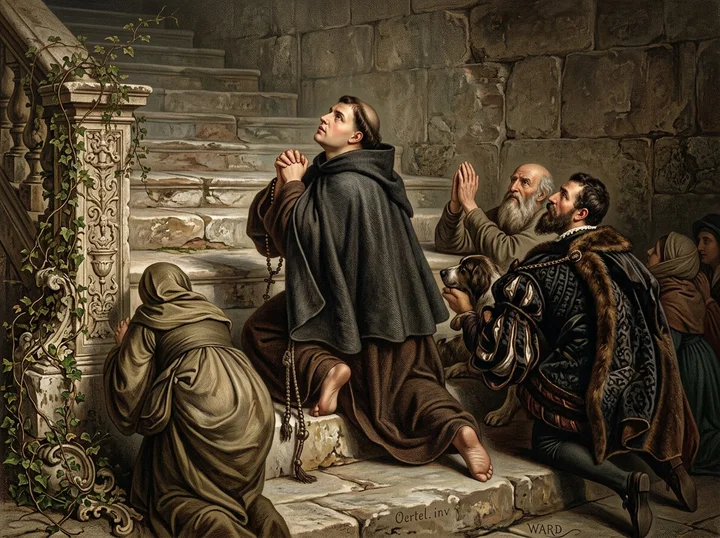
In such a frame of mind, and tossed with doubts, he one day visited the Scala Sancta, or sacred stairway, down which, as tradition said, and this good monk Luther believed, the Saviour stepped when he left Pilate’s judgment hall. The stairs were brought from Jerusalem in 326; and it was commonly reported that the angels had carried them hither in the night. Too sacred by far to be tread by human feet, the devout pilgrims made the ascent of the twenty-eight marble steps on their knees.
Up this stairway the good monk was painfully toiling, pausing at every step to repeat an ave, or prayer. But when half way up, he stopped. As if a voice sounded from the heavens, he heard those words of inspiration that twice before had thundered in his ears, “The just shall live by faith!” Overcome by confusion and shame that he should have been so blinded by superstition as to believe that by such idle works he could be saved, he resolutely rose and descended the stairs.
This visit to Rome was a sorrowful one; for as Luther afterward said, “The nearer we approach Rome, the greater number of bad Christians we meet with.” “Yet,” he declared, “if they would give me one hundred thousand florins, I would not have missed seeing Rome;” for it was needful that the future Reformer should know beyond a doubt the corrupt state of the church. From Rome he went back to Wittenberg to preach those glorious truths that were to free from error the whole Christian world.
To this day the tourist at Rome may see devout Catholics from every nation, ascending Pilate’s stairs as a penance for themselves or their friends. As they ascend, they pause in their merry laughter, and through a hole cut in the wooden casing that protects the marble, kiss a drop of blood said to have fallen from the Saviour’s brow as he descended the steps. Beside these marble steps is a pair of wooden stairs by which they can come down. It is not deemed necessary to show any reverence in the act, since each ascension atones for years of sin. At the top of the staircase, in the little room built for the purpose, is said to be a picture, painted by St. Luke, of Christ when he was twelve years old.
How glad we may be that we have the Bible to read, and know that atonement for sin lies not in idle works, but in the blood of Christ! W. E. I.