MOUNTAINS

8%

S. D. A. Publishing Association · Battle Creek, Mich. · May 26, 1886

FromThe Youth’s Instructor, Vol. 34, No. 21.

Read the full edition

MOUNTAINS

WHY the Creator has heaved up so large a part of the earth into vast mountains it may be hard to tell, but it is certain that in doing so he has given us ideas of grandeur that could not be had from any thing else in nature. The ocean is grand, especially in a storm; but there is such a sameness in it that the eye seems to take in but little. The sky appears to shut down so close, and to leave us such a narrow circle, that we long to have the curtain lifted, and a wider view opened before us. We know rather than see that the ocean is vast, and it is this knowledge that gives us a feeling of solemnity.
But the rugged mountain, with its beetling cliffs, its yawning gulfs, and its summit lost among the clouds, does not deceive the eye like the ocean. We realize the awful magnitude of the object before us. It makes us feel our own littleness, and gives us a glimpse of the power of God.
It may be on account of their awe-inspiring character that mountains have been chosen for the scene of the grandest events of the world's history. It was from a mountain-top that Noah and his family looked out upon the face of the new earth as it rose out of the flood. It was upon the crest of Sinai that the awful presence of the Lawgiver was manifested. Upon Carmel the fire from heaven descended; and it was upon a mountain that the prophet of God heard the “still, small voice.” On a mountain our Saviour was tempted, on a mountain he was transfigured, and from the Mount of Olives he ascended to heaven. We also read that he went up into a mountain to pray, and it was on a mountain that he preached his most memorable sermon.
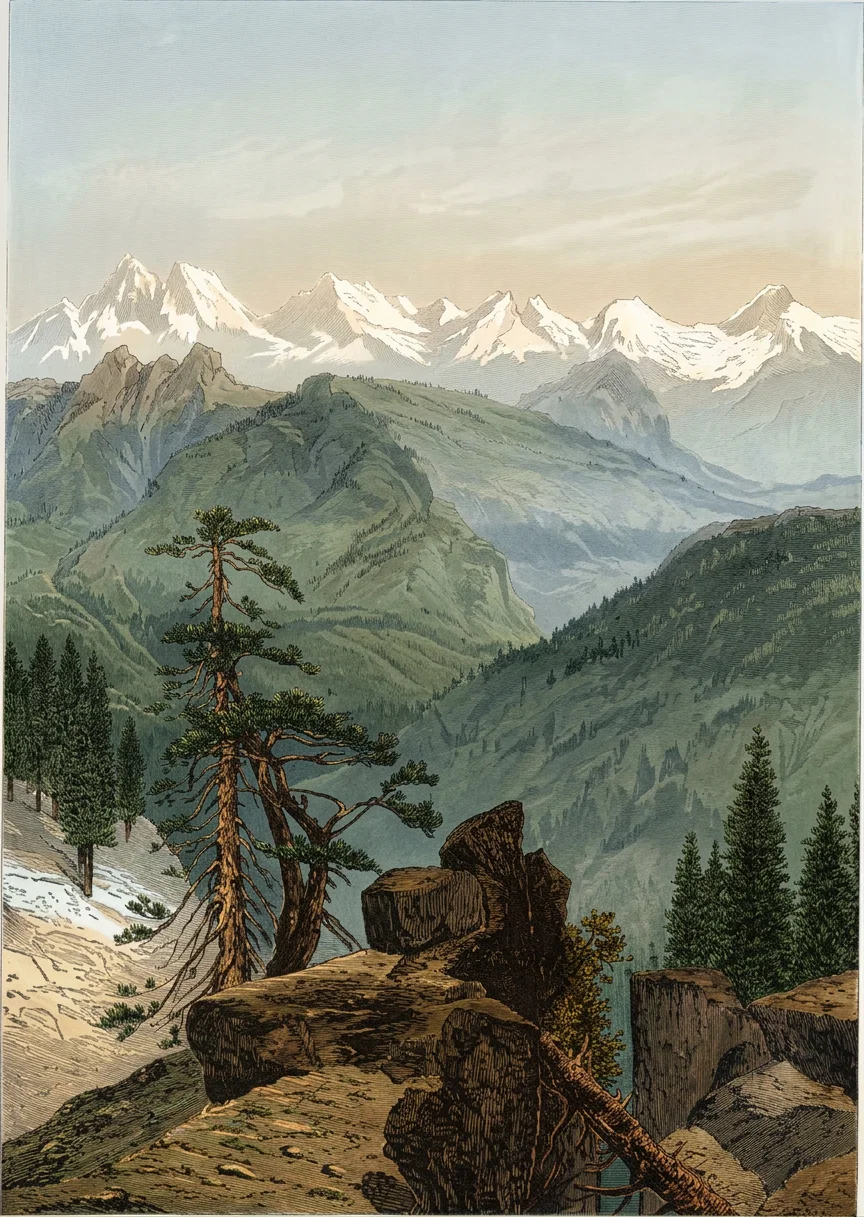
The picture on this page represents a scene among the Sierras [See-err-rahs.] Sierra is a Spanish word. It comes from the same source as serrate, which means “toothed like a saw.” It is applied to a number of mountain ranges, both in Spain and in those parts of America explored first by the Spaniards. Its application to a mountain range seems quite natural, since a long line of peaks seen against the sky, would present, on an immense scale, a toothed edge like that of a saw.
The loftiest group to which this term is applied, is the Sierra Nevada [Nay-vah-dah] range of Spain. Translated into English, the name is the Snowy Range.
Although so near the sea, these mountains are nearly twelve thousand feet above it; and, as a consequence, very abrupt and grand. Their highest summits are always covered with snow for more than two thousand feet from the top. These glistening white peaks can be clearly seen in the back-ground of the picture, with the sun shining brightly on one side of them.
The snow keeps growing deeper and deeper, until great masses of it break away, and slide down the mountain.
Restored with AI
By being piled so high, and pressed so hard, the snow becomes almost as heavy as ice; and when a vast amount of it shoots down the mountain-side, it soon gains such speed and force as to sweep every thing before it. Trees, rocks, and great quantities of earth, are carried along swifter than the flight of an arrow, and towns are sometimes buried, or hurled with their inhabitants into the depths below. Such a snow-slide is called an avalanche.
After a time, the great masses of snow gathered in the steep gorges and valleys change to little granules of ice, and the whole body of it is more like a heap of fine hailstones than it is like snow. Now the whole mass, pressed by the weight above, begins to move slowly down the mountain.
The motion is so slow that it cannot be seen, but if a pole is stuck into the glacier (for so this great moving mass of ice is called), it will be noticed, after a few hours, that the pole is several feet lower down the mountain than it was at first. As it reaches the lower slopes of the mountain, where the weather is warmer, the sun melts the ice on the surface of the glacier; and the water thus formed, as it trickles down through the loose particles of the cold layers beneath, freezes, and binds the whole together in a solid mass. Sometimes the glacier reaches the sea, and is pushed way out over the water, until by and by a great lump, hundreds of feet deep, is broken off by its own weight, and moves out to sea,—a floating mountain of ice. It is in this way that icebergs are formed.
G. H. BELL.