THE RODENTS

8%

S. D. A. Publishing Association · Battle Creek, Mich. · May 26, 1886

FromThe Youth’s Instructor, Vol. 34, No. 21.

Read the full edition

THE RODENTS

Among the many animals God has made are some that are, in a good many things, a great deal alike; and these creatures that so much resemble one another, naturalists have set apart in groups by themselves. Those I wish to talk about this time are called ro-dents, a name which comes from a Latin word meaning “to gnaw.” This class includes a great many animals that you often have a chance to watch,—mice, rats, rabbits, squirrels, beavers, and many more.
The teeth of these gnawers differ from those of other animals. Some rodents have three pairs of teeth quite like the double teeth in your own head, others have six pairs; and the hard covering, or enamel, on these teeth is wrinkled so that they can easily chew the grain they live on.
But they have another kind of teeth that are really wonderful. These are called in-ci-sors, or cutters. If you have ever been bitten by a squirrel or mouse, you will know how very sharp these little teeth are.
Now the wonderful thing about these teeth is that they always stay as sharp as a knife or a pair of scissors. If you were to gnaw such hard wood as the mice make holes in, I have no doubt your teeth would soon grow so smooth that you could not make very great headway; but these little fellows are not so troubled. The front part of these long, sharp teeth is covered with a hard enamel; while the back part is softer, and wears away with much use, leaving always a knife-like edge. But for all that, the whole tooth would wear away if nature did not continually build it up again.
Restored with AI
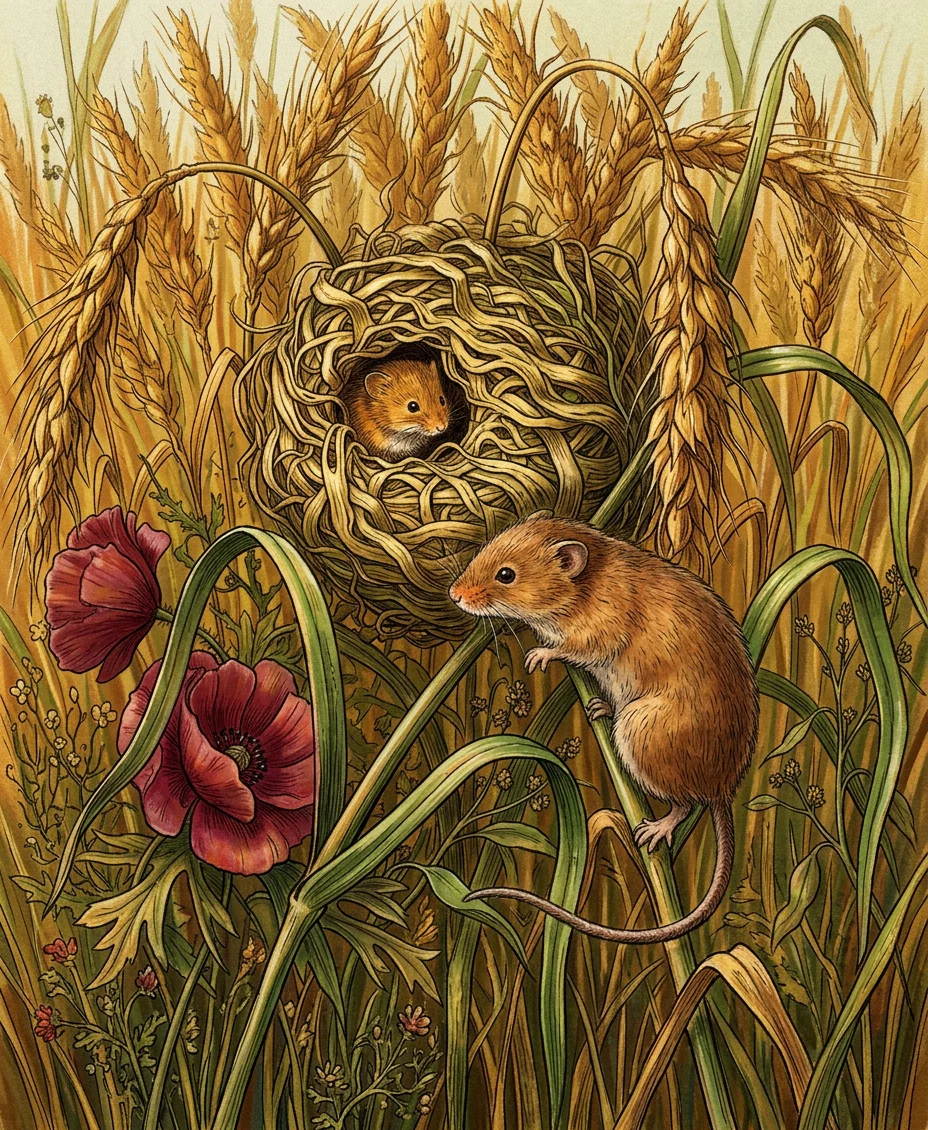
One of the prettiest rodents is the little harvest mouse, which is only half as large as the common house mouse. In the picture on this page you can see them and their home, which is built where three or four long stalks of grain bend over and cross each other. In and out, and round and round, the little fellow weaves his nest of grass and leaves, and binds together the stalks that hold it up; when it is all finished, it is not larger than the ball you toss about in your play. The little mouse, by twisting his long, slender tail around the straws, can climb up and down the wheat stalks at ease. When winter comes, he leaves this summer house, and takes shelter in corn or hay-ricks, or scratches out a burrow, and lines it with wool and hair.
A near relative to this mouse is the rat, one of the most destructive of the family. Because they are such troublesome creatures, most people dislike them very much; but some who have taken pains to get acquainted with them and watch their habits, have found that they really know a great deal.
Over across the ocean, in the city of Paris, is a great prison called the Bastille (bas-teel). A noted prisoner in one of its deep dungeons, was so troubled with the rats that he hardly knew what to do; for they would run over his face when he was asleep, and often bite him. Finding that he could not get rid of them, he undertook to tame them; and at the end of two weeks they would run after him when he called them by name, and would eat out of his hand.
Dr. Benjamin Franklin had a white rat that he called Scugg. Scugg was very fond of its noble master; and once when he was away, became ill because it could not see him. When he came home, the rat was so glad to see him that it died of joy. Rats are also kind to one another. Dr. Franklin tells of an old rat that had grown blind, and could not find its way; and that he saw a young rat place a twig in the old one's mouth, and taking hold of it with its own mouth, lead the old one along.
Away off in that desolate part of Asia, called Siberia, lives a little rodent known as the economic, or saving mouse, because it has a habit in fine weather of hoarding up food for winter. Its house is in a burrow, with runways all around; and here it lays up roots of all kinds, which it has scraped and dried in the sun. Sometimes their food gets damp, and then these wise little creatures take it out and dry it over again. In times of plenty, these mice sometimes lay up as much as fifty pounds' weight of food. The poor people in this country often hunt the burrows of this mouse, and rob it of its supplies, leaving just enough to keep the mice from starving. Sometimes in the spring of the year these mice make long journeys over land; but when winter comes, they return. The people are so glad to see them that they keep a festival in their honor.
W. E. L.