To those used to the easy traveling by railroad and steam-ship, where everything is made as agreeable and convenient as possible, a journey on the back of a camel presents a degree of hardship and novelty to be found perhaps nowhere else. In our picture we see a long caravan making its noon-day halt under the shadow of a great rock, no doubt the only shelter from the burning sun and sand for miles around. Isabella Bird Bishop, in Leisure Hours, gives a vivid and interesting description of a journey from Egypt to Sinai and back, under the escort of several Arabs, of whom Hassan was the chief. Perhaps you will get as good an idea of the ups and downs of desert travel from a few extracts out of this article, as from any thing that might be written.
Of the camel she had to ride, she says: “My beast is a saddle-camel, quite young, and not completely broken; it occasionally shies, and for a few yards afterwards breaks into an agonizing trot. It does not lie quiet while I mount it, but two or three times, just as I have been getting on, it has jumped up with an angry roar, and has taken the combined effort of several Bedaween to make it lie down and keep down. I have now traveled on saddle-horses, pack-horses, mules, asses, cows, elephants, and a camel; and though the fatigue of sitting ten hours daily on a camel’s back is very great, and its slow, swinging gait is wearisome and painful to the muscles, it is not nearly so bad as I expected—not worse, I think, than an elephant, and not so bad as a Japanese pack-horse.”
“I usually walk,” she says, “as far as I can to lessen the tedium of the day. . . . When I can walk no farther, my camel, with much difficulty and many objurgations, is made to lie down. Hassan stands on one side and the sheykh on the other, and with Hassan’s help I attempt to take a flying leap into the middle of the saddle. Sometimes this is successful the first time; and if it is, Hassan puts an arm in front of me, and the sheykh puts an arm behind me, and the dreaded moment arrives, which I am more cowardly about each time. The camel, with a jerk which might dislocate one’s neck, jumps on his knees, nearly throwing me backwards, then another violent jerk brings him to his haunches, and would throw me over his head but for Hassan’s arm; then the forward movement is arrested by another jerk which sets him on his four legs, and leaves me breathless on the lofty elevation of his hump. This process is reversed as one dismounts, and is repeated six times daily!
“But things are not always so comparatively smooth; for just as I am prepared to spring, the brute makes a snarling lunge with his teeth either at me or his driver, or just as I am half way up, jerks himself up on his four legs, and the whole has to be gone over again. Yesterday, I had just touched the saddle, when, by a rapid movement, he threw me off sidewise; and this morning, jerking himself up before I had clutched firm hold of the saddle, he threw me over his shoulder, and bruised me a good deal. After being mounted, the caravan straggles in single file, Hassan bringing up the rear, my camel being led, and for four or five hours we crawl over the burning, glaring sand.
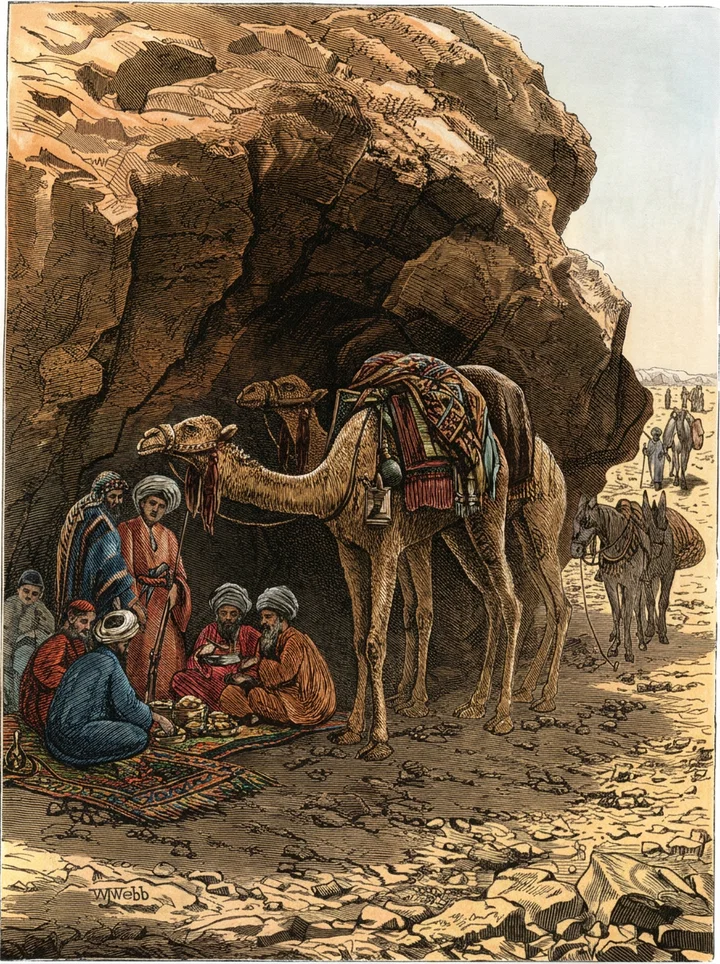
“I now understand what is meant by, ‘As a hireling I earnestly desireth a shadow.’ At 8:30 the shadow of my driver is fully eight feet long, and as the morning wears by, it shortens to something a little over two feet; then I know that noon has come. The camels halt; and if there be a rock which casts a shadow, Hassan lays a blanket in the shade for me, and while the Bedaween smoke and sleep for an hour, I read the Scripture account of the wanderings, and lunch on a cluster of raisins. I am learning a deep sympathy with the Israelites, and their unbelief and murmurings become more intelligible as the days go by.
How terrible must have been the trudge through this ‘waste howling wilderness,’ how bitter the regrets for the green valley of the Nile, how weary the barren sands, how terrible the burning heat! Better than all do I understand the words, ‘the shadow of a great rock in a weary land.’ To-day, on the parched plain no rock was found to give shelter in the heat of noon. There was but a big stone about two feet high, under the lee of which the Arabs scraped a big hole, into which I crawled, and lay down screened by a blanket laid over my double umbrella. The sand was burning even through my clothing.
“After this halt, the baggage-camel and the sheykh start early, so that I may find my tent pitched when I arrive at the camping-ground; and I, with Hassan and my driver, follow. Then come five exhausting hours over the blinding, burning sand, and oh! how eagerly I watch the driver’s lengthening shadow growing, growing, growing, till it slants surely twenty feet across the sand, and then in the distance I see my white tent, and soon the day’s toils are done. The camels are turned loose for a short time to browse upon such scanty herbage as exists—gray and bitter—some species of artemisia, the tamarisk, and the acacia. The Bedaween makes a fire of the dried camel’s dungp. 86 which they have picked up on the way, to which is added a little charcoal brought from Egypt, at which they boil their coffee and roast their maize; and I take my supper. The camels are then brought in and made to lie round the fire, looking like ‘wrecked ships.’ The Arabs talk and smoke, then putting on their goat’s-hair cloaks, lie down to sleep outside their camels; Hassan retires into his small bell tent, out of which his feet protrude; and by the time that it is quite dark, the camp is quiet, till the grunting and roaring of the camels at daybreak awake me.”