THE OCEAN

6%

S. D. A. Publishing Association · Battle Creek, Mich. · Jun 9, 1886

FromThe Youth’s Instructor, Vol. 34, No. 23.

Read the full edition

THE OCEAN.

THE ocean is God’s great treasure-house of wonders and mysteries,—a world in itself! Though you may visit it every day, the charm remains the same, whether you walk upon the shell-strewn beach, and examine the different specimens of star-fish, crabs, and sea-weed, or whether you sit on the shore and meditate. Its restless, roaring waves seem sounding a never-ceasing requiem over the unnumbered throng who lie quiet and lifeless in its chilly bosom or on the wreck-crowded sands. However fiercely the winds may shriek, and dash the waves mountain-high upon the surface of the ocean, there is eternal calm and silence in the depths below. The first sensation one experiences on nearing the beach comes from the delicious draughts of fresh air one inhales if the breeze is blowing in-shore; for the air of the sea is in a state of almost perfect purity, and rapidly drives before it the pestilential atmosphere of thickly crowded cities near its coast.
They “that do business in great waters, these see the works of the Lord, and his wonders in the deep;” and the submarine divers are, perhaps, the ones best entitled to give us information of the mysterious dwellers in the ocean’s depths, as they are the only ones who ever come back to tell their experience. Even they know little of its immensity, for in the latest reports of deep sea-soundings taken by our government vessels, the water in some places was found to be 4,579 fathoms, which is a little more than five miles deep, and the limit of a diver’s descent is one hundred and sixty feet.
The divers all have a thick rubber suit, with heavy weights of lead attached to their feet, and a copper helmet for the head, with small glass windows for the eyes. The helmet is tightly riveted to the suit at the neck, and the man’s only chance for fresh air to breathe lies in a rubber tube inserted in the back of this head-gear, and passing up through the water to the boat above, where two men are constantly engaged in pumping air into it. He also has a signal line connected with his belt in front.
The atmospheric pressure upon our bodies is twenty-one hundred and sixty pounds to the square foot; but in the sea, at ten feet in depth, the weight of the water is six thousand two hundred and fifty pounds, while at a depth of one hundred and sixty feet, it reaches the enormous sum of one hundred thousand pounds to every square foot of the diver’s body. The metal helmet prevents this pressure from being equally distributed, and that is where the diver’s chief danger lies. The weight on his rubber suit forces the blood to his head; and if lowered too quickly into deep water, he would be instantly killed. For instance: the steamship Oregon, which was sunk a few miles off Fire Island, about two months ago, lies in one hundred and thirty-two feet of water. The divers went down by means of the tail masts which are standing a few feet above the surface, and they had to “coax” themselves down little by little, till they could bear the weight of the water; and only after two or three attempts could they stay below long enough to make an examination of the ship.
If by any chance the diver’s air-tube or life-line becomes entangled while searching a wreck, he signals to his friends above, and they immediately haul him up. Sometimes they do not understand the signals, or other mistakes occur, and when he is finally pulled up, they find only an inanimate body in the armor. It is a perilous avocation, but there is a certain fascination about it; besides, men will risk great dangers to gain a livelihood. There seems to be always a supply of divers to equal the demand for them.
Divers sometimes use what is called a water-glass. It is a square tube, like a long box, with a pane of thick glass at one end. By placing this end beneath the water, and putting the face close down to the upper end, to exclude the light, the diver is enabled, if the sea is calm, to look through many feet of water to the bottom, and can see the different fish swimming silently among the long, waving, beautifully colored grasses and sea-weed, or darting from under the rocks upon their prey; for in ocean, as on land, the strong continually harass and devour the weak.
The sea-weeds are rootless plants, deriving their subsistence entirely from the water. They adhere to rocks and stones by means of a flat disk on the end of the main branch.
There is also in the ocean a curious flower, called the sea-anemone. It is fastened to a rock, and waves its long, brilliantly tinted leaves on the water. One might easily imagine a delicate fragrance coming from it; but woe to the small fish who comes near enough to be reached by those same leaves! They quickly enfold him, and he is literally tucked into the stem, which is only the open throat of a living creature, with a ravenous appetite and a good digestion. After the fish is swallowed, the leaves unfold, and again wave gracefully to and fro, appearing as harmless as they did a moment before.
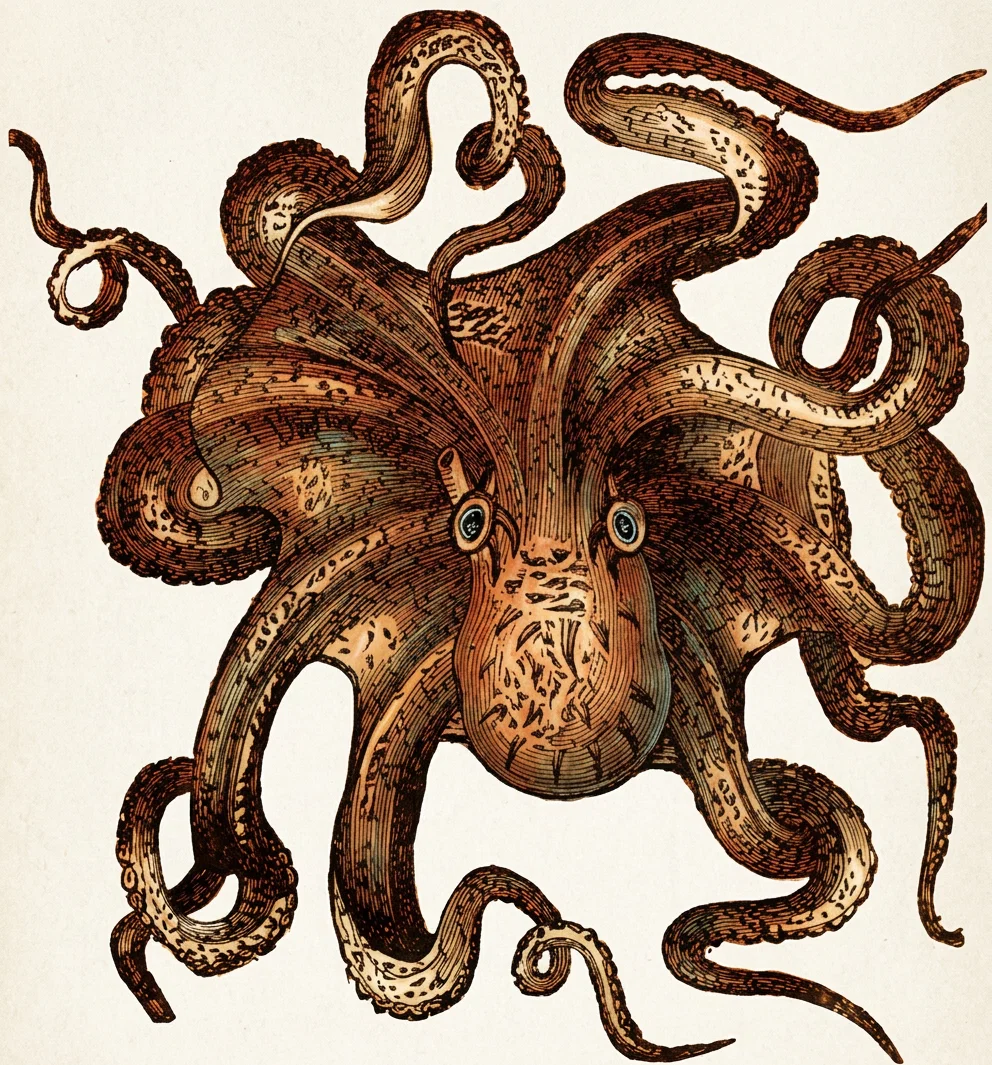
Divers are in danger, too, from sharks and other marine monsters who may, with one snap of their teeth, sever the air-tube. Sidney Dare, the well-known diver, says of the devil-fish, or, as the naturalists call it, the octopus: “One of these fish one night parted my life-line; and another time, one was settling down over me, to devour me, when he was seen by the crew in the boat, who struck at him with an oar, and frightened him away. If he had once got his arms around me, nothing could have saved me from being sliced up by his jaws.”
The octopus is a repulsive creature. It has a great, fleshy, bulbous body, with two round, glassy eyes as large as the top of an ordinary tea-cup, and a horny beak. It has seven or eight long, flabby arms attached to a thick, muscular collar at the neck. These arms are bristly, and of a brown color outside; underside they are white, and are furnished with a row of suckers to retain the prey when caught. Usually the fish are five or six feet long, arms and all, but they are sometimes found of great size. One enormous specimen captured by an English war-ship weighed eight tons; and another, sent to the New York aquarium several years ago, had a body ten feet long, and its arms measured thirty feet. When it attacks its victim, it belches forth an inky fluid, that darkens the water; and from this fact it is sometimes called an ink-squid.
Restored with AI
In sailing out of port, one often sees the porpoises, which to me resemble small whales. They frequent nearly all our salt-water harbors in search of smaller fish for food. Whenever they come upon a school of mackerel, herring, or porgies, they do murderous work with their jaws, which are armed with from forty to fifty sharp teeth. It is a wild, rollicking scene to view a lot of them plunging and tumbling through the foam, often lifting their black bodies nearly out of the water. To a landsman, it seems as if they were doing it in playfulness; but it is serious work for them, and more serious for the small fish, who are trying to escape their pitiless pursuers. Porpoises vary in size all the way from fifty to eight hundred pounds.
Whenever they can, fishermen are always glad to capture a porpoise for its commercial value. Every part of it is marketable. The skin when prepared is even better than the alligator’s hide for carriage leather and for shoes. The blubber, or fat, yields an oil equal to that of the whale; and a superior grade, which comes from the jaws, is much used by jewelers and watch-makers. Some parts of the meat are esteemed delicate food, and the rest of the fish is sold for fertilizing purposes.
Another frequenter of harbors is the shark. I saw, one summer, a man-eating shark which had just been caught in North River, where the street boys were in the habit of swimming daily. He was six feet long, and weighed nearly four hundred pounds. He had a wide, cruel-looking mouth, and rows of terrible teeth. I thought, while looking at him, that if I had met him alive, and in his native element, distance would certainly have “lent enchantment to the view.”
I feel as if I had only touched upon the marvels of old ocean; but if I have succeeded in awakening in any of you a desire to study for yourselves, and to find out about the pearl divers, coral builders, sponge gatherers, and other delvers in the sea, and to lead you to know more about the many wonderful things of the deep, I shall feel amply repaid for writing this article.
L. E. ORTON.