“Of making many books,” wrote the wise king, “there is no end.” If Solomon grew weary with “much reading” in those days of limited books, I wonder if he wouldn’t sigh more heavily now could he step into a modern bookstore. What would he think could he see one of the printing-presses of to-day, capable of turning off in an hour between thirty and forty thousand newspapers, printed on both sides, and neatly folded for mailing? In his wildest dreams of improvement, I don’t believe he thought of anything like that.
Restored with AI
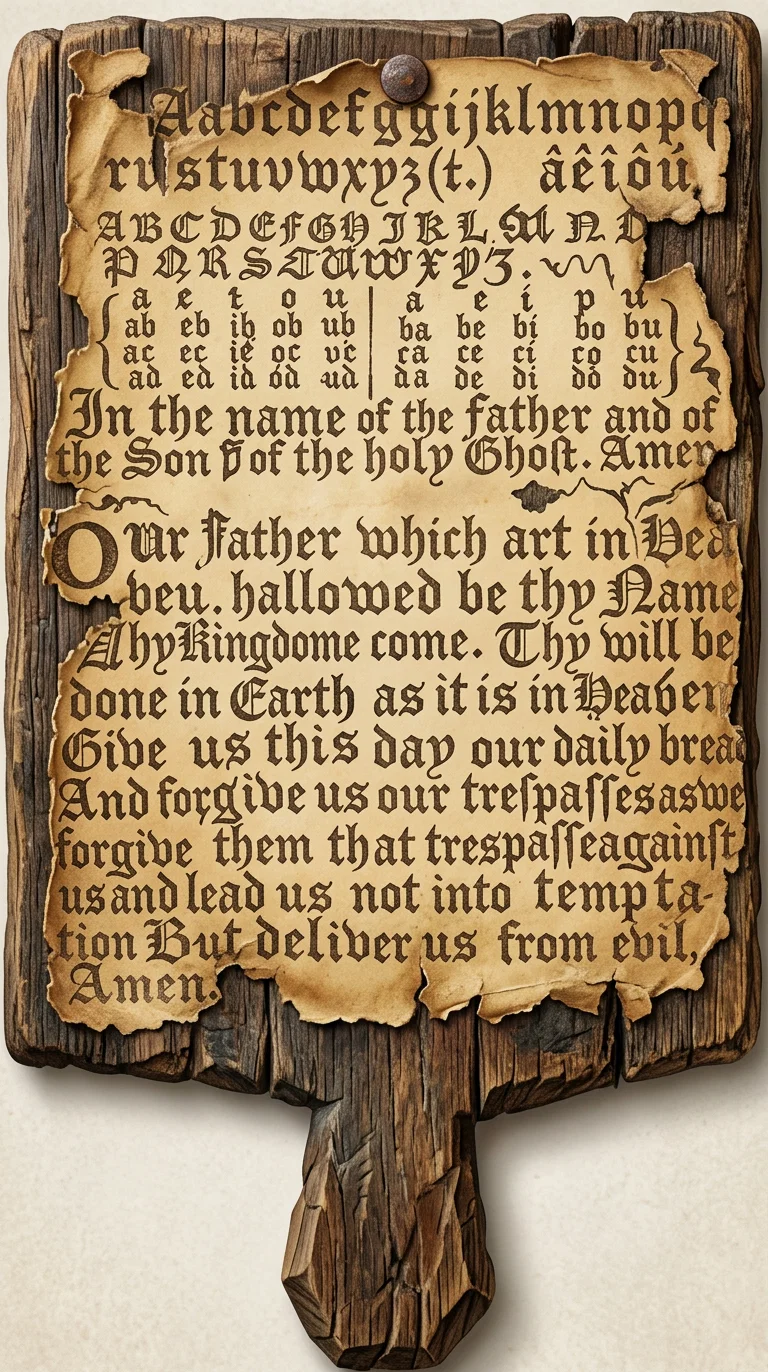
The earliest writing was done on brick, horn, shells, and stone. The bricks, while soft, were impressed with a stamp; and among the ruins of ancient cities, relic-hunters may still find these bricks stamped with curious figures and unintelligible writing. The horn and stones were rudely engraved, and the letters scratched on the surface were often stained with some color. The accompanying picture of the horn-book, with the Lord’s prayer engraved upon it, will give an idea of these first attempts to preserve a record. By and by, thin pieces of board covered with wax came to be used, and were written on with an ivory pencil; but of course, on wax soft enough to take an impression, the writing was soon effaced, and so these were cast aside for the smooth inner bark of trees. Parchment, or the prepared skins of animals, was also largely used, and papyrus, a broad-leaved rush of the Nile. It was often difficult to get parchment, and so the original writing was frequently erased to make way for a new book, in many cases not so good as the original one. These parchment books were not often put up in the square form our books present, but were rolled up; and from this we get our word volume, meaning a roll.
In the little town of Nablus, in Palestine, may be found a very ancient roll. It is owned by the Samaritans, whom you will remember as the mixed race of Jews and heathen inhabiting the Holy Land during the captivity. They form the oldest sect in the world, and perhaps the smallest, numbering, all told, only one hundred and twenty persons. Their famous book roll contains the first five books of the Bible, or the Pentateuch, the only portion of the Scriptures which they believe inspired, and it is said to have been copied by the great grandson of Aaron, thirteen years after the conquest of the Holy Land. Whether this be true or not, it is hard to tell; for strangers are not permitted to handle the sacred roll, and the word of a Samaritan is not always to be relied upon. The roll, a picture of which is given on this page, is kept in a silver case, opening on hinges, and the whole is wrapped in a scarf of red satin. The case is oddly chased with figures of the tabernacle and its furniture.
Frequently the wealthy kept educated slaves, who copied books for them; but at length the greater part of the work fell into the hands of the monks, who in their cloister cells, away from the tumult and bustle of life, peacefully spent their days in keeping alive the feeble flame of learning.
And then came the time of Gutenberg and the first printing-press, when the sun of learning shot his clear beams athwart the land, scattering the mist and the vapor that enveloped the minds of the people. It was a great day for the world when Gutenberg struck off the first sheet from his press! No more were books to be multiplied by the tedious process of the pen.
These early printers, when once the secret of printing was blazed abroad, took great pains to inform the public that their books were printed. One of them said of his book, “It is not written with pen and ink as other books be, to the end that every man may have them at once; for all the books of this story, thus imprinted as ye here see, were begun in one day, and also finished in one day.” And they might justly glory in this “preservative of all arts,” and build air-castles high as the skies, for the most visionary would not have foreseen the perfection to which his beloved art is brought at the present day. W. E. L.