THE history of the chosen people of God has ever been filled up with remarkable and interesting experiences. In every age of the world we find this true. And as we read their history in ancient times, we cannot fail to be impressed with many of the wonderful occurrences of those times. There is, perhaps, in all the Bible no more deeply interesting narrative in relation to their history than that covering the time from Joseph’s abduction and carriage into Egypt, to the time of their deliverance from the cruel bondage under which they were permitted to suffer for many generations.
Our tenderest feelings of sympathy are touched by the recital of the cruel treatment which Joseph received at the hands of his brethren, through jealousy; and gratitude and wonder inspire us as we read of the remarkable providence of God in preserving him amid the dangers and trials through which he passed, to be the instrument in God’s hands for the preservation of his father’s family and of the nation, when death by famine seemed inevitable. Though hidden from their understanding, God had a grand and beneficent purpose in permitting all these experiences to come to his people.
The record tells us that after a season of prosperity in the land of Egypt, changes in their circumstances occurred. Joseph was long since dead. The king who ruled in the land when they first found a home in it was no more. Other kings had occupied the throne who were less kind and friendly to them. The numbers of the family of Joseph had increased until they had become a vast nation. Then arose a feeling of jealousy in the hearts of the rulers of Egypt, who feared that the strangers in their land would become so strong and numerous that they could not control them, and that they would, in case of any trouble with the neighboring nations, join with them in war, and overthrow the Egyptian throne. So they made the children of Israel slaves to the Egyptian king, and set taskmasters over them, who treated them most cruelly, and afflicted them with heavy burdens. “But the more they afflicted them, the more they multiplied and grew. And they were grieved because of the children of Israel.”
Thus they lived under the cruelties and hardships of slavery for many long and weary years. Generation after generation lived and passed away, and no deliverance came. Their burdens were constantly being increased, and they subjected in every way to the most cruel treatment by their wicked masters. Their innocent children were murdered to prevent their growth to manhood, and to decrease the number of the people.
But we read that “in process of time the king of Egypt died: and the children of Israel sighed by reason of the bondage, and they cried, and their cry came up unto God by reason of the bondage. And God heard their groaning, and God remembered his covenant with Abraham, with Isaac, and with Jacob. And God looked upon the children of Israel, and God had respect unto them.”
God’s grand purpose was during all this time being fulfilled. But the time had now come when a change,—a mighty change,—was to take place. The time for their deliverance from slavery and restoration to freedom, was at hand. God chose a man, preserved from death in his infancy in a remarkable manner, reared amid the wealth and splendor of the Egyptian court, educated in all the wisdom of the nation, and taught in the school of adversity,—such a man was chosen as his instrument for their deliverance.
At last the children of Israel, through Moses and Aaron, made request of the king that they might be allowed to go three days’ journey into the wilderness to sacrifice untop. 102 God. The king refused to grant their request, and oppressed the people still more heavily. But by mighty wonders and miracles, afflictions and distresses which were allowed to come upon the nation, the king at last consented to their request. Terrible distress had come upon the nation in consequence of their refusal to grant the request of the Israelites.
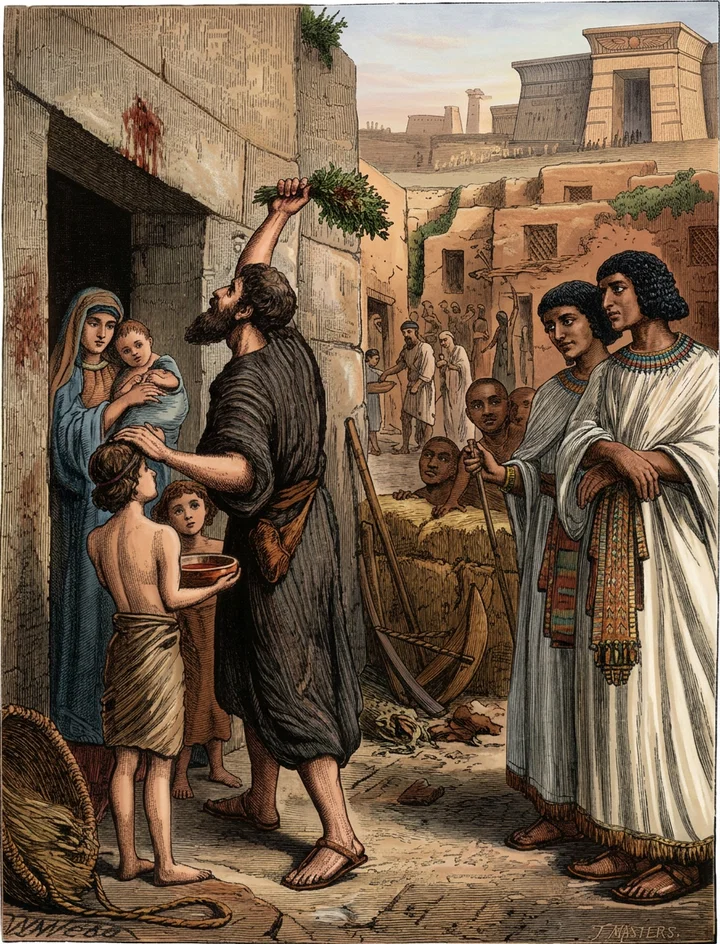
The Lord had given definite directions to his people, what they were to do. Their sure deliverance was promised, and the day of its accomplishment made known to them. Specific directions in regard to the preparations for their departure were given them. Every thing was in readiness, and the people waited. The Lord spake to Moses and Aaron to instruct the people upon a certain day of the month to take a lamb from the flock, and in the evening to slay it. Here our artist has most impressively represented the next scene, in the accompanying engraving. They were then to take the blood of the lamb in a basin, and dipping a bunch of hyssop into it, strike the side and upper door-posts with it. The father, the head of the family, is in the act of doing this. With what awe and wonder his wife and children watch him, who have doubtless been fully instructed in regard to its meaning, and understand what is to occur. Standing a little aside we see some of the Egyptians, watching the scene with curiosity and contempt. What significance has it to them?—Not much, we think. In the background we see a company of idolaters wending their way to their temple of worship, and others engaged in various employments, little dreaming of the scenes so soon to transpire. But what means this strange proceeding on the part of the children of Israel? Surely it must have some important significance. We turn to the 12th chapter of Exodus, and there we learn its meaning. The last and most terrible punishment that was to come upon the people of Egypt for their refusal to let the children of Israel go, was the destruction of the first-born in every family, from the king on his throne to the captive in the dungeon. In the night season the angel of the Lord was to go through the land and smite with death; but every house which bore upon its door-posts the marks of the blood, he was to “pass over,” and spare its first-born. Realizing its significance as they did, what solemnity must have accompanied the ceremony, in the minds of the children of Israel, and what a terrible significance to the stricken nation of Egypt when, upon a certain morning, their dead revealed to them its meaning.
The hearts of the king and his people had become hardened in their wickedness; and notwithstanding the oft-repeated promise of the king to let the people go, it was as often broken, and their request denied. But God had spoken, and his promise could not be broken. In the silence of the night, while the people lay unconscious in slumber, the angel of the Lord passed through the land, and visited every dwelling; and whatsoever house bore upon its door-posts that significant token of blood, was safe from the terrible doom that awaited those thus unprotected.
At midnight a fearful cry arose in all the land of Egypt; for there was not a house in which there was not one dead. The king and his servants rose up and urged the children of Israel to depart; for they said, “We be all dead men.” With hasty preparations for their journey, the burdened slaves went forth from the land of their adoption and bondage—six hundred thousand, besides children and a mixed multitude; and they sang upon the farther banks of the Red Sea their glorious deliverance from their pursuing oppressors, whom they saw most miserably perish in its rolling waters.
And of such importance was this simple token of blood, with its accompanying services performed in the land of Egypt, that the Lord gave his people directions that each recurring year, upon the fourteenth day of the month, when they came to the land which he would give them, it should be repeated as a memorial to them and their children forever; that when their children should ask what these things meant, they should say, “It is the sacrifice of the Lord’s passover, who passed over the houses of the children of Israel in Egypt, when he smote the Egyptians, and delivered our houses.”
Thus we find through all the subsequent history of this people, their strict observance of the “feast of the pass-over,” to them so full of interest and meaning. J. W. B.