With maternal kindness, Nature offers to all her children the chief, the most innocent, and the most universal of all pleasures,—one which may be enjoyed without expense, and is equally accessible to the poor and the rich. Yet how many there are who disregard the ennobling and soul-inspiring charms of nature, and constantly seek for other, and often harmful, pleasures and recreations! They forget that true pleasure and happiness are received from a knowledge of God; and this knowledge is not obtained from his divine word alone, but also from the manifold works of his hands spread out before us. Here we can also more fully learn to understand the gospel of Jesus Christ; for in teaching his disciples, our Saviour often made use of the works of nature to illustrate his teachings and to lead them to reflect on heavenly and spiritual things. It is a noble employment, and well worthy of man, continually to study the book of nature, from which he can gain some conception of the goodness, wisdom, and power of the Creator. The mind soon tires of worldly pleasures and amusements, but there is an ever-growing enjoyment in contemplating the wonderful works of the Lord. Were we to reflect on them for a million of years, we would not become weary, but would ever find new charms in them.
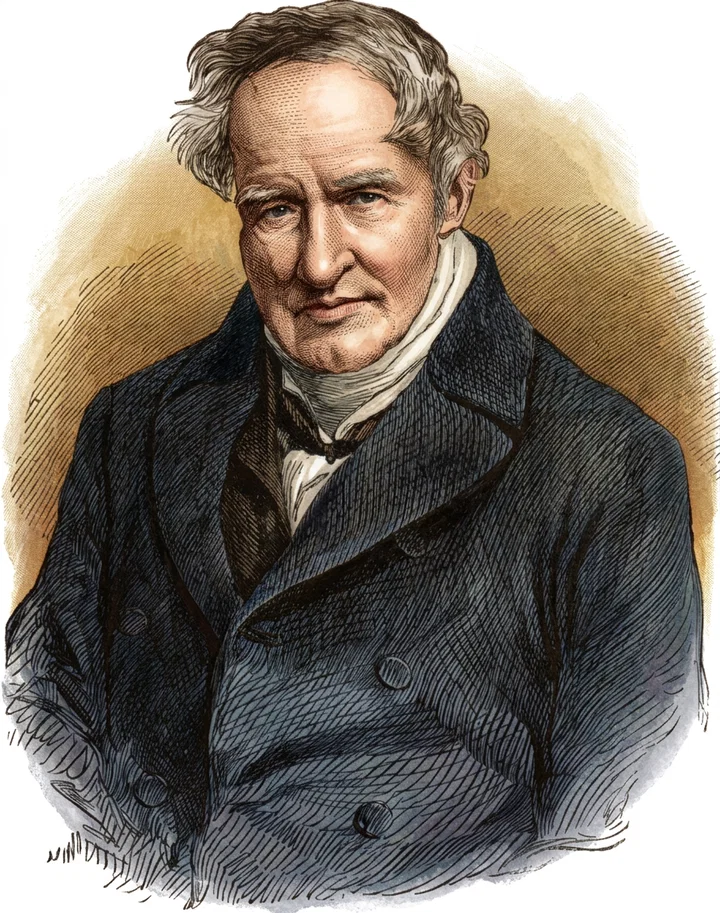
In all ages of the world there have lived men who have been inspired with such a love of nature that they have devoted their lives to the study and investigation of its beauties and wonders. And one of the greatest and noblest of these in modern times—one who has contributed more, perhaps, than any other naturalist to the progress of physical science, is the one whose picture appears on this page, and of whom we will here give a short sketch.
Alexander von Humboldt was born at Berlin, Germany, Sept. 14, 1769. His father, whom he lost when he was not quite ten years of age, was chamberlain to the king of Prussia. Being a studious boy, and having ample means to pursue the path of knowledge, he acquired a good education at the universities of Frankfort-on-the-Oder, Berlin, and Göttingen. His love of natural history was strongly manifested at an early age, and during his residence in Göttingen he made visits of scientific exploration. During one of these he explored the banks of the Rhine, the fruit of which is his first publication. In accordance with the wishes of his father, he followed business occupations for a number of years, filling at one time an office in the mining department, spending several years in this capacity. His researches here were published in a work of two volumes.
At the death of his mother he came into possession of a considerable fortune, which enabled him from that time on to devote himself to his most loved work of studying nature. He accordingly, at the age of twenty-seven, resigned his office in connection with the mining department, and entered upon a series of exploring tours. He spent three months at Jena, where he was the intimate associate of Goethe and Schiller. Circumstances now led him to Paris, where he became intimately acquainted with a distinguished young botanist, Aimé Bonpland, who afterwards was his companion in many and various scenes. Some time after, he succeeded in obtaining permission from the Spanish government to visit all the Spanish settlements in America and the Indian Ocean, with every additional favor which could promote his researches in the various departments of natural science. This tour was undertaken in company with his young botanist friend, and consumed five years, during which time he explored a vast extent of territory in Venezuela, Granada, Ecuador, Peru, Mexico, Havana, and North America. This course of travels is unparalleled for variety and importance of scientific results, not only in the different departments of natural history, but also in geography, statistics, and ethnography. It has been truthfully said that America was discovered anew by Alexander von Humboldt, as it was through his researches that the people of the Old World became acquainted with its plants, animals, natives, and many other natural resources.
Humboldt now took up his residence in Paris for a number of years, and occupied himself in arranging his collections of manuscripts and in experimenting on the chemical constitution of the atmosphere. In 1807-17, his great work, embodying the chief results of his travels, appeared in two forms, folio and quarto, in each consisting of 30 volumes, and containing 1425 illustrations.
In the year 1829 he again entered upon a tour of exploration, this time to the northern part of Asia, exploring principally the Ural and Altai mountains, the Chinese Dsongarei, and the Caspian Sea. The principal results of this expedition were the scientific examination of the beds which produce gold and platina, the discovery of diamonds in an extra-tropical region, the astronomical determination of positions, magnetic observations, and geological and botanical collections. The whole journey occupied nine months, and extended over 10,000 miles. This expedition has led to increased knowledge of the earth's magnetism and of meteorology; for it was through the earnest proposal of Humboldt that a net-work of magnetic and meteorological stations has been spread out over the whole world, by means of which the general condition of the earth in this respect is constantly ascertained.
It is impossible to estimate the amount of Humboldt's contributions to science. During his journey in Spanish America he determined astronomically more than 700 positions with regard to its geography. His barometrical observations were very numerous. To him we are indebted for the most important generalizations concerning magnetism and climate, some results of which are exhibited in the isothermal and other lines which have begun to be drawn in our maps. The botanical discoveries made by himself and Bonpland are given to the world in a number of valuable works. He is the founder of the new science called vegetable geography. He discovered not less than 3,600 new species of flowering plants. It is said that his knowledge was one of the most profound and covered the widest range of scientific investigations of all scientists that have lived on this earth. His works comprise the sciences of astronomy, zoology, botany, mineralogy, vegetable and animal geography.
Humboldt died in Berlin, May 6, 1859, after having spent all of his fortune in travels and scientific works.
Let us, like this great naturalist, endeavor more and more to become acquainted with the God of nature; let us think of his greatness, and admire his wisdom and power, which we behold in all the works of his hands. This employment will not only make us happy, but tend to make us good also; for a constant view of God through his wonderful works will surely inspire us with love and veneration for so glorious a Being. And let us prepare ourselves for a home in the new earth, where we shall have a mind and heart that can fully comprehend and appreciate the wonders of creation, not only on this earth, but throughout the immensity of the whole universe. A. SWEDBERG.