It was over eighteen hundred years ago that Jesus walked this earth, and taught as never yet man taught, healing the sick, comforting the broken hearted, and giving to the perplexed people the simple teachings of the gospel for the traditions and burdensome ceremonies imposed on them by hypocritical priests. With gladness the common people listened to his words and received him into their hearts. But the bigoted priests could not endure his doctrines, for they were directly opposed to their teachings, which tended to exalt man instead of God.
With apt and cutting parables Jesus exposed their hypocrisy, and won their bitterest hate. Gladly would they have killed him but that they “feared the people.” So with cunning malice they “sought to entangle him in his talk.” Selecting, one day, some of the Herodians, who professed great friendship for the Roman governor, and some of the Pharisees, who were the strictest of the Jews, they approached the place where Jesus was teaching and healing the people. With a great show of sincerity they addressed him: “Master, we know that thou art true, and teachest the way of God in truth, neither carest thou for any man; for thou regardest not the person of men. Tell us therefore, what thinkest thou? Is it lawful to give tribute unto Cæsar, or not?” A simple and direct question surely, yet how deep a plot it concealed; for if Christ should say it was unlawful, the Herodians were ready to report the matter to the Roman governor; and if he should say it was lawful, the Pharisees were equally ready to summon him before their council for speaking things contrary to the religious teachings of the Jews. “But he perceived their craftiness, and said unto them, Why tempt ye me?” “Show me the tribute money. And they brought unto him a penny. And he said unto them, Whose is this image and superscription? They say unto him, Cæsar’s. Then said he unto them, Render therefore unto Cæsar the things which are Cæsar’s; and unto God the things which are God’s. And when they heard these words, they marveled, and left him, and went their way.”
We fancy the common people who stood near must have been glad to have this much-disputed question settled, and so easily—render to your temporal rulers the things which they demand, provided what they ask does not conflict with the requirements of God. And the angry Pharisees, covered with confusion that their plot was revealed—what a rebuke was given to them!
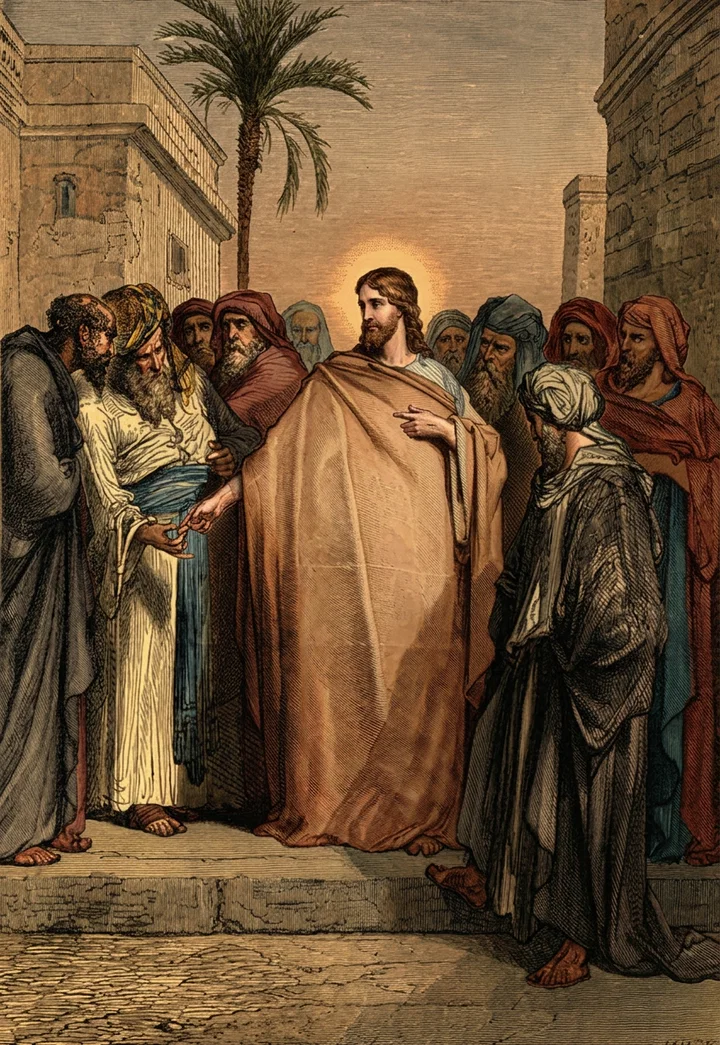
I wonder if we might not learn a lesson from Christ’s talk with the Pharisees that day, for these things “were written for our learning.” Are we not as forgetful sometimes, as these proud Jews, to “render unto God the things that are God’s”? W. E. L.