THE city of Edinburgh, Scotland, dates back so far in the past that its origin is lost in antiquity. It is commonly supposed that the city derives its name from a Northumbrian king named Edwin. The city, like many others, owes its origin to its castle, which is fabled to have been the residence of young Pictish princesses, before their marriage, and hence is called the Maiden’s or Virgin’s Castle.
Objects to admire or wonder at meet the stranger at every turn. Here stand, hallowed by the legends of by-gone centuries, buildings so old and quaint that one almost holds his breath in gazing upon them, the very stones of which they are built being black with an old, old age, and crumbled by the storms of over a thousand years; and dwellings ten and twelve stories high, and places where stood others fifteen stories in height, which, though now destroyed, were yet so strong and massive as to tax to the utmost the skill of modern engineering to level them safely.
The streets of the “Old Town,” the ancient part of the city, which was slowly built up as the centuries passed, follow the turnings of the foot and cow paths which they originally were. The Haymarket, Cow-Gate, and Cannongate, with their little closes (alleys), were once peopled by titled families; but they have long since been given over to the poor and lowly, who live in apartments, the walls, paneling, and carving of which are marvels of exquisite workmanship; the fireplaces of delicate carving, would, if transported to America, command fabulous sums among our wealthy citizens for service in their own homes.
Where High Street narrows to the Netherbow, stands the house of John Knox, the reformer. It is a well-preserved specimen of the quaintly gabled, picturesque buildings of old “Edinboro.” Only three of the rooms are now shown to visitors,—the sitting-room, bed-room, and study. They are paneled with oak taken from other old buildings of the same period, as the original paneling has disappeared. In this house John Knox lived from 1560 to November 24, 1572, when he died at the age of sixty-seven. He was buried in St. Giles’s churchyard, and over him the Regent, Morton, pronounced his famous eulogy: “Here lies he who never feared the face of man.” Along the lintel of the door on the ground floor is the following inscription in old spelling: “Lufe God Above All And Your Neighbor As Yourself.” And in front, looking up High Street, there is a rude effigy, supposed to be that of the reformer.
St. Giles is the ancient parish church of Edinburgh. It is dedicated to a saint of the name, supposed to have been born in Greece. It is an object of interest, both from its antiquity and its associations. It is supposed to date from the ninth century.
The Haymarket is of great antiquity. It was formerly the place for public executions, and a circle, inclosing a cross on the causeway, at the east end of the street, marks the spot where the scaffold stood.
Among the many fine monuments of this city is the “Scott Monument,” a cross of brown stone, one hundred and ninety-seven feet in height, erected to the memory of this author. A marble statue of Sir Walter, attended by his dog Bevis, is placed under the canopy of this monument. A stairway of 287 steps leads to the top, while from its thirteen galleries views of all parts of the city can be obtained. In the niches are statues of some of the most familiar characters in his poems and novels. The monument cost £15,650.
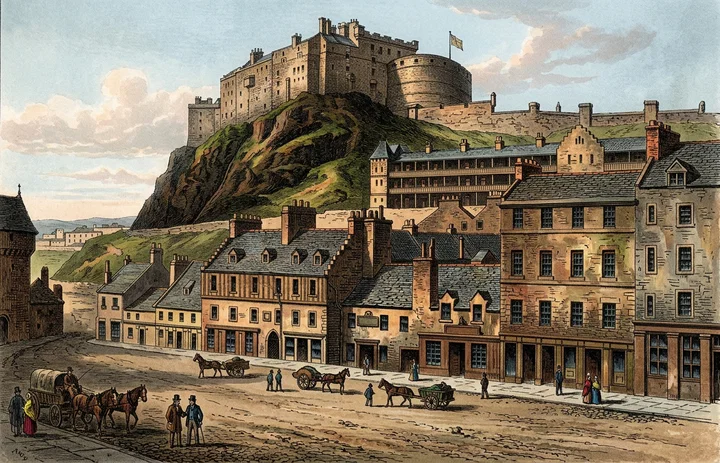
The beautiful old castle, perched upon the granite rock in the heart of the city, is, however, the chief object of interest. Built on a rock rising three hundred feet out of the plain, its position is both commanding and picturesque. A large part of the present building is comparatively modern, yet as a fortress it probably existed during the fifth century. In one of the rooms is deposited the Regalia, the ancient honors of Scotland,—
“The sceptre, sword, and crown, that graced the brows Since Fergus, father of a hundred kings.”
In 1255, Margaret, queen of Alexander III., and daughter of Henry III., of England, complained to the Scottish estates that she was confined in the castle, “a sad and solitary place without verdure, and by reason of its vicinity to the sea, unwholesome.” In the octagonal room, with paneled and inscribed walls, James the “First and Sixth” was born. Upon the summit of the castle over this room lies the ancient cannon called Mons Meg. At the other end is situated St. Margaret’s Chapel, not only the oldest extant part of the castle, but also the oldest building in Edinburgh. After being neglected and lost sight of for centuries, it was rediscovered and some of its shafts and pillars restored by Dr. Daniel Wilson, who regards it as the veritable Chapel of the Holy Rood, found by Queen Margaret. To the antiquarian, the city presents nothing so ancient or so interesting architecturally as this small building. W. B. C.