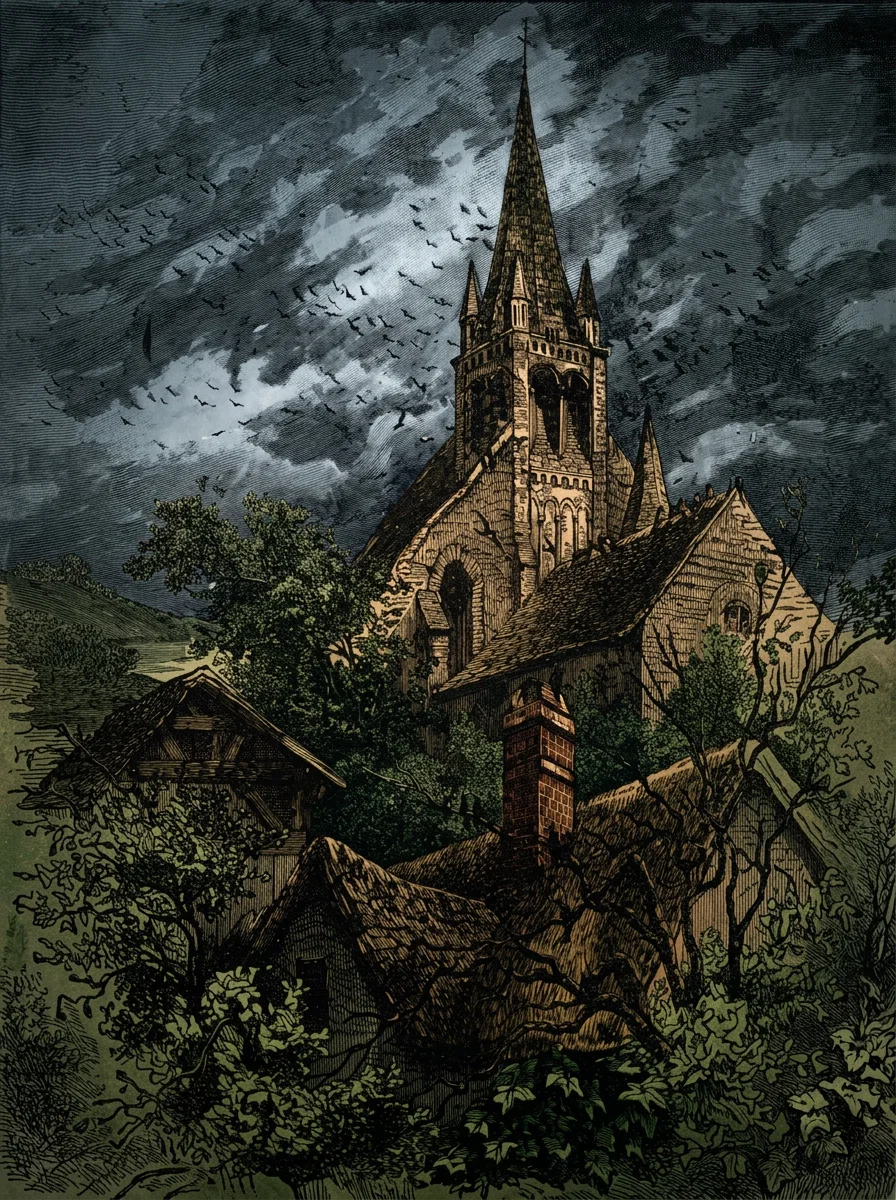
CLEAN HANDS

3%

S. D. A. Publishing Association · Battle Creek, Mich. · Sep 29, 1886

FromThe Youth’s Instructor, Vol. 34, No. 39.

Read the full edition

CLEAN HANDS.

THE Laroom children were gathered around their mother in the dining-room. The sun shone brightly across the carpet. Jip, the canary, whistled merrily in his cage, and Nig, the tiny terrier, was in his gayest mood; but neither the sun’s shining, Jip’s singing, nor Nig’s frisking could drive the shadows from the sober faces gathered in the room. First, after the mother, was Noll, a stout boy of sixteen; then Lucy, with sweet, fair face; then jolly, dark-eyed Rob; and lastly, little Grace, sitting in mamma’s lap, wiping the tears from her cheeks, while they brimmed in her own blue eyes.
Restored with AI
“There’s only one thing to be done, mamma,” said Noll, “you have a little property; and if every thing else of papa’s belongs to his creditors, I don’t, and I’ll take care of the family.”
“I’ll help,” said Rob.
Mrs. Laroom looked at her boys, and really the sunshine, or something, did brighten up the room wonderfully.
“Of course, every thing will be sold, and we shall be obliged to move from here,” continued Noll, “so I’ll start right away and see what can be done.”
“Look in the Herald first,” said Mrs. Laroom, handing the paper to Noll.
“Why,” said he, glancing eagerly down a column, “Mr. Rand wants an under book-keeper. I think I could do that well. Father used to say I was as quick and accurate as Peterson, and every one said he was a good book-keeper.”
Noll went out hopefully to find Mr. Rand. The gentleman was acquainted with the Laroom family, and knowing of the death of Mr. Laroom and of his business entanglements, would gladly have given the place to Noll, but it was already promised to one of Noll’s classmates.
“Have you any thing else that I could do?” inquired Noll, at last.
“Nothing that a boy brought up as you have been would do,” said Mr. Rand.
“Tell me what it is and see,” said Noll.
“Well,” said the gentleman, “the engineer would like some one to ‘fire,’ clean machinery, move coal, and so on; but it’s a dirty job.”
“Will you keep the place for me a few days till I try for something better?” said the boy. “I’ve no great fancy for coal-dust and gudgeons, but I’ve a family to take care of, and must do as I can.”
“The place shall be ready for you any time during the week,” said Mr. Rand; “but I hope you will find something better.”
For a week Noll carefully watched the papers, and went from place to place without losing courage, but at the end of the time had not succeeded in finding any thing better than the work in the engine-room; accordingly, he entered on his duties there. Dirty and monotonous, indeed, the work proved to one unaccustomed to such surroundings, or to labor; but the hardest of all was when, dingy and grimy, he came from his work and met his old classmates, the assistant book-keeper, well dressed, neat and jaunty, and was passed with a cool stare or a mocking jest at his discolored hands.
“Please read that again, mother,” said Noll one morning at prayers; and the mother read slowly from the Bible, “The righteous, also, shall hold on his way, and he that hath clean hands shall be stronger and stronger.”
Noll kept thinking of the verse all day, and it greatly helped and cheered him. “Strange that mother should read that this morning,” he said to himself, “when I was so discouraged, thinking that I never could be any body in all this dust and blackness, and my hands can be just as white and clean before God as a baby’s if I choose to have them so. That’s worth trying for.”
“The most faithful, trusty boy I ever knew,” was the report Mr. Rand had of Noll when, at the end of seven months, he sent for the engineer and inquired of him concerning the boy.
“Ah,” said Mr. Rand, “send him up to the office as soon as he is at liberty.”
“So, Noll, wondering a little at the summons, came up from the engine-room with his face darkened by coal-dust and a smutty hand holding his cap, and stood quietly waiting at the side of his employer’s desk.”
Mr. Rand turned, and looking Noll over sharply, said, “My boy, I have a good report of you, and as the place for which you first applied is now vacant, you can have it; that is, if you have not become so attached to coal-dust and gudgeons as to prefer them to the office.”
“O, no, sir, thank you,” said Noll. “I shall like the other place so much if you think I can fill it to satisfy you. I do not like the coal-dust, and never should.”
“Yet you did the work well,” said Mr. Rand, and ‘he that is faithful in least,’ you know, is apt to be faithful in much, so I’ve no great fears of you; and, Noll, there’s another text I’ve been thinking of as you stood there (a merry little gleam shone in his eyes as he spoke); “you’ll do well to remember that ‘he that hath clean hands shall be stronger and stronger.’”
Noll flushed a little as he thought to himself, “I wonder if Mr. Rand has been reading my thoughts all the time I have been in his employ, and knows how hard I have been trying, however soiled my hands might appear to every one else, to keep them clean before God.”
Mr. Rand had not been reading the boy’s thoughts, but he had seen his faithfulness and honesty in doing disagreeable work, and the sight of those young hands darkened by the dust and drudgery of the engine-room, yet clean from deceitfulness and shirking, had brought the verse to his mind.—S. S. Classmate.

THE VEGETABLE KINGDOM OF AUSTRALIA.

While Australia grows a great variety of plants, few of them are strictly native; and although peaches, plums, pears, apricots, cherries, apples, etc., grow luxuriantly here, this is only their adopted land. Some of the productions of the country, however, are natives of no other part of the globe. Only on the northern and north-eastern coasts does the native vegetation resemble that of other countries. There the numerous palms and other plants are similar to those grown in most tropical countries.
Before coming to this country, we had heard much of a native cherry which was said to grow its stone on the outside. We made many inquiries of native Australians about the matter, but for a long time were able to gain little or no satisfaction. At last, being in the vicinity where the reputed curiosity was to be found, we learned that its shape resembled the yew berry, but that in taste it was much inferior; also that it has a hard seed which, curiously enough, grows on the stem near the fruit. This seed has been fancifully styled the stone. Some may eat the fruit, but it is insipid and unpalatable, and is hardly known outside of the localities where it grows.
There is a tree found in this country which, at first sight, one might suppose to be laden with tempting fruit; but on approaching near enough to pluck the pear-shaped production, his curiosity changes to disappointment; for upon examination, what he supposed was fruit proves to be a hard, woody substance in which is incased the seed vessels of the tree. Another curious thing is the fact that this seed protector is attached to the stem by its broader end, and so, a little way off, looks for all the world, just like a pear attached to the tree by the wrong end.
And thus, at the antipodes, things seem to go by contrasts. An English observer has said of this place: “It is a strange country of anomalies, where it is summer at the same time it is winter in Europe, and vice versa; where the barometer rises before bad weather, and falls before good; where the north is the hot wind, and the south is the cold; where the swans are black, and the eagles are white; where the mole lays eggs, and has a duck’s bill; where there is a bird with a broom in its mouth instead of a tongue.” Just how far these words are true concerning this land, we are not able to state, not having had opportunity for personal observation on all these points. One thing is certain: that in many ways, Nature here seems to almost outdo herself in her strange productions. We will speak more at length on this point in future articles.
Very few edible fruits or plants now found here are native to the Australian soil. There may be found in great abundance, however, in barren scrubs and brushes, a dwarf honeysuckle, which yields, at certain seasons, a large quantity of sweet resembling honey. This is found among the thread-like portions of its flower cone. Besides this and the misnamed native cherry, we do not now call to mind other native productions that are edible for man.
The native grasses are plentiful, spreading over boundless districts of the interior. Among these the oat grass seems to be the most prominent. The native blacks take the seeds of this grass, bruise them between stones, making them into cakes and baking them for their own eating. Kangaroo grass is also found in large quantities in low places, and is considered an excellent variety of feed. But the grasses of this country do not cover the ground uniformly as the American kinds do there. Here they grow in tufts, with spaces of bare surface between, which gives the country a sterile appearance.
Beautiful, gay-colored flowers abound here in the woods. Small shrubs with yellow and golden blossoms, climbers with rich crimson and other colors, and the more humble plants make the earth gay with brilliant dyes. The most magnificent plant of all, however, is the waratah, or native tulip, a tall, stately plant, straight as an arrow, with a stem from three to six feet in height, and grows on the hillsides. Its leaves closely resemble the oak, though considerably larger, and are of the richest green. The flower grows at the very top of the stem, and is of a very bright crimson. Another production worthy of mention is a gigantic lily, or spear-flower. The stalk of this beautiful plant rises from the center of an immense group of long, broad, curving leaves, to the height of fifteen or twenty feet, and is covered with a huge cluster of gorgeous crimson lilies. But one thing, in a great measure, robs the native flowers of Australia of much of their attractiveness—nearly all of them are without odor.
Many of the trees are valuable. The cedar, in color, resembles the American butternut, though perhaps a shade darker, and in texture somewhat softer. When polished, it has a pretty appearance. The Norfolk Island pine grows to a great height, some having measured two hundred and seventy feet. The Moreton Bay pine is remarkable for the slenderness of its trunk in proportion to its height. A tree of this kind with a diameter of only two feet will stretch to the height of from one hundred and fifty to one hundred and seventy feet. Another tree, called the bunyabunya, looks like a huge umbrella at the top of an exceedingly long stick. It frequently stands one hundred and fifty feet high, and has a diameter of five or six feet in some cases, without tapering, perceptibly, for sixty feet from the ground.
Then there are the several varieties of the eucalyptus trees known as red and white gums, also the stringy-bark. From the latter, the bark is removed in large flakes, and the particles being exceedingly interwoven with each other, makes it valuable for building the huts of those living in new districts. The bark is cut into the proper lengths and nailed upon the roof and sides of a building in the same manner as sawn boards. When in the interior, lately, we saw several houses made in this way. The red and white gums are used some for making furniture, but only to a limited degree. They compose the principal firewood of the country, though boxwood is considered far superior to either of them.
Acacia trees are also numerous, together with tree ferns and enormous nettles. The trees of an Australian forest are not generally so close together as those of an American forest. They have fewer branches also, and therefore the forests have less density of shade than our home forests. Here there are no sombre shadows,—no glades of profound gloom. The forest walks are comparatively light and airy, and the grass grows beautifully. Most of the trees are evergreen, or as a certain writer expressed it, “never-green.” The latter term, strictly speaking, seems to be the proper one; for some of the leaves are of a dull reddish color, others brownish, as in American autumn. These forbidding colors, continuing without change, rob the forests here of that grandeur displayed in northern countries where the trees cast their leaves in the fall, and are in the spring clothed in pretty, bright green. J. O. Corliss. Melbourne, Australia.