The Sea of Galilee

7%

S. D. A. Publishing Association · Battle Creek, Mich. · Dec 29, 1886

FromThe Youth’s Instructor, Vol. 34, No. 52.

Read the full edition

The Sea of Galilee.

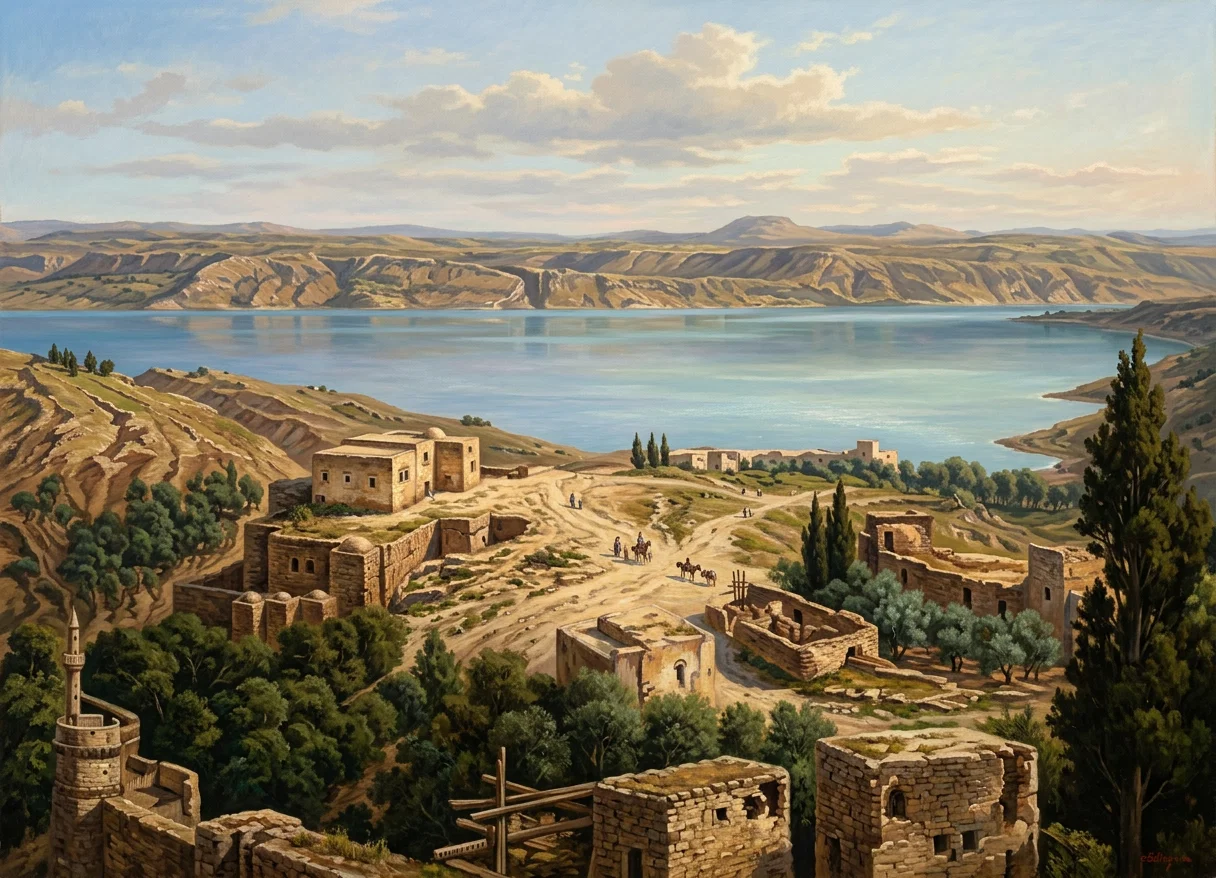
As the season returns in which we celebrate the birth of Christ, it is pleasant to recall the story of his life, and the places where he performed so many of his mighty works. Perhaps there cluster around no one spot so many sacred associations as are connected with the Sea of Galilee, of which our picture gives a feeble outline.
Restored with AI
The lake is very regular, having no deep indentations or jutting headlands. In shape it is oval, some fourteen miles long and half as wide, its clear, sparkling waters reflecting the deep blue of an oriental sky. “The sight is very lovely,” says one traveler,—“a clear, blue expanse of water, . . . with the Jordan flowing in at one end, and out at the other,—a sparkling diamond suspended by a silver thread.”
To the east rises the high table land of Bashan, while on the west the waters are hemmed in by the more rugged hills of Palestine. Some travelers have complained of the tameness of the scenery around this lake, because it has neither the boldness of the Dead Sea nor the softness of our western lakes. But we can heartily agree with Mr. Prime, when he says: “I cannot imagine where those travelers have carried their eyes who have described the scenery of the lake as tame or uninteresting. The first great characteristic of it is the deep basin in which it lies. This is from three to four hundred feet deep on all sides except at the lower end, and the sharp slope of the banks, which are all of the richest green, is broken and diversified by the wadys and water-courses which work their way down through the sides of the basin, forming dark chasms or light sunny valleys. Near Tiberias these banks are rocky, and ancient sepulchers open into them, with their doors toward the water. They selected grand spots, as did the Egyptians of old, for burial places, as if they designed that when the voice of God should reach the sleepers, they should walk forth and open their eyes on scenes of glorious beauty. On the east the wild and desolate mountains contrast finely with the deep blue lake; and toward the north, sublime and majestic, Hermon looks down on the sea, lifting his white crown to heaven with the pride of a hill that has seen the departing footsteps of a hundred generations.”
At the northern end of the lake stood Capernaum, the city in which our Lord dwelt, and in whose vicinity he performed his mightiest works. It was on the shore of the lake that Jesus was walking when he saw the four humble fishermen, and called them from their nets to make them fishers of men. From a boat on these waters he often taught the people who crowded on its pebbly shores to hear the words of life. On the eastern side he fed the fainting multitudes with a few loaves and fishes. Once he walked on the waves; and again, he stilled the tempest.
And then we remember the time when “seven fishers, with nets in their hands, walked and talked by the seaside sands.”
“Seven sad men in the days of old, And one was gentle, and one was bold, And they walked with downward eyes; The bold was Peter, the gentle was John; And they all were sad, for the Lord was gone, And they knew not if he would rise,— Knew not if the dead would rise.
“The livelong night till the moon went out, In the drowning waters they beat about,— Beat slow through the fog their way,— And the sails drooped down with the wringing wet, And no man drew but an empty net; And now ’twas the break of day,— The great, glad break of day.
“‘Cast in your nets on the other side!’ (’Twas Jesus speaking across the tide;) And they cast and were dragging hard;
  • *
And when they had gotten close to the land, They saw a fire of coals on the sand, And with arms of love so wide, Jesus the crucified!
“’Tis long ago, yet faith in our souls Is kindled just by that fire of coals That streamed o’er the mists of the sea; Where Peter, girding his fisher’s coat, Went over the nets and out of the boat, To answer, ‘Lovest thou me?’ Thrice over, ‘Lovest thou me?’”
Yet withal a feeling of sadness steals over us when we remember that these scenes of busy life have given place to desolation and death; that instead of populous towns, ruins greet the eye; and that where the lake was once alive with fishing crafts, now hardly a boat is to be seen.
“Oh, how lonely are we As we walk by the sea Where the Master so often has trod!”
W. E. L.