In the northwestern corner of Wyoming Territory lies one of the most wonderful regions of the Great West,—the geyser district at the head of the Yellowstone River. A geyser, as you all know, is a gigantic fountain of boiling water, playing at intervals of a longer or shorter time, according to its age. In Iceland and New Zealand are geysers that have been celebrated for hundreds of years; but those in our own country have not been known till recently, yet they are the largest and grandest hot springs in the world.
Just west of the basin of the Yellowstone River lies the Firehole River, the chief branch of the Madison. If you look in a good atlas, or any map of the territories, I think you will find the Yellowstone and the Madison, and can form a pretty accurate idea of where this great geyser region of the Firehole River lies. Here, in a valley some twelve miles long and two or three wide, are hot springs on so magnificent a scale, that if all similar wonders in the world were brought together, they would form no comparison to these.
It would not be possible, without the aid of ample illustrations, to make plain to you why this hot water at intervals projects itself into the air; and therefore I shall give you instead some word pictures from the pens of famous explorers, in regard to some of the most prominent geysers of this region.
“Further from the river, near the center of the large group of spouting and boiling geysers,” writes one traveler, “is a large, oval opening, with scalloped edges, the diameters of which were eighteen and twenty feet.
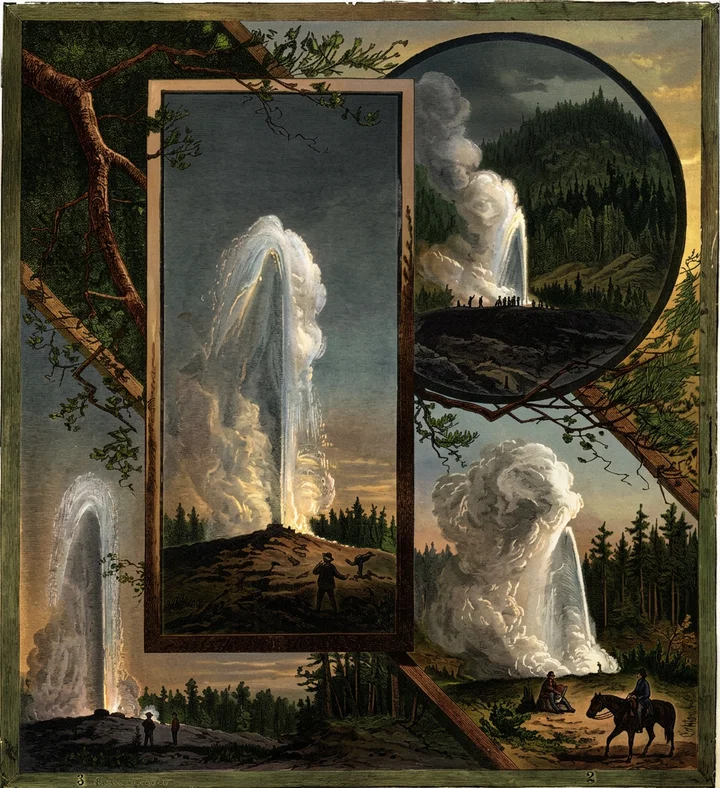
“No water could be discovered, but we could distinctly hear it gurgling and boiling at a great distance below. Suddenly it began boiling and spluttering, and sending out huge masses of steam, causing a general stampede of our company. When within about forty feet of the surface, it became stationary, and we returned to look down upon it. It was foaming and surging at a terrible rate, occasionally emitting small jets of hot water nearly to the mouth of the orifice. All at once it seemed seized with a fearful spasm, and rose with incredible rapidity, hardly affording us time to flee to a safe distance, when it burst from the orifice with terrible force, rising in a column the full size of this immense aperture, to the height of sixty feet; and through and out of the apex five or six lesser jets or round columns of water, varying in size from six to fifteen inches in diameter, were projected to the marvellous height of two hundred and fifty feet. . . . “This grand eruption continued for twenty minutes, and was the most magnificent sight we ever witnessed. We were standing on the side of the geyser nearest the sun, the gleams of which filled the sparkling column of water and spray with myriads of rainbows, whose arches were constantly changing,—dipping and fluttering hither and thither, and disappearing only to be succeeded by others, again and again, while the minute globules into which the spent jets were diffused, when falling sparkled like a shower of diamonds, and around every shadow which the denser clouds of vapor, interrupting the sun’s rays, cast upon the column, could be seen a luminous circle, radiant with all the colors of the prism, and resembling the halo of glory represented in paintings as encircling the head of Divinity. . . . This geyser we named ‘The Giantess.’”
Another wonderful one is the Comet, which has three openings. “One, a very small aperture, emits puffs of steam similar to the exhaust pipe of a steam engine. The large one in the center boils violently during an eruption, but does not throw water to a great height. The third opening is the geyser proper.”
In describing its eruptions, Colonel Barlow says: “A roar was heard near the hillside a hundred yards distant, . . . and we saw a huge mass of steam issuingp. 158 from a crater at the base of a hill, accompanied by a column of water rising to a height far exceeding that of any geyser yet seen. This grand fountain continued to play for several minutes, when, having subsided, I approached to obtain a closer view of the aperture whence had issued such a powerful stream. A sudden gust of steam drove me away, following which the water was again impelled upward and upward, far above the steam, until it seemed to have lost the controlling force of gravity. . . . I have no hesitancy in saying this geyser played to the height of over two hundred feet.
“The enthusiasm of the party, as they watched this wondrous display, knew no bounds. Those who were usually loud and boisterous in the exhibition of their feelings, became subdued and simply gazed in silent awe; while the more sober members seemed to lose their natural gravity, and manifested their delight in shouts of rapture.”
“We could not distinguish,” says another observer, “the geysers from other hot springs except by seeing them play, and doubtless there are many besides in the valley of great size, which we saw when quiet, and classed as boiling springs. . . . Taken as a whole, the Firehole Basin surpasses all the other great wonders on the continent. It produces an effect on the mind of the beholder utterly staggering and overpowering.”
And yet not so very far from these boiling, seething torrents rise the high peaks of the Rockies, capped with snow! What varied forces are at work in Nature, and what uncontrollable ones! On the outside are glaciers, the great frozen rivers of the Alps, slowly and almost imperceptibly descending from the regions of perpetual snow to the sea. And underneath are the geysers, that suggest strange, uncontrollable, and unknown quantities of heat in the interior of the earth! How small human wisdom appears when trying to explain these mighty forces of the Creator! “Touching the Almighty, we cannot find him out: he is excellent in power and in judgment.”
W. E. L.