THESE old wells! How many memories throng the mind, as we rest here by this curbing in the cool of the evening, and watch the women coming out to draw water! Perhaps there is no other place in all Palestine where one can observe to such good advantage the peculiar characteristics of the inhabitants as right here at these public wells; for, as you will doubtless remember, water is comparatively scarce in the Holy Land, and it was seldom that a private individual could afford the luxury of a well. Accordingly the well, which frequently stood on the outskirts of the town, was a common place of resort for the women, who came hither at the cool of the day to exchange bits of friendly gossip with one another while they filled their water jars.
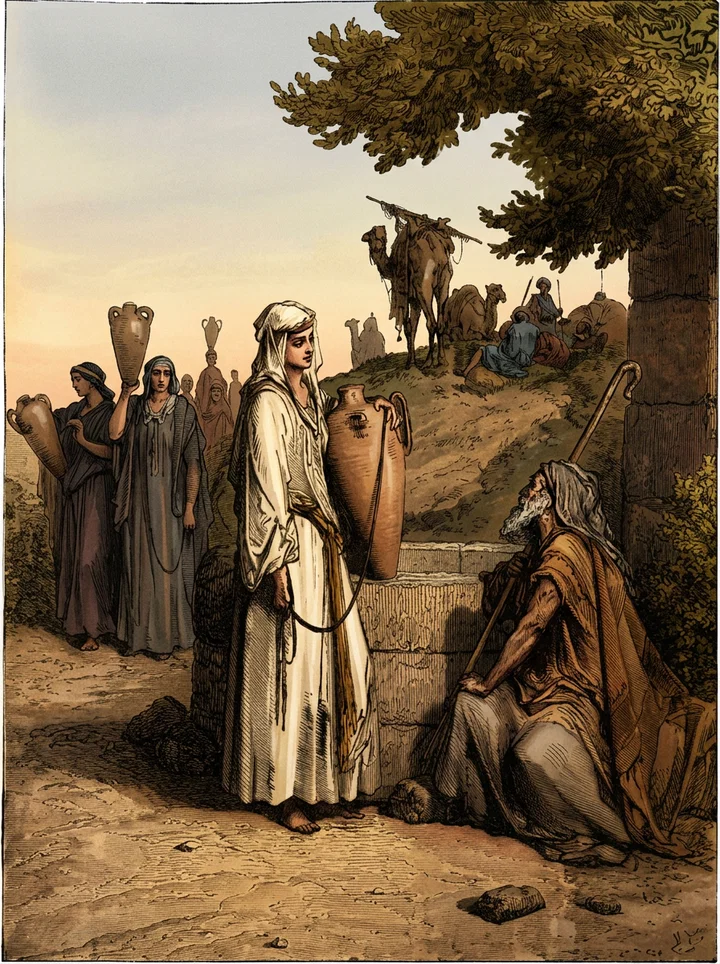
As we sit here and watch them, coming singly or in companies, with their large earthen jars, to draw water, we are reminded of a time, when, long and long ago, a traveler, worn and thirsty, paused outside a city gate by a well; and making his camels kneel down without the city, he cast his eye over the group at the well,—critically, we may suppose, for he had come a long journey to find a wife for his master's son. And even while he was communing in his heart with the Lord, asking for a sign whereby he might know the right one, there came to the well a damsel “very fair to look upon.” And when he asked her, as a test of kind-heartedness for a drink of water, she gave a drink not only to him, but drew water for his ten camels also. “And the man wondering at her held his peace; to wit whether the Lord had made his journey prosperous or not.” And we hardly know which to marvel at the most, the unusual benevolence and pure innocence of Rebekah, or the stupid indifference of Eliezar, who stood helplessly by while she, unaided, drew water from the deep well for all the thirsting animals.
By the gate of Bethlehem there stood a remarkably pure well of water; and we remember how one time when the city was held by enemies, and David was cut off from the water where in childhood and youth he had so often quenched his thirst, he longingly cried, “O that one would give me drink of the water of the well of Bethlehem which is by the gate!” And when the three mighty men secretly broke through the ranks of the enemy, and at the peril of their lives brought the water, David’s soul was touched by their devotion, and he poured the water out before the Lord, saying, “Be it far from me, O Lord, that I should do this; is not this the blood of men that went in jeopardy of their lives? And he would not drink it.”
And we remember another time, many, many years after this, when a company of travelers wound their weary way through the Judean hills, to the country of the Samaritans; and one, the Leader, paused to rest by a well, which was Jacob’s well, while his disciples went into the town to buy food. “There cometh a woman of Samaria to draw water: Jesus saith unto her, Give me to drink.”
The woman marveled at the request, for the Jews and the Samaritans were bitter enemies, and “had no dealings” with one another. “Jesus answered and said unto her, if thou knewest the gift of God, and who it is that saith unto thee, Give me to drink; thou wouldst have asked of him, and he would have given thee living water.” And the woman, still wondering at his strange words, made answer, “Sir, thou hast nothing to draw with, and the well is deep; from whence then hast thou that living water? Art thou greater than our father Jacob, which gave us the well, and drank thereof himself, and his children, and his cattle?”
And then Jesus replied, in those gracious words that have brought comfort to so many of his followers since that day, “Whosoever drinketh of this water shall thirst again; but whosoever drinketh of the water that I shall give him, shall never thirst; but the water that I shall give him shall be in him a well of water springing up into everlasting life.” That all may have this priceless gift we know; for we have in the Record, these words left us: “Let him that is athirst come. And whosoever will, let him take of the water of life freely.” W. E. L.