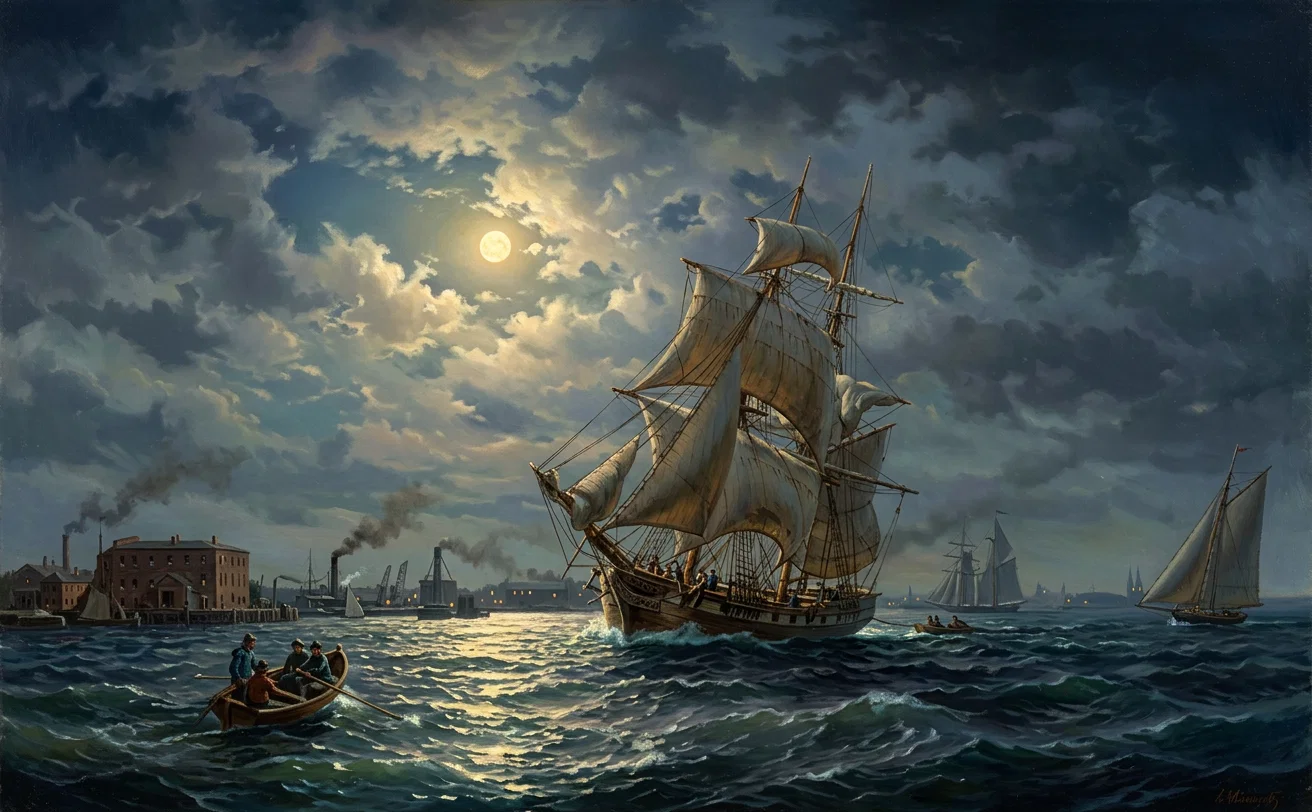
NEW YORK HARBOR

6%

S. D. A. Publishing Association · Battle Creek, Mich. · Nov 24, 1886

FromThe Youth’s Instructor, Vol. 34, No. 47.

Read the full edition

NEW YORK HARBOR.

NEW YORK harbor is one of the finest and most commodious in the world. The bar, at Sandy Hook, is eighteen miles from the city, and has two channels capable of admitting ships of the heaviest draft into the lower bay. This bay is from nine to twelve miles wide, and affords a safe anchorage. It is connected with the upper, or New York Bay by the Narrows, which is the channel between Staten Island and Long Island, and has well-manned and well-stocked forts on either side, to protect us from the invasions of foreign foes.
Restored with AI
New York Bay is of an irregular oval shape, about eight miles by five, extending eastward into Newark Bay and northward into the Hudson River. It is really the port of three cities,—Jersey City, New York, and Brooklyn. The Hudson and East Rivers, which, like two great arteries throbbing with life, separate the cities, afford, with their long line of wharves on either side, accommodations for fleets of vessels. And the forests of masts, with different flags flying at their tops, show that they are utilized by the shipping of all nations.
The scenery at the entrance of the harbor is picturesque and striking. On one side is the low, sandy coast of Long Island; in contrast, on the other side are the hills, rising higher and higher till they fade away into the blue distance, while in the foreground the islands, clothed with verdure, seem like emeralds in silver setting.
The harbor itself presents an ever-shifting panorama. Here are the ships of the Indies, bringing the products of the tropics; the stout-ribbed whalers from the Arctic seas; iron-clad frigates, representing the navies of the world; the grand ocean steamers; the graceful yachts of the millionaires, alongside the humble crafts of the oystermen and clam-diggers of Long Island Sound. The ferry boats glide in and out of their slips, their decks black with human freight, while the schooners and tugs cross and recross their track; whistles shriek, and signals are given, making a scene of confusion and bustle not unlike busy Broadway. The wonder is that there are so few collisions. The tide rises to about five feet, and that, in its swift and ceaseless ebb and flow, adds its share to the variety. Everything seems to be in a hurry here, even Nature herself.
At the docks the ponderous merchantmen are loading and discharging their cargoes. Accompanied by a friend, I visited some of the docks this morning to find something to interest the readers of the INSTRUCTOR. We saw one Portuguese ship unloading salt. It was a kind of rock salt used here in packing fish and in freezing ice-cream. When once begun, the unloading proceeds rapidly. The salt was hoisted by means of horse power to the deck, where it was weighed, and then pounded down through a wooden spout into the carts waiting on the wharf, and then drawn away to the warehouses near by.
When a ship approaches the coast, she signals for a pilot, and usually has not long to wait; for the pilot boats are constantly cruising in the offing. The pilot brings the ship over the bar and into the lower bay, where a tug boat takes her in charge, and tows her up through the Narrows to the city, so that in a few hours after taking on the pilot, the ship is safe at her moorings at the wharf, where her owner or agent meets her, and the preparations for discharging her cargo immediately begin.
There is a duty, or Government tax, on all foreign goods, so that at each warehouse a revenue officer is stationed, to see that all U. S. claims are paid before the goods are delivered to the consignee. And a sharp lookout is kept on each vessel from the time she reaches Sandy Hook till the claims are satisfied.
A lot of raw sugar from Cuba had just been unloaded on one dock. An inspector was grading it, and another officer was weighing the hogshead, while farther out on the wharf the ’longshoremen were shoveling it into the barrel. It had yet to go through the refining process here; nevertheless it did look rather queer to see one laborer up in the hogshead with his boots on, packing the sugar down with his feet. Afterwards the hogsheads were drawn to the immense storehouse near, and by means of an engine and tackle were hoisted to the fourth floor.
Brooklyn has most of the storehouses of the three cities, and it well repays the visitor to go there. One gets a better idea of the vastness and variety of our commerce. The floors are marred by contact with the freight from all parts of the habitable globe. Spices and fragrant oils, tropical fruit and beverages, dye stuffs and drugs, perfume the air, till one feels as if in a foreign clime, and the old hymn,—
“What though the spicy breezes Blow soft o'er Ceylon's isle,”
comes involuntarily to the mind.
But if ships arrive laden with comforts and luxuries for us, they also depart, carrying to other ports the products of our own well-favored land. One was loading with grain. They have what struck me as an odd contrivance for transferring grain from the cars to the vessels. It is in reality a tall, narrow house, built upon a flat boat; and it looks ready to topple over every minute. It is furnished with buckets fastened to an endless belt, which pour the grain over the ships' sides through an iron tube to the lower hold, where men stand ready with bags to catch it as it comes through. Each bag, when filled, is sewed up and tucked snugly away in as small a space as possible, for ballast.
The great ocean steamers do not require much more ballast than their vast coal bunkers afford. The large steamship, City of Rome, burns 265 tons daily; and the Umbria has seventy-two furnaces, which daily burn 340 tons of coal. One hundred and four men are employed to run the furnaces of the Umbria. If the coal and passengers' baggage are still insufficient ballast, other cargo is taken on.
All night the harbor is brilliant. Each ferry house has its cluster of lights. These, mingling with the thousand twinkling ones of the city and the shipping, together with the flashing string of electric lights from the Brooklyn bridge, overarching all on the one side, and Liberty's beacon sending out its powerful rays on the other, forms a picture which is indeed like a dream of fairyland. L. E. ORTON.