Perhaps the most interesting spot on the Jordan at the present time is that opposite Jericho, and called the “pilgrim's bathing-place.”
Thither resort every year large companies of pilgrims, to bathe in the river made sacred by the baptism of our Lord. In describing this ceremony, a recent work on Palestine says:—
“The mouth of the Jordan is seldom visited except by European travelers; the crowds of pilgrims visit the river higher up, near what is called Helu ford, though each sect of Christians has a special spot for the completion of the pilgrimage. . . . The Greek pilgrims bathe at a spot where there is a narrow clearing down to the water's edge; the Latin sacred place is higher up, near the ruins of an old convent. The ceremony is most interesting and picturesque from the start from Jerusalem to the return. In former times the crowd of pilgrims was said to number hundreds of thousands, and even now they amount to several thousands. The day fixed is Easter Monday, and the Turkish Government has for many ages guaranteed the safe conduct of the convoy. It starts from the neighborhood of the Church of the Holy Sepulchre [at Jerusalem], in front of which the pilgrims generally assemble, preceded by a white flag and noisy instruments; the rear-guard being composed of Turkish troops with the green flag of the Prophet. A merry, joyous crowd they seem, the roar of voices often drowning the incessant clatter of the tomtoms in the front and rear. Few of them are on foot except the Russian peasants. Every kind of quadruped, camel, horse, mule, and ass, have been impressed for the occasion, and the hapless camels flounder down the steep descent to Jericho with huge baskets of women and children on either side. The Bedouin of the neighborhood hangs about the desert cliffs and dells ready to cut off any incautious straggler, and to send him to rejoin his company prematurely stripped for his bath. . . . Arrived long before sunset at Er Riha, the modern Jericho, but really near the ancient Gilgal, the motley crowd bivouacs for the night.”
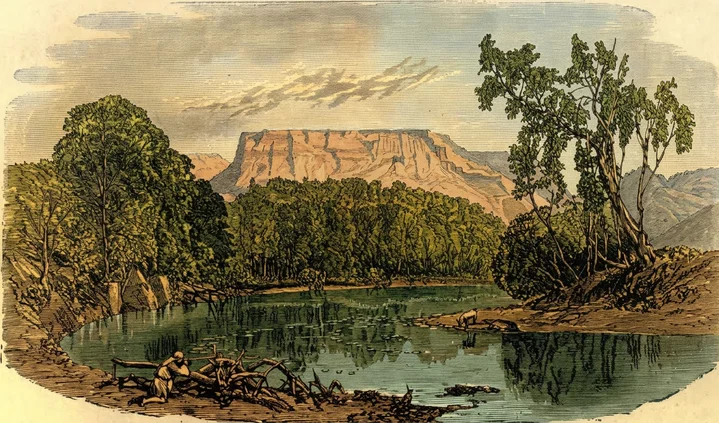
“A stroll among the tented and untented groups will afford one of the most varied and picturesque scenes which even in that land of the picturesque the traveler can encounter. Every custom, from the sheepskin-clad and odoriferous Russian to the bright dresses of the Bulgarians, the quaint robes of the Georgians, the brilliant colors of the Greek, and the solid richness of the Armenian, is collected from all Eastern Europe and Western Asia. But soon all is hushed, and the camp fires are smouldering embers, and the long, straggling camp, stretching some three miles across the plain, is buried in sleep, recalling the camp of Israel first pitched at Gilgal, this very spot. Long before sunrise, about three o'clock, there is a sudden roll of kettle-drums, and lights are struck all over the plain. There is none of the merriment of the preceding day, but by torchlight, in solemn silence, with the paschal moon hanging forward out of the deep black sky and dimming the glare of the torches, the mixed multitude presses on to the bank of the sacred river. Just after daybreak the head of the procession reaches the open space on the river's bank, and before the sun has well overtopped the hills of Moab, the first comers are plunging in the whirling eddies of the turbid stream. . . . Most of those who have come in families bathe in a long white garment, which after this Jordan baptism is carefully preserved as the winding sheet of its owner. I have noticed devout families joining hand-in-hand in a circle in the water, the women having their babes slung round their neck, and reciting the creed, ducking at each sentence, while they hang on to the overhanging boughs. One remarkable feature is the number of little children and infants; but the age of the pilgrim matters not, and the Jordan baptism needs never to be repeated. Primitive and rude the scene may be called, but there is no indecorum or irreverence, and very little superstition. Who that has stood by the brink of that river could have turned back without having washed in the Jordan? Who is so utterly devoid of sentiment as not to sympathize with that pilgrim multitude? and who can look on the Eastern baptism without feeling that he has reproduced before his own eyes the scenes and the surroundings that accompanied the preaching and the baptism on this river bank of the great forerunner, John the Baptist?”
“The ceremony is not a long one. After it is over, every one cuts a stick or bough to preserve in memory of the visit (a palmer's staff); and most come provided with a bottle, which is filled from the sacred stream. Silently the crowds remount and gradually depart; the last Turkish fez has closed the rear-guard two hours before noon. The camp of the previous night is reoccupied, and the pilgrims rest and sleep till sunset, when they eat their evening meal. At dead of night they set out, roused by the kettle-drum, and in silence resume their march back to Jerusalem. The last act of the great pilgrimage has been completed, and every one of the caravan is now a true ‘palmer.’”