JOHN BUNYAN

9%

S. D. A. Publishing Association · Battle Creek, Mich. · Jan 12, 1887

FromThe Youth’s Instructor, Vol. 35, No. 2.

Read the full edition

JOHN BUNYAN.

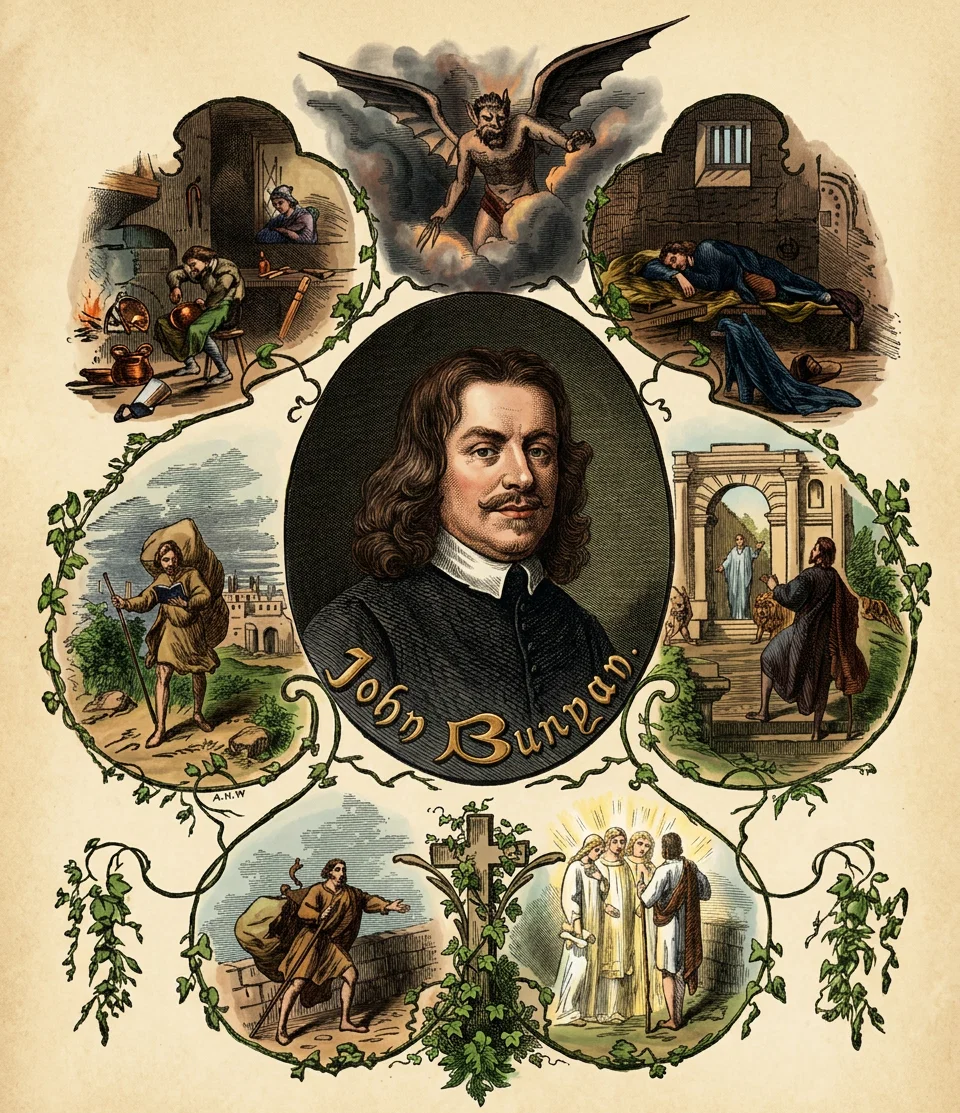
Over two hundred years ago there lived in England a good man by the name of John Bunyan. He was a very poor and unlearned man, yet he did so much good that his name is better known to this day than that of many who were counted famous in his time. Bunyan was a tinker by trade. The center piece of our engraving gives a picture of him, and up in the left-hand corner you may see him at work at his trade, mending some old kettles. The tinkers were a low class in those days, roving around the country from place to place, wherever they could find work. They were often classed with the gypsies. But Bunyan seems to have been better off than most tinkers, for he had a home. He was so very poor that when he was married neither he nor his wife had so much as a dish or a spoon between them. But she brought with her two books, “The Plain Man’s Pathway to Heaven,” and “The Practice of Piety,” that in the end proved to be of more worth to him than almost any other dowry she might have brought; for his mind, already inclined toward religion, was set, by reading these books, to earnestly seeking the way of life.
Now he began to preach to his neighbors and to all whom he could get to listen. But though he preached what he thought was true, it didn’t happen to be what most people at that time believed; and as it was not allowable for a man to speak his mind freely on matters of religion, it came to pass that the authorities shut John Bunyan up in jail. He was in great distress at this turn of affairs, for he did not know what his family would do now that he could not do any more tinkering. At length he bethought him to learn to make tagged laces, which he sold to hawkers for barely enough to keep his wife and four children alive. For twelve years he was kept in jail, at first guarded closely, but afterwards allowed more freedom.
In the quiet of his prison he had a good chance to study his Bible and think of serious things. By and by he began to write out what he had been thinking. He told what he had to say in homely English, but it so took hold of the hearts and imagination of the people that his books are much read even at the present day. The book people are now most familiar with is called “The Pilgrim’s Progress.” This was begun while Bunyan was in jail. In our picture the artist has given several scenes from this book, and I shall tell you a little about the story, in the hope that if you have never read the book, you will do so as soon as you can.
Bunyan imagines that he has a dream, in which he sees a pilgrim setting out from the City of Destruction, with so great a load on his back that he can hardly walk under it. The man’s name is Christian, and he has set out on a pilgrim’s journey toward the Celestial City. He falls into a great many mishaps. At one spot on the road he comes to a place somewhat ascending, whereon stands a cross, at the sight of which Christian’s burden rolls off his back down the hill, and is seen no more. Then while he is wondering that the sight of the cross with the bleeding One hanging thereon should so ease him of his burden, three shining ones meet him, and give him new apparel and a written roll that he is to read when he desires consolation on his journey. Further on he comes to the top of a hill called Difficulty, where he finds a house built by the Lord of the way for the refreshment of pilgrims; but before he can enter the house he has to pass through the porter’s lodge between two chained lions. At the door, four beautiful ladies make him welcome, and on his departure equip him with a suit of armor. His path next lies through the Valley of Humiliation, where he meets a terrible dragon, Apollyon, and, after a desperate struggle, gets the better of him. By and by he falls into the clutches of a grim giant called Despair, who thrusts Christian into a dark dungeon, and cudgels him so soundly that he well-nigh despairs of his life. But escaping from the giant’s toils, he pursues his journey, crosses a deep, dark river, whose waters threaten to engulf him, and at last reaches the Celestial City, a place most glorious to behold, where the king of the country bids him welcome to its delights forevermore.
This is in brief the story; of course Bunyan did not write it simply for the sake of the story. He hoped that by making use of the imagination of his readers, he might more strongly impress on their minds the truths he wished to talk about, for the story most fitly represents the Christian life. No one knew better than Bunyan how to portray the hard struggles with Despair in Doubting Castle; for he had been driven almost to frenzy by the old giant himself. Bunyan believed in the doctrine of hell fire, and so strongly was his sensitive nature stirred by it that he thought he never could be saved. For a long while he fancied he heard hobgoblins shouting in his ears, “Sell him! sell him!” and he was afraid he had committed such a sin as Judas did, and had betrayed his Lord. But after a time his mind grew calmer, and he was able to enjoy religion.
Restored with AI
Bunyan lived to be sixty years old. His place in society after he came out of prison was very different from that in which he had formerly moved. His book had made him many admirers, and he was now familiarly known among the Baptists as Bishop Bunyan. He could travel freely from place to place, preaching his doctrines, and laboring for the welfare of his hearers. It was in the year 1688 that he went on a journey to reconcile a father and his son, prevailing on the old man not to disinherit the younger one; but this labor of love cost Bunyan his life. He had to ride through a heavy rain, and became so thoroughly drenched that a fever shortly set in and terminated his life. He lies buried in Bunhill Fields, near the grave of good Dr. Watts.
Many people try to make out that Bunyan was in his youth a very bad man, because he often calls himself the vilest of sinners; but this was only because the least things looked in his eyes large as mountains, and led him to cry that all his righteousness was as filthy rags when compared with the purity of Christ. The worst things he ever accused himself of were a fondness for dancing on the village green, and ringing the bells for chimes.
Everybody ought to become acquainted with John Bunyan through his “Pilgrim’s Progress;” and you ought to read it when you are children. I have heard a lady, who read it several times when she was a girl, say that it added half to her enjoyment of the book when she read it now, because she first read it when she was so little that she could understand nothing about it but the story. But whether it is the story that attracts you, or, as I hope, the good moral the book teaches, you must be sure to read the “Pilgrim’s Progress.”
W. E. L.