ABOUT BEETLES

10%

S. D. A. Publishing Association · Battle Creek, Mich. · Jul 28, 1886

FromThe Youth’s Instructor, Vol. 34, No. 30.

Read the full edition

ABOUT BEETLES.

If all the birds were to cease their singing, the music of nature would not be dead. From millions of tiny creatures the harmony would still be carried on. If you were to listen, you would hear their low monotone, a subdued accompaniment to the brilliant songsters. It comes from the thousands upon thousands of creatures that people the insect world,—a part of the great realm of nature that from its apparent insignificance we often pay little attention to, but which is really a most interesting field of study, and one well worth consideration.
If you were to upturn a stone, perhaps the most familiar specimens you see would be the beetles, or, to use their scientific name, the coleoptera, from two Greek words meaning sheath-winged; for these little creatures differ from other insects in that they have four wings, two large, light, gauze ones that they can fold away beneath the two hard outside ones. The latter are useless in flying, but serve excellently well to protect the gauze wings and delicate body of the insect from harm. Their manner of breathing, though common to all insects, is very curious. They have no lungs, but their whole body, even to the wings, is full of little air tubes, by means of which the blood of these tiny creatures is purified.
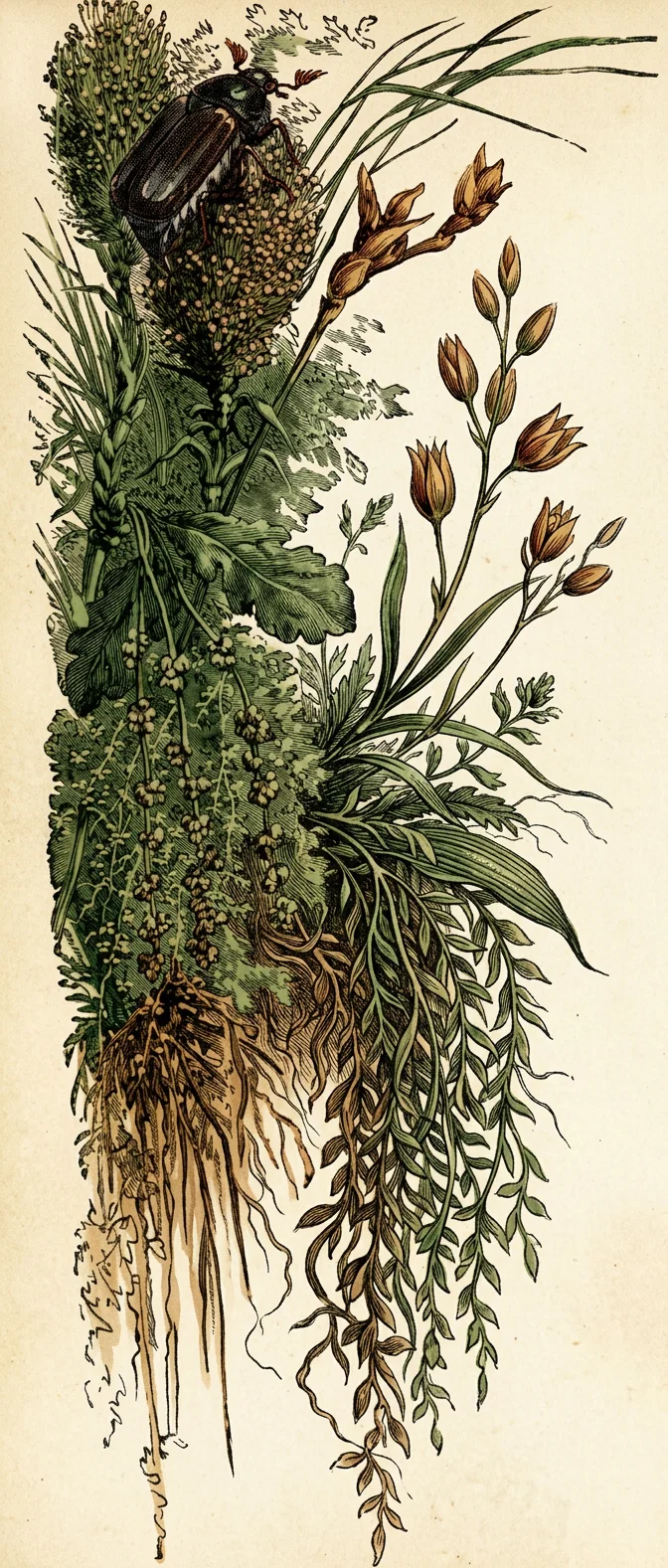
In our picture the artist has shown us two prominent members of this order. The one at the top of the page is the cock-chafer, a European insect, but a close relative of our own May beetles. The cock-chafers fly rapidly, but have no skill in steering, and hence are constantly hitting against objects and falling to the ground. They cannot fly very long at a time, for they are obliged to pause occasionally to fill their bodies with air.
I really wish something good could be said about the cock-chafer, but naturalists have given very bad accounts of his doings. In certain countries of Europe they sometimes come in such vast numbers as to constitute a plague, stripping the trees of their verdure, and leaving the land as desolate as a winter’s landscape. But they are more to be dreaded when they are first hatched out than at any other time. All insects undergo certain changes, or metamorphoses before they become fully developed, as you have doubtless observed; for you have seen the butterfly, first an unsightly caterpillar then a silk cocoon, and lastly a gorgeous insect. It is in this first, or larval, state that the cock-chafer does such an amount of mischief. The larvae have a white body, slender black legs, and a horny head furnished with two jaws like curved shears; and they feed on the roots of grasses and other plants, sometimes killing an entire harvest.
Restored with AI
Figuier, a French naturalist, says of these insects, “In years when their number is not very great, one hardly perceives the damage done by them; . . . but in certain years cock-chafers multiply in such a frightful manner that they devastate the whole vegetation of a country. Sometimes they congregate in swarms, like locusts, and migrate from one locality to another, when they lay waste everything. To present an idea of the prodigious extent to which cock-chafers increase under certain circumstances, we will give a few statistics: In 1574 these insects were so abundant in England that they stopped many mills on the Severn. In 1688, in the county of Galway, in Ireland, they formed such a black cloud that the sky was darkened for the distance of a league, and the country people had great difficulty in making their hay in the places where they alighted. Their voracious jaws made a noise which may be compared to that produced by the sawing of a large piece of wood, and in the evening the buzzing of their wings resembled the distant rolling of drums.”
The lower picture shows us the stag beetle, a formidable creature that is not really half as savage as it looks. It is powerfully strong, and makes use of its mandibles in lifting objects. It never attacks other insects, but lives on vegetable juices. It really seems possessed of a slight degree of intelligence, for one naturalist says he had a stag beetle which followed him around like a dog when he offered it honey.
But this is not the only one of the coleoptera that manifests some instinct. In speaking of one variety, a naturalist says: “One should especially notice the artifice which this one employs, as indeed do many of the coleoptera, to escape from his persecutors by counterfeiting death. As soon as it is seized by an enemy, its members stiffen and become motionless. The body, abandoned to itself, lies unevenly on whatever side it falls, for its legs no longer bend; if you bend them over, they remain in the inclination given to them. Nothing then betrays life in this little dry and slender being, frozen with fear, and imitating death, without, perhaps, being aware itself of what it is doing.”
Perhaps the INSTRUCTOR boys and girls have noticed this peculiarity many times; but if you haven’t, get outdoors among these myriads of tiny creatures, and see how much you can learn of their habits. W. E. L.