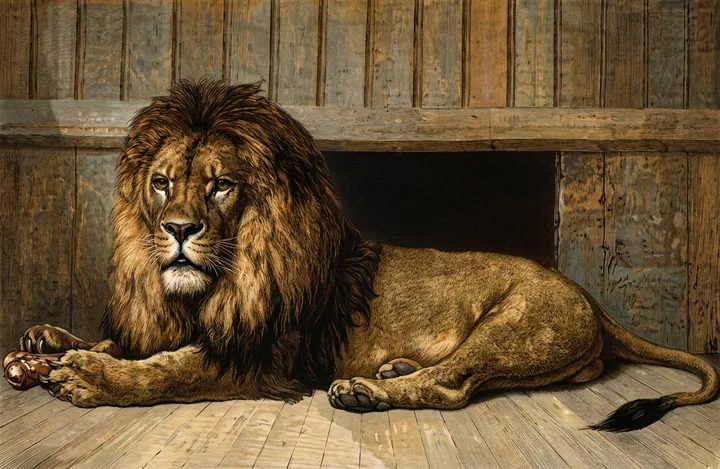
THE LION.
By L. E. Orton
The lion is a native of Asia and Africa. It is about three feet high, and of a tawny yellow color. The lioness looks exactly like a huge cat; the lion differs only in having a full, shaggy mane encircling his neck. Hunters in those countries tell us that his tongue is sometimes as soft as velvet, and sometimes of file-like roughness. At nightfall he usually crouches near some water where animals come to drink, and lies in wait for his prey. While the poor victim stoops to quench its thirst, the lion springs, like a flash, upon it, and kills it with one crash of his powerful jaws. He is so strong that one blow from his paw would break a man’s leg.
Being a sort of great uncle to the cat, he cannot be trusted. Though the “king of beasts,” he does not always show the nobility that high rank obliges; and his savage disposition will manifest itself, even after long years of docility and familiarity with human beings.
Many years ago, a German king, when a boy, had a lion’s cub for a pet and playmate. They grew up together, and were very fond of each other. The king had a wise counsellor, who advised him to send the lion away now that he had become large and strong, or at least to confine him where he could do no harm. The king laughed, and said, “He is my oldest friend; why should I turn him off? He is as tame as a dog.” But he was not so tame, however, as the king imagined.
One night, after going to bed, the king had a queer dream. He dreamed he was dressed, and a servant was brushing the sleeves of his coat with a very hard brush; and as the brush touched his hand again and again, it hurt him so that he gave a cry. He awoke. Something was brushing his hand, which lay over the side of the bed. It was the rough tongue of the lion, who had crept into his master’s room through a door carelessly left ajar. The hand had just commenced to bleed. At the first taste of warm blood, all the savage nature of the lion awoke, and he stood there, just ready to spring, his mane bristling, his tail lashing, and his eyes flashing fire.
The king saw his peril, but he did not lose his wits; he kept his bleeding hand perfectly quiet, and with the other he softly and swiftly reached under his pillow for his pistol, and saved his own life by shooting his “friend” through the brain. Had he slept one minute longer, it would have proved his last sleep.
We were fortunate enough one day to reach the menagerie in Central Park at feeding time. When the animals saw the meat, they were so impatient and hungry that they acted much like naughty children under the same circumstances. The tigers snarled, and the panthers hissed, and paced up and down their cages; while the lions roared so terrifically that it shook the whole building, and some of the people ran out of doors. It seemed as if the iron bars were not sufficient to hold such animals in check.
The attendant threw a large piece of raw meat into the lion’s cage; as he crouched there, licking it, with the sleepy look in his eyes, I wondered if he could remember his home far away in the jungle, when his roar made all the beasts fear, and when the dizzy spring through the air was the prelude to all his feasts. It is rather hard to be confined in a cage all the rest of his life, after such a free condition; but he serves as a lesson in natural history to thousands of children, who could never go to see him in his native land. If he could only reason about it, he might console himself some by thinking he was fulfilling a mission. L. E. ORTON.