FROM MOUNT TABOR.
Perhaps one of the finest views to be obtained in the Holy Land is that which greets the traveler’s eye from the summit of Mt. Tabor. Away to the westward stretches a triangular plain, the largest and most fertile in Palestine. Its eastern side, extending from Mt. Tabor southward to Engannim is fifteen miles in length; the southwestern, hemmed in by the hills of Samaria and the Carmel range, is eighteen miles in length; and the northern, bounded by the hills of Galilee, twelve miles. On the eastern side, three valleys branch off from the great plain toward the Jordan valley, like three fingers from the palm of the hand. The southernmost of these valleys lies between the Samarian hills and the rugged cliffs of Gilboa; the middle one, called the valley, or plain, of Jezreel, between Gilboa and Little Hermon; and the northern, between Little Hermon and Tabor.
Mt. Tabor, which stands at the northern arm of the plain, lies entirely apart from the surrounding mountains except where a low ridge connects it with the hills of Nazareth. It is a symmetrical, rounded mass of limestone, bare and rocky on its southern side, but on its northern covered with oaks, terebinths, and syringas to its very summit. On its level top may be found the ruins of an old wall, with broken remains of cisterns, vaults, towers, and houses, going to prove that here once stood a fortified town, while vestiges of convents and churches give hints of the days of the Crusaders.
Mt. Tabor rises above the surrounding country fifteen hundred feet; was this the “high mountain apart,” where Jesus was transfigured before his disciples? So tradition and the priests who dwell in the Greek chapel on its summit would have us believe; but the ruins of the old town go to prove the contrary, for it is hardly probable that Jesus would have taken his disciples so near a populous town to show them the glorious spectacle of his transfiguration; there are other “high mountains” near here where the scene might have occurred.
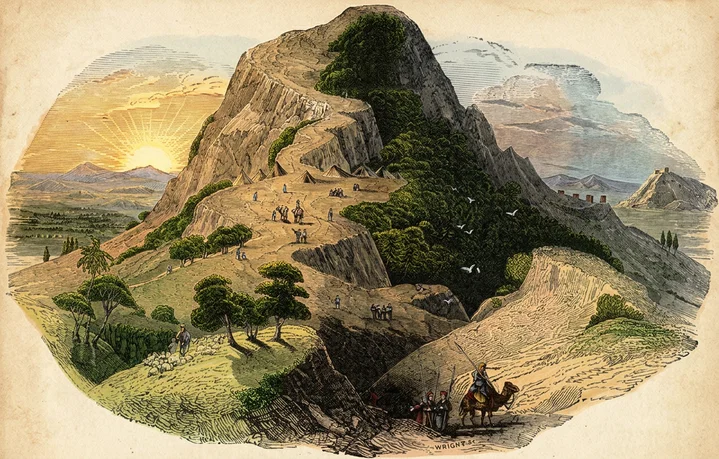
But the tradition which makes Tabor the site of the transfiguration is not the only thing that lends an interest to the locality. Hundreds of years before, Tabor was the rallying place of a little army, when Barak, under the direction of Deborah the prophetess, gathered there his ten thousand men and swept down on the hosts of Sisera and of Jabin king of Hazor, as they lay pitched in the plain near the southern end of the Carmel range. And thus reads the ancient chronicle: “The kings came and fought; then fought the kings of Canaan in Taanach by the waters of Megiddo; they took no gain of money. They fought from heaven; the stars in their courses fought against Sisera. The river Kishon swept them away, that ancient river, the river Kishon.” Standing on Tabor, you can see the line of the river Kishon, as it flows along the southern part of the plain and follows the northern slope of Carmel to the sea. And you will know how, when the clouds broke and the torrents descended on Sisera’s discomfited hosts, it converted the springy soil of the head waters of the Kishon into a veritable marsh where the nine hundred chariots of iron proved worse than useless, and the proud captain was fain to flee on foot for his life. “The stars in their courses fought against Sisera.”
Perhaps you will remember another battle that occurred near here in the valley of Jezreel on the southern side of Little Hermon, when Gideon and his picked three hundred put to rout the Midianites. You remember the stratagem they employed to gain the victory, stealing upon the slumbering camp of the enemy under cover of darkness, and dividing themselves into three companies, each man armed with a trumpet and a lighted lamp in a pitcher; and how at a blast from their intrepid leader, they raised the rallying call of Manasseh, broke their pitchers with a din like the clash of arms, letting the light blaze forth, and with a mighty blast from the three hundred trumpets, shouted, “The sword of the Lord and of Gideon!” And all the startled host “ran and cried and fled.”
Though you can from Tabor look over the greater part of this historic battle ground, there are other and tenderer memories stirred by the view that greets you. Just opposite, on the northern slope of Little Hermon, lies Nain, a desolate cluster of ruins and hovels. On the hillside, a three hour’s walk to the west from where we imagine the gate of the city must have been, lies an old cemetery, with rounded, whitewashed tombs, answering for headstones. We can imagine how, long years and years ago, from these city gates there “was a dead man carried out, the only son of his mother, and she was a widow.” And Christ, going toward the gates of Nain, “saw her, and had compassion on her, and said unto her, Weep not. And he came and touched the bier; and they that bare him stood still. And he said, Young man, I say unto thee, Arise. And he that was dead sat up, and began to speak. And he delivered him unto his mother.”
Farther to the eastward lies Endor. In which one of these cave dwellings could it have been that Saul, forsaken by his God, sought the woman having a familiar spirit and beheld the invited though unwelcome apparition of Samuel? The town, even to the present day, has a weird aspect, in keeping with the home of a wizard, and the inhabitants partake of its squalor and misery.
To the south, rise the bald peaks of Mt. Gilboa, where Saul met his ill-timed fate. We can well imagine, when we see its barren summit, that the words of David have been literally fulfilled: “Ye mountain of Gilboa, let there be no dew, neither let there be rain, upon you, nor fields of offerings: for there the shield of the mighty is vilely cast away, the shield of Saul, as though he had not been anointed with oil.”
To the north may be seen the outlines of the basin that holds the Sea of Galilee, and you can catch a glimpse of its blue waters at the upper end. But how shall we go on to tell of Shunem, Jezreel, and all the places of interest between Tabor and Carmel; or describe to you the rounding sweep of Carmel, as it skirts the plain to the south, and at last dips its feet in the blue waters of the Mediterranean? How often the Saviour must have passed up and down these hills, or across the plain, passing to give comfortp. 130 to a sin-laden soul, to heal the sick, to give sight to the blind; how often from this very mount of Tabor he looked on the scene that greets our eyes, and drew rest and comfort from it, as he did from all his Father’s works. Pleasant were it to look on the spots he viewed, to tread the ground he trod! W. E. L.