Most of our readers have no doubt heard of those wonderful phenomena of nature which deceive by their illusive, or false, appearances,—representing distant objects suspended in the air, or reflected from the surface of water, sometimes right side up, sometimes turned over, at other times double, being both erect and inverted. These phenomena are known as mirage (mi-razh). The word is French, from the Latin mirari, to wonder; and indeed the beholder is struck with astonishment at the first appearance of anything so unnatural which he cannot readily explain. Instances of this illusion are quite common in some localities, that in our picture representing a “mixed one” on Lake Ontario.
It is thought these phenomena were first explained by Gaspard Monge, a French mathematician who accompanied Bonaparte’s army on its Egyptian expedition. Certain it is that a wonderful mirage appeared to their view as the army crossed the desert upon that occasion, and possibly the circumstance led the professor to search out its cause. In describing the scene, the historian says:—
“The army found itself traversing boundless plains of sand without water or shade, and with a burning sun over their heads. All the wells on the road were either filled up or exhausted. Hardly a few drops of muddy or brackish water were to be found to quench their thirst. In the midst of the general depression, a sudden gleam of hope illuminated the countenances of the soldiers. A lake appeared in the wilderness, with villages and palm-trees clearly reflected on its glassy surface. Instantly the parched troops hastened to the enchanted spot, but it receded from their steps; again they pressed on with burning impatience, but it forever fled from their approach; and they had at length the mortification of discovering that they had been deceived by the mirage of the desert.”
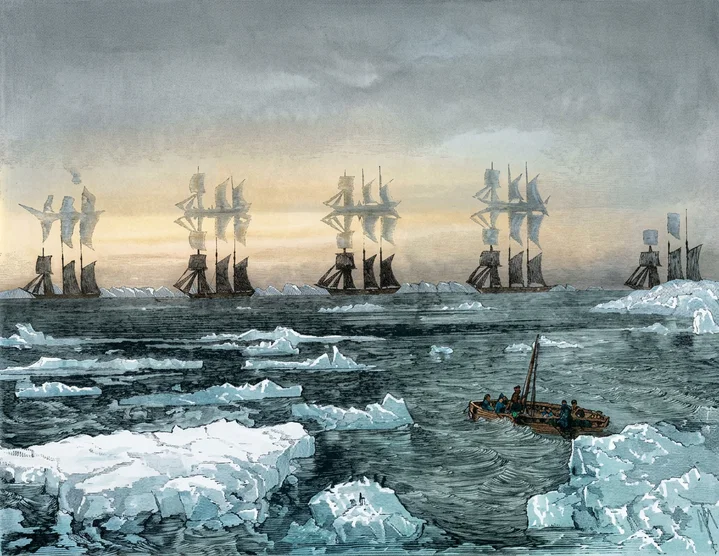
It would make this article too long to explain fully how these phenomena are produced. After we tell you they are caused by refraction and reflection in different strata, or layers, of air of different densities, you will be interested in studying what causes affect the density of the atmosphere, also how refraction and reflection are affected by different degrees of its density, and in this way, like Professor Monge, you may learn how so many remarkable instances of mirage occur.
The phenomena of the mirage embraces a great variety of atmospheric illusions. One writer has said that “in particular climates, at certain seasons of the year, there are seen in the ocean and the sky, representations of cities, groves, mountains, rivers, spacious plains, castles, arches, and rows of superb pilasters. Like some splendid phantom, they fill the spectator with astonishment and delight, then vanish into air, or assume, with the rapidity of a kaleidoscope, new combinations, even more astonishing and beautiful than those which preceded them.”
“Some English voyagers were so enraptured with these splendid visions, as to term the place where they were seen ‘the enchanted coast.’ An eye-witness says that the general aspect of the coast ‘was that of an extensive and ancient city, with ruined castles, churches, hills surmounted by turrets, battlements, spires, and pinnacles. Scarcely was one particular object sketched than it assumed a different shape,—now a castle, then a cathedral or an obelisk, then, with equal suddenness, it would form a bridge, with an arch some miles in extent, presenting an appearance of the utmost magnificence, but of the most evanescent duration.’”
An instance of mirage is on record where the reflection of a party of travelers upon the thick mist, in the Himalaya Mountains, gave the appearance of a large body of armed soldiers advancing to attack them. And another, where an old tree, with four branches sticking out, was mistaken by a crew of sailors for a shipwrecked boat.
The several beautiful representations afforded by these phenomena may be pleasant to the eye, but they are only phantoms, fleeing as one approaches them, without returning any lasting benefit. The thoughtful observer discerns in every phase of this illusion a likeness to earthly pleasure,—that as the mirage vanishes as we approach it, so fades the latter, only dazzling to lead astray; and ere he is aware, he is giving utterance to such sentiments as—
“So passes away earthly glory!”
And—
“Where is the world in which a man was born? Alas! where is the world of eight years past? ’T was there; I look—’tis gone; a globe of glass, Cracked, shivered, vanished, scarcely gazed upon, Ere a swift change dissolves the glittering mass.”
The human mind naturally craving happiness, we all begin our lives in the pursuit of something which we hope may bring it. We are attracted hither and thither by what we suppose is its glitter of show, and though we fail to obtain the coveted treasure upon one trial, we are not disheartened; for kaleidoscope-like, other opportunities, in endless variety, present themselves, and we have but to make another choice. Thus, step by step, we are led on, finding at every attempt that “the glass cracks, shrivels, and vanishes, ere it is scarcely gazed upon.”
Shall we infer from all this that it was not the design of our Creator that mankind should be happy?—Just the opposite. He created man to be happy; and if he had not, in the Garden of Eden, transgressed God’s holy law, his would have been a life of “unending, perfect bliss.” God would have us learn that we were created to be happy in glorifying him, and that happiness sought otherwise, like the mirage of the desert, is delusive. M. J. C.