THE MAORI HOUSE

9%

S. D. A. Publishing Association · Battle Creek, Mich. · Jan 19, 1887

FromThe Youth’s Instructor, Vol. 35, No. 3.

Read the full edition

THE MAORI HOUSE.

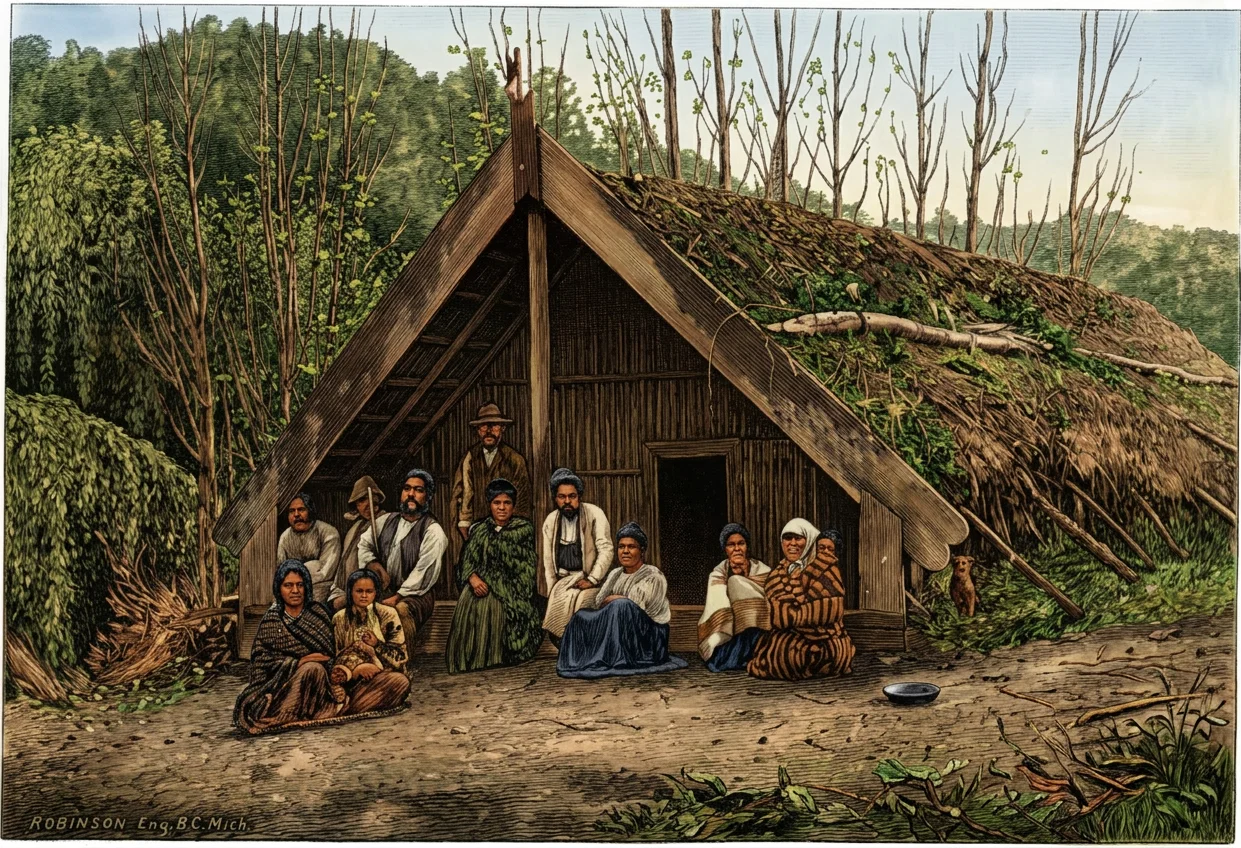
Our artist has presented us this week with a picture of a Maori’s house, or whare-puni, as it is called; meaning, literally, a sleeping-house. These whare-punis vary much in style and finish. The one before us is such as is found in the King Country, a part of New Zealand under the exclusive control of a king, while the remaining portion is under the supervision of the British Government. Those residing in this country are permitted to live by themselves, and make their own laws, without molestation from those around them. The whare-puni presented to us in this illustration is one belonging to the middle class of people. It is larger than the ordinary size.
All the houses are built after the same plan, the usual size being about eight by sixteen feet, though some are much larger, and others are very small indeed. The frame-work of the house is of wood, the posts, ridgepole, and rafters being cut to fit into one another, and then securely lashed. The roof is thatched with rushes, and extends sometimes ten feet beyond the gables of the whare, this projection serving as a veranda or portico, which is raised up from the ground in front by a wooden wall about three feet high, running across from side to side. There is no gate to this wooden barrier; but for a few feet before the doorway, it is made sufficiently low to be stepped over. The post rises from the middle of this barrier to support the ridgepole; and upon the various posts are frequently seen wood carving, sometimes very elaborate.
If the whare is one of the best, it has, upon the post supporting the roof, one of those grotesque Maori images, similarly represented in all Maori carvings, the head large, with lolling tongue; the body long, and the elbows projecting at a sharp angle; the fingers and hands placed over the stomach; the thighs ill-shaped, and the lower extremities generally thick and not clearly defined. The two broad and massive slabs of wood forming the two uprights, on which rest the beams sloping to the wooden walls, as well as the beams themselves, are almost invariably ornamented with carvings of fantastic design. Horrible monsters, which they consider to be the ancestors of the tribes, writhe and twine in and out with a puzzling intricacy of design. In the best houses, every visible piece of wood is ornamented in this manner. The one presented to us in the picture does not display all of these carvings, which are only to be found in the first-class houses.
Restored with AI
If you step over the low wooden barrier, and enter the whare, which you can do without difficulty, you will find that the interior does not present a very neat appearance. If you pass it in the evening, you may possibly find the family group gathered in a festive circle around the family tin basin and the black kettle. The tin basin contains an unsavory and ill-looking mess of pipis. The kettle is filled with weak tea, which the family drink from tin mugs, two or three using one mug. With this, they eat their bread and cured fish. The food, such as it is, seems to be plenty, for the victuals lie in profusion about the earthen floor, and at the close of the meal are gathered up and stowed away for the next repast. It will be noticed that in front of this whare sits a large family. Many of them have their pipes in their mouths. When smoking inside of their whares, the interior, having only a low door, and one small opening to let in the air, or rather to let out the smoke, is very poorly ventilated.
The ladies of distinction are very dignified, and move with stately grace, holding their heads well back, and swinging the arms with an easy motion. They have plentiful blue-black hair. A woman of fashion is tall, with a massive, heavy face, broad shoulders, and hair falling down in heavy masses; or, if the hair is wiry and irrepressible, it may radiate in a frizzy glory around her head. It may be you would find her dressed in a scarlet tunic, with a black skirt, or in a black tunic and a scarlet skirt. Perhaps the tunic will be striped, or of many colors, being thrown back over the shoulders, and falling down in easy folds.
The old Maoris are unpleasantly fond of shaking hands with the white stranger. This may be to a certain extent due to the helplessness and loneliness of old age, which, among the Maoris, is very unlovely, so that they are thankful for the notice of even an alien. The aged Maoris, are much more courteous than the younger ones, who are often shy, reserved, and sometimes sullen. Association with the white man has made them less hospitable than formerly, when they would have scorned to charge any fee for entertainment or hospitality shown even a stranger. If we meet a Maori and hold out the hand, he will bow his head as we approach, and shout a friendly tena-koe; (Here you are!) and if you come close to them, they will chatter to you, as though you understood all they said. A Maori village is a most interesting sight, and not the least interesting feature is the youth and children. They are full of fun, as indeed are their elders, and jest and tease each other good-naturedly, with much shouting and laughter.
Each whare is surrounded by a garden, where they cultivate various kinds of vegetables. Originally the cultivation was confined to the kumera, or sweet potato, and the taro, a wild plant, which by cultivation was rendered more suitable for food. Their food consisted of these plants, and of eels, sea fish, rats, dogs, and wild fowl. The nearest approach to bread was made from the root of an edible fern, not very wholesome or palatable. This of course is now very different.
You will notice a dog at the right hand of the picture. In New Zealand the dogs of the present day are very different from what they were many years ago. The native dogs have become extinct, and the mixture of European blood has not improved their appearance. It might be said that the New Zealand dog is a sort of nondescript animal, a mixture of all conceivable breeds, mangy, starved, and sullen. No two dogs are alike in size, shape, or color. One thing they represent as a unit, and that is cruelty and starvation.
The Maoris are an indolent people. They build their whare, or sleeping house, remaining in one place until the ground has been cultivated a few years, and then go to another place. There is one feature, however, among the Maoris, which is very commendable. They are religiously inclined, and as a general thing they are moral. They have their idea of moral purity, and any transgression of it is considered a crime of the worst character. At the present time, most of the Maoris profess Christianity, but they know but little of its power. S. N. HASKELL.