THE BEST WAY.
By W. E. L.
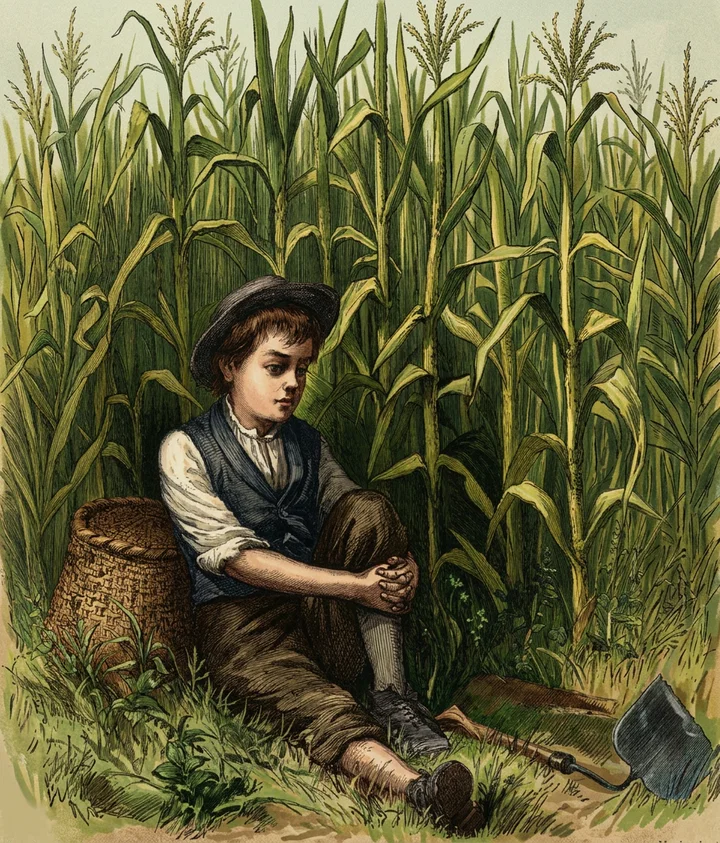
How hot the July sun poured down! Will rested on his hoe handle, and drew his sleeve across his face to wipe off the moisture. Such a lot of potatoes to hoe! He looked back at the rows that he had hoed, and then over at what there was still to do. A sullen look crept into his face, but he worked on. At the end of the long row he halted; and flinging the hoe in the furrow, sat down in the shade of the tall corn that was nodding its tassels in the fitful breeze.
“I don’t believe there ever was a boy that had such hard times as I do,” he muttered to himself. “It’s just work, work, work, work, from morning till night. I’m sick of it.” And Will pushed back his hat and leaned against the old basket to think it over, and build castles about what he meant to do by and by. When he grew to be a man, he wouldn’t work on a farm all day; he would live in a fine house, like Mr. Brown’s, with a great spreading lawn and tall shade trees in front; he knew just how it looked, for he went by there almost every time on his way to town. Once he had seen a little boy just his own size out in the yard, reading in a book, and how he wished he could change places with him. He would have a span of gray ponies, too, such as he had seen Mr. Brown driving out of the great gate. So he went on planning and thinking, till the minutes crept into half an hour—a whole hour—or more. Suddenly Will was startled at a rustle near him in the corn, and springing up, he saw Uncle Esek looking at him with a peculiar twinkle in his eyes.
Uncle Esek was no real relation to Will. He was an old, weather-beaten man who lived in a little log house a mile up the road from Will’s home. He was shrewd and keen, and by his kindly words spoken at just the right moment, he often helped many a perplexed boy out of his troubles.
“Well, what is it?” said Uncle Esek, glancing down at the hoe and then at Will’s flushed face, from which the discontented look had not yet faded away.
Will looked as if he would rather not tell, not feeling sure what answer Uncle Esek would give him; but at last he said: “Don’t you think it’s mean to make a boy work all the while, anyhow? When I get to be a man, I shan’t do anything I don’t want to,” and he looked up rather defiantly; then he told him what he had been planning.
“Well,” said Uncle Esek in his slow, quiet way, “I can remember when Mr. Brown was a little boy like you, and didn’t live in half so good a house as yours. He had to work just as hard, too.”
Will looked surprised.
“Yes,” continued the old man, “he worked just as hard; but he didn’t fret about it, and stop to build castles in the air when he ought to have been at work. ‘The hand of the diligent maketh rich,’ the good Book says, and I think you will find this true. And there is another verse, ‘Seest thou a man diligent in his business? he shall stand before kings; he shall not stand before mean men.’”
“But Mr. Brown don’t ‘stand before kings,’” urged Will.
“No,” said Uncle Esek, “but every body respects him and values his good opinion.”
Will picked up his hoe thoughtfully, while Uncle Esek continued: “Every thing in this world worth the having costs something. We always have to pay all that a thing is worth before we get it. If we want money, we must work for it; if we want to be wise, we must study hard and think a great deal; if we want to have an easy time when we are old, we must work for it when we are boys.”
“May be that’s so,” said Will; “I never thought of it before. But anyhow you can fix it, I don’t like to hoe potatoes, though I suppose it will have to be done,” and he moved slowly towards his unfinished work.
“That’s right,” said the old man, looking after him; “do the things that are waiting right at hand to be done. And after all, my boy, it doesn’t make so much difference what we work at, though it is a great deal pleasanter to do what we enjoy; but it is the way in which we do the work that makes men of us.” W. E. L.