ONE night, over five hundred years before Christ, the richest and grandest of Persian kings could not sleep. His mind was troubled; so he called for the book in which were recorded the principal events concerning his kingdom. The book was not written in a dry and uninteresting style, but the best poets which the realm could afford were often engaged to write these chronicles. Hence, they often proved to be among the finest productions of the time; and, in connection with this, the nature of its contents made it a very suitable book for the occasion.
In reading, it was found that Mordecai, a Jew who sat in the king's gate,—a custom very common at that time,—had informed the Persian king, Ahasuerus, that two of his chamberlains had formed a conspiracy against him. This interested the king, and he wished to know what reward this man had received for being instrumental in saving his life. So he asked: “What honor and dignity hath been done to Mordecai for this?”
“There is nothing done for him,” the reader replied.
When morning dawned, Haman, one of the leading princes of Persia, came early to see the king and to receive permission to have Mordecai hung. Now Mordecai was a good man; but Haman hated him because this servant of God would not follow the example of others in giving him the reverence which belongs alone to the Creator. Previous to this, Haman had sent out a decree “by posts into all the king's provinces, to destroy, to kill, and to cause to perish, all Jews, both young and old, little children and women, in one day, even upon the thirteenth day of the twelfth month, which is the month Adar [about the first, week in March], and to take the spoil of them for prey;” and at that time Ahasuerus, or Xerxes, ruled over the whole civilized world.
After the king had received an answer to his question, he said to one of his attendants: “Who is in the court?”
“Behold, Haman standeth in the court,” was the reply.
“Let him come in,” said the king.
Then Haman came in and stood before the king, who immediately asked: “What shall be done unto the man whom the king delighteth to honor.”
“Now is my chance,” thought Haman, “for to whom would the king delight to do honor more than to myself.” So, with his expectations high, he thought of a truly grand plan, and answered:—
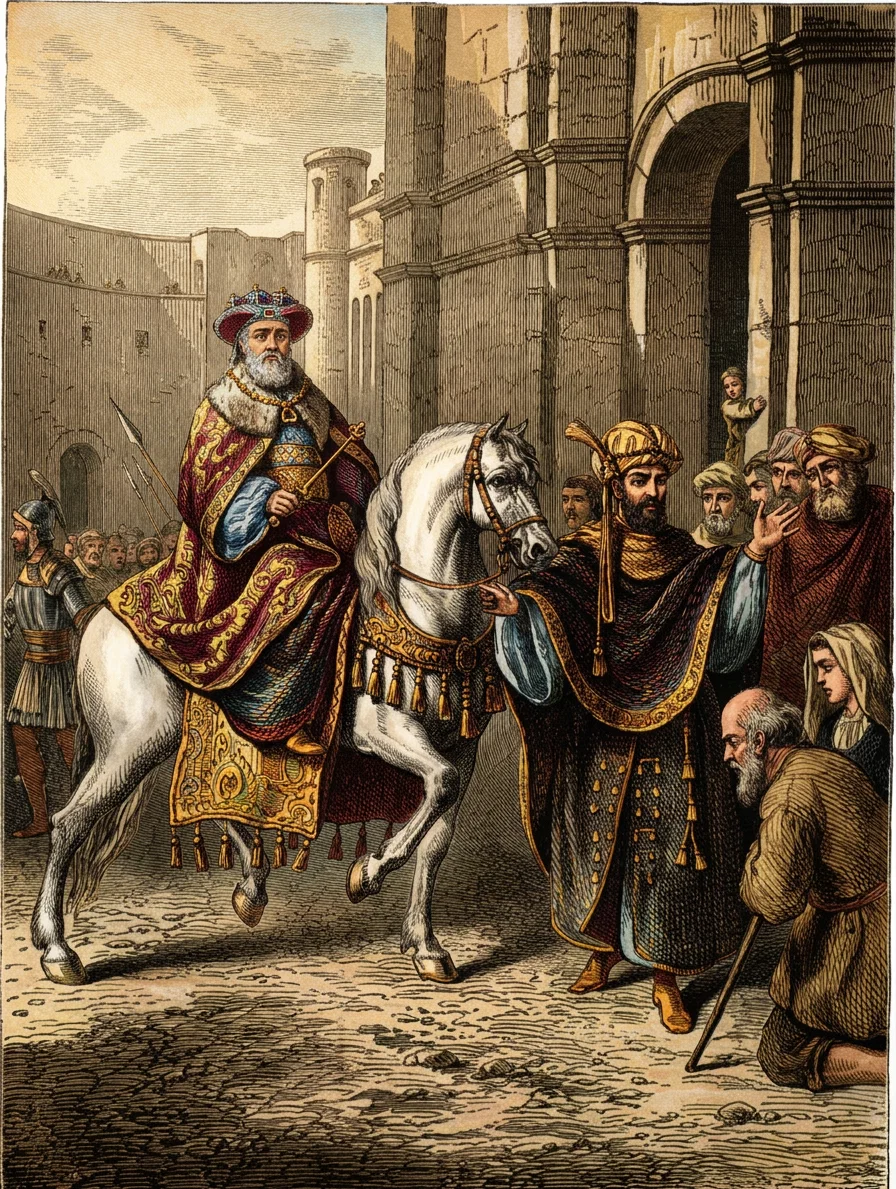
“For the man whom the king delighteth to honor, let the royal apparel be brought which the king useth to wear, and the horse that the king rideth upon, and the crown royal which is set upon his head; and let this apparel and horse be delivered to the hand of one of the king's most noble princes, that they may array the man withal whom the king delighteth to honor, and bring him on horseback through the street of the city, and proclaim before him, Thus shall it be done to the man whom the king delighteth to honor!”
“How majestic! I will look! How the people will admire and honor me as I sit in state! To what high positions I can yet attain!” are thoughts that quickly passed through Haman's mind. But alas, for human expectations! Little did Haman then know of the mortifying ordeal through which he was soon to pass; for, in answer the king said:— “Make haste, and take the apparel and the horse, as thou hast said, and do even so to Mordecai the Jew, that sitteth at the king's gate; let nothing fail of all that thou hast spoken.”
Restored with AI
Then Haman did as he was commanded; for to disobey was death. Mordecai was led in state through the city, and Haman went before that man whom of all men he hated, proclaiming: “Thus shall it be done to the man whom the king delighteth to honor!”
Haman had been caught in his own trap. He hastened home with shame, and covered his face. How had he fallen! But worse things followed. He was hung on the very gallows which he had prepared for Mordecai, “fifty cubits [over 87 feet] high,” and “Esther set Mordecai over114the house of Haman.” And “Mordecai the Jew was next unto king Ahasuerus, and great among the Jews, and accepted of the multitude of his brethren, seeking the wealth of his people, and speaking peace to all his seed.”
“Let the wicked fall into their own nets,” but “we know that all things work together for good to them that love God.” W. A. BLAKELY.