HAVE our young readers ever noticed the many shapes which are given to the falling particles of snow as they descend from the clouds? If they have not, and will examine the flakes during several storms, they will not only be delighted, but surprised at the almost endless variety of forms these take. It is said that “Nature has laws that regulate the form of every flake, although no one has yet discovered just what they are; but because rarely more than three or four kinds of flakes come at the same time, it is believed there are certain conditions and causes which govern the architecture of every one.”
The formation of a snow-flake is so truly wonderful that the readers of the INSTRUCTOR will be interested in what scientists teach about it, and so we will quote what a writer in the January Treasure-Trove said about the beautiful snow crystals. The paragraphs read as follows:—
“A snow-flake is a very little thing, and few people stop to do more than admire it; but it is more than beautiful, it is wonderful, for the process by which even one flake is formed includes many great forces.
“We know that every bar magnet has a positive and a negative end called poles. If the positive ends of two bars are brought together they will not cling, there is no attraction; but if positive and negative ends are placed together they will be attracted and cling. Now every atom of matter which forms crystals, has two ends which are as opposite in character as the ends of a magnet, and these are also called poles. If the particles of matter are left free, opposite poles will seek each other, and thus by attraction and repulsion regular and beautiful crystals are formed. This is the way with the snow.
And this same power of crystallizing is given to the atoms of nearly all substances. Gold, silver, iron, copper, and lead, when melted and allowed to cool slowly, arrange themselves into crystals. Diamonds are only crystallized carbon. The ruby, sapphire, and emerald are all crystallized quartz, with different colorings. If you dissolve sugar in water, and then allow the water to evaporate, you will have sugar crystals. If you melt alum in water and then stretch a thread across the dish so that it touches the liquid, as the water evaporates the particles of alum will cling to the thread and build themselves into beautiful crystals. Each substance has its own regular form of crystals, salt for instance takes the form of cubes.
“When the air is perfectly saturated, and the clouds are heavy with water vapor, then it falls to the earth in rain, hail, or snow. If the temperature is below freezing point and the air is not too bitter cold, the vapor falls in snow-flakes, ‘cloud crystals’ as some one has beautifully named them.
“More than a thousand different forms of snow crystals have been seen; and although there is such an endless variety, they all have a likeness, for every snow-flake is either six-sided or has six points radiating from a center at six equal angles.
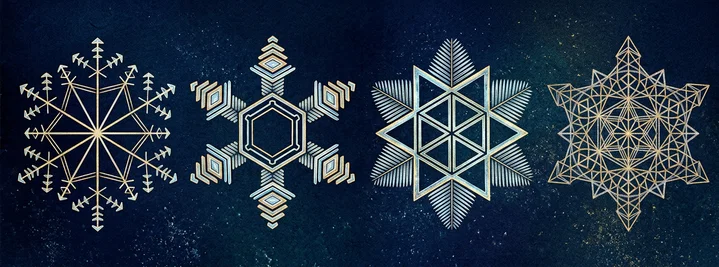
“The crystals are sometimes simple, being flat, six-sided figures or having six plain rays; often they are very complex, with the six spikes branched and feathered like fern-leaves and flowers. They are more complex and larger when the air is unusually damp, and probably the different temperatures through which they pass in falling has also some influence upon their forms.
“I do not suppose you have ever seen snow tinted with yellow, red, or green, yet there is a very tiny water-plant, called an algae, which sometimes comes down in the snow-flakes.”