I am enjoying a pleasant afternoon stroll in the woods, where the declining sun pours a full flood of light down among the numberless millions of gleaming summer leaves.
The scene of my resort is not some frequented watering-place, nor a northern lakeside enlivened by the picnics of the summer tourists. My vacation is not a rest of two or three months taken from intellectual toil. The circumstances are merely these: a fair portion of my life has been passed amid farm toils, farm cares, and farm pleasures, and I have learned that the innocent pleasures need by no means be separated from the toils and cares. So while others delve from dawn till dark, and worry because daylight lasts but twelve hours, or because every stone which they turn over does not reveal a dollar, I have decided to take an occasional hour to learn, if possible, what nature is doing around me,—why the birds sing so lively and twitter so cheerily in the forest tangles, why the sun shines so softly on these summer leaves, and why cardinal flowers and the golden-rod look so bright after the August rain.
As intimated, I am enjoying an hour of that kind this balmy afternoon. I am reclining against a prostrate tree in a maze of ferns, amid the shades and sweet sounds of the forest. Not a human voice or footstep is near; but at a distance, here and there, rings a supper bell. The westering sun sheds a profusion of rich rosy light among the stately green trees, revealing to the eye myriads of sporting insects. The chipmunk is cheerily chippering his queer little tune. Near me is an oft-repeated rustling among the dry leaves, which reveals the persevering search of the Towhee Bunting for her favorite food of insect larvae and eggs.
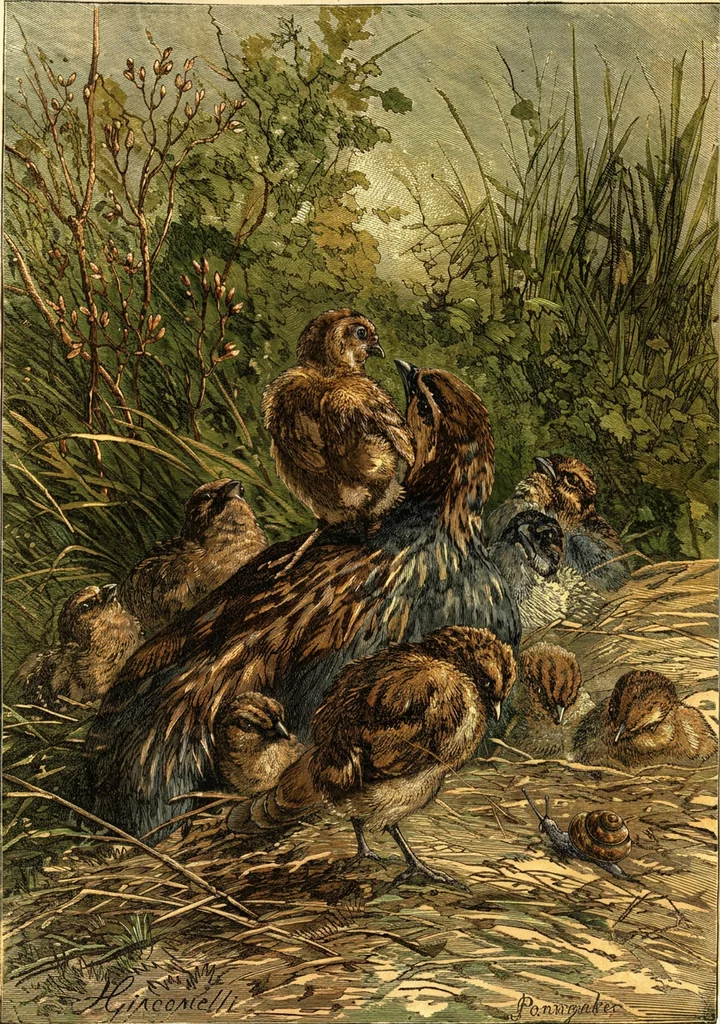
But yonder! What is it?—that graceful form with noiseless step,—now hidden, now in full view among the uncertain undergrowth. As a “born naturalist,” I must know. So, improving its brief concealment behind a large trunk, I drop hat and paper; then on hands and knees creep the length of a fallen log. Rising carefully, I find myself in full view of a perfect and very beautiful specimen of the Ruffed Grouse (the Partridge of our Eastern and Northern States, the Pheasant of the Southern). She glides with short, strutting steps, her head and neck erect, and thrown forward with pleasing grace at each advance. But as she moves toward me, I detect a mysterious shyness in her manner; for though she does not appear to see me, there seems to her a mysterious something in the air, bespeaking danger near. A sudden whirring flight of a hundred yards carries her into concealment, which, however, is easily searched out by following the direct course of her flight. We find her perched without effort at concealment on a conspicuous log. Evidently she does not think herself hidden; her apparent thought is to be mistaken for something else.
Deciding to match our patience with hers, to see how long she will stand thus immovable, and how she will get out of that posture, we stand quite still, then sit, and finally lie down, feigning sleep. Suddenly she lays aside all her caution, makes a half-turn upon the log, jauntily upturns her head, the better to take in the situation, then prunes her feathers and oils them after the manner, almost exactly, of domestic fowls.
When her toilet is completed, she slides down the opposite side of the log, just as I have seen turtles slide from rocks or old logs into the water; and though I go immediately to the place, not fifty feet away, she has entirely disappeared.
This slight-of-hand way seems habitual with the partridge from the day it leaves the egg. I have, in traversing the woods, suddenly found myself confronted by the mother bird of this species flying full in my face, picking at my clothing, or feigning a broken limb or wing. So sudden and deceitful are these maneuvers, that when I have been thus led by them perhaps a hundred feet, I have as wholly forgotten the bevy or skulking little ones, which by that time has entirely disappeared, as I have till now forgotten to mention them in this description.p. 18
Often when closely pursued after a deep fall of light snow, the partridge plunges into the depths of a friendly drift, under the very eyes of the hunter, and, fortunately for the poor bird, her pursuer never knows where she is coming out. Usually, we are happy to say, it is where she is least expected.—G. A. R., in The Fireside Teacher.