HOW seldom do we who enjoy the sunshine and the pure air think of those whom necessity compels to work for a life-time below the surface, cut off from the common comforts of mankind! While enjoying the ruddy glow of the coal grate on a chilly winter evening, who ever gives second thought to the toil and deprivation that are bestowed by the hardy miners to make the rest of the world comfortable?
Old Mother Earth contains stores of wealth which bravery and industry have made a source of blessing to millions; and it is about one of these avenues of resource that I shall now tell you.
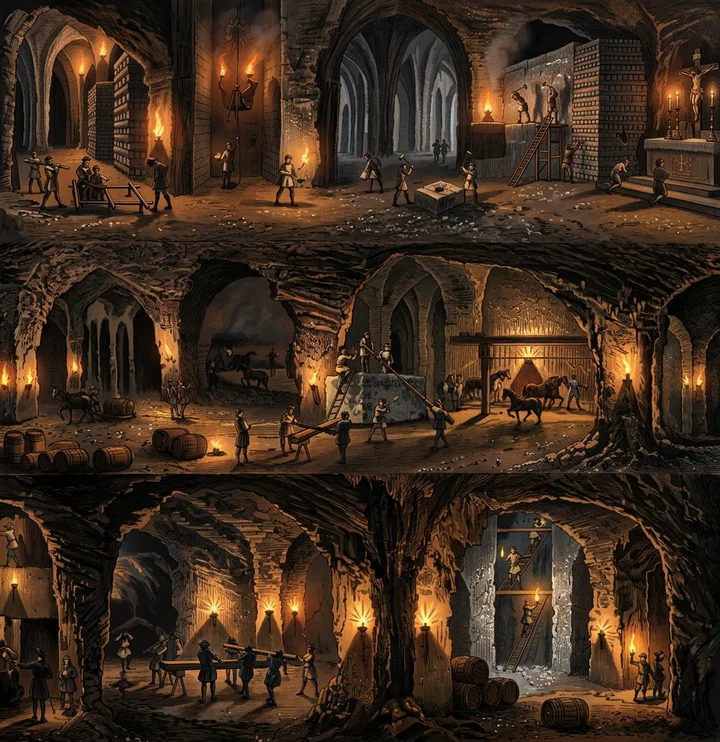
In Austrian Poland, about seven miles south-east of Cracow, a city which you can find readily on your maps, lie what are probably the largest and most productive salt mines in the world. They extend two miles in length, one in breadth, and are from six hundred to eleven hundred feet deep. As many as fifteen hundred men and six or seven hundred horses are employed in working these mines, and in 1875 they brought in a revenue to the empire of some six million dollars. In our picture the artist has given us a view of that part of the mine that has been worked the longest.
But let us in imagination make a tour of this underground region. We bargain with two brawny Polish miners to conduct us through the intricate windings. Remembering the old saw, “When you are in Rome, do as the Romans do,” we make the descent in the shaft used by the miners, instead of employing one with the modern improvements for the comfort of timid folks. Each guide is provided with a torch, and one is given us also. We take our seats in a rude iron basket, with our legs hanging down, and grasping the chain above, begin the descent. The flare of the torches serves only to make the midnight blackness of the gloomy passage visible.
When four or five hundred feet down, we stop and get out. This is the part of the mine that has been worked the longest. The mine is full of difficult ascents and intricacies that are crossed by bridges and ascended by staircases; and as we thread passages, now to the right, now to the left, over bridges and staircases, we soon become so bewildered that we lose all trace of our whereabouts, and would never be able to find our way to the air and the sunshine if it were not for the trusty fellows who are going, one before us and the other behind us, to prevent any such accident.
But you will see that we are constantly going down, down, into the heart of the earth, following the vein of salt. What a surprise! Our narrow passage has opened into a large chamber, full seven hundred feet below the surface! All the salt has been taken from this part of the mine, and the room is now fitted up as a chapel. There are altars, and crosses, and images of saints, all made out of the pure rock salt. The light of the torches, reflecting on the salt crystals, makes the whole glitter like diamonds.
Crossing more bridges, and down more steps, we come to a little river, over which the guides row us in a rude boat. And now we go down more staircases, some of them of the most rickety kind, and across more little rivers, to which the first was but an introduction. And here we stand in a space nearly a hundred feet high, and two hundred in length and breadth,—the chamber of Letow. There is a larger one half a mile away, called the chamber of Michelawic. There are chairs, thrones, columns, altars, statues, and chandeliers in these, in all the splendors of rock salt. What good fortune! You have thought to bring along a few of our common fire-works. Let us put out the lights, and set them off. Such radiance! The pitchy blackness is suddenly illumined by a most gorgeous display. The rock salt reveals all the colors of the rainbow, and each crystal flashes like a diamond. It is as if the sun, moon, and stars were flashing before our eyes.
The chamber of Michelawic is consecrated to St. Anthony, and on the 3d of July grand mass is celebrated here, followed by a banquet. The principal officers of the mine are present, the workmen are given a holiday, and are presented with small sums of money, not very much, to be sure, but enough to make the poor fellows wish that the 3d of July came more than once a year.
But there is another place that we must visit; and that is the Infernal Lake, made up of the little streams we have crossed, and that all flow into it. It is seven or eight hundred feet long, four hundred broad, and about fifty deep. One might well suppose it the most dismal place on the earth; and if ever there was a spot where the evil ones congregated to lay their plans for the destruction of mankind, we might suppose they would choose some such place as this.
Setting off our fire-works, we produce a most wonderful transformation. The bright light makes more visible the surrounding gloom, and it would require no great stretch of the imagination to believe that we could hear a chorus of imps, and see their forms capering about in the gloom. Our own voices wake the dreariest echoes.
Here is a small boat, and we will embark on the inky waters. Ah! what sound is that? Groans,p. 50 shrieks, and horrid laughter break upon the ear. Straining our eyes, we can discover no forms in the deep gloom. At the end of a wild refrain, we distinguish the words, “Gluck Auf! Gluck Auf!” (Welcome! Welcome!), as if the demons were bidding us to the hospitalities of the Infernal Pit. And suddenly, about a hundred feet before us, appear in flaming letters the words “Gluck Auf!” while the weird chorus is taken up again.
But now the mystery is solved, and our demons appear in the shape of muscular, ill-looking miners, who ask for a few kreuzers in return for the efficient aid they have lent in making the scene impressive. These we freely give, and it is astonishing to see how four or five cents will brighten up the stolid faces of these poor fellows.
At the lower depths there are no lack of miners who work steadily with pickaxes and crow-bars in getting salt. They here spend twelve hours out of the twenty-four, and receive only thirty or forty cents a day for their wages; and on this pittance they manage to support large families. Most of them are Poles, who are unable to read or write. They are compelled by the necessity of toil and their narrow circumstances to spend their lives below the surface.
Returning, by the way we had come, to sunlight and warmth once more, we can but feel deeply thankful that the lines have fallen to us in pleasant places.
W. E. L.