Among the Jews elevated to high positions at the Babylonian court was Nehemiah, the king’s cup-bearer. His office brought him into familiar and daily intercourse with the sovereign. For four long months he inwardly bewailed the defenseless condition of the city of his fathers, until at length a noticeable change came over his countenance, and the king kindly questioned his servant as to the cause. ‘Why is thy countenance sad,’ he asked, ‘seeing thou art not sick? This is nothing else but sorrow of heart.’
“The result was, that Nehemiah was allowed to go to Jerusalem, armed with the usual generous commissions which Eastern monarchs grant to their favorites, so that whatever material he needed for the work of restoring the walls and fortifications of the city might be forthcoming.
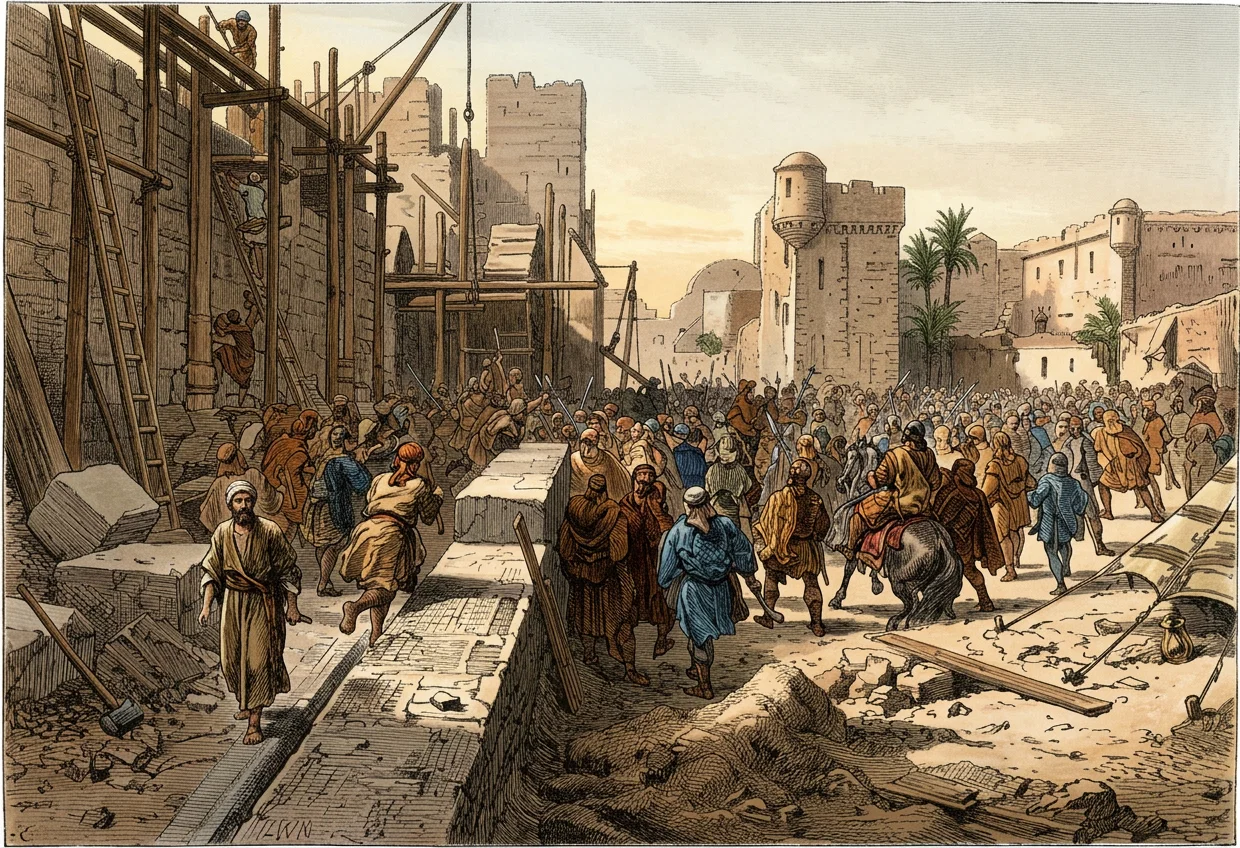
“On the third night after his arrival in Jerusalem, accompanied by a few associates, he rode out by moonlight and made a tour of the city-walls. He planned this excursion for the night, and kept his purpose even from the rulers and priests, for he was aware of the bitter feeling of the surrounding heathen, who would be sure to resist his project as soon as it was known. He knew, too, that there was treachery within as well as hostility without the city. But after he had fully informed himself and had laid all his plans, he took hold of the work with an energy and a consecration that carried everything before them. The whole community rose up as one man; ‘the people had a mind to work.’
“Their enemies of the surrounding tribes, neither few nor weak, ridiculed and threatened the wall-builders, who strengthened themselves by prayer and at the same time armed themselves with swords, spears, and bows. They remembered the Lord, the great and terrible. They resolved to fight for their families and homes. They were divided into two companies, half for work and half armed for defence. Even the working-parties went armed, some working with one hand and holding a weapon with the other. Nehemiah had by his side a trumpeter to give the signal for rallying the separated companies at any point where they might be attacked; ‘our God,’ he said, ‘will fight for us.’ He also required all to remain within the city by night, to guard against surprises by the enemy.”
“Disheartened by these precautions, Sanballat, Tobiah, the Arabians and the Ammonites gave up the struggle. They were compelled to look on while the walls steadily rose and were joined together, part to part, until no breach was left. They made vain efforts to call Nehemiah off from his great work and to entice him into their snares. He turned aside to no other duty or occupation until the wall was completed, smiling at threats of personal violence.
Restored with AI
“On the twenty-fifth day of September, the wall was completed—in fifty-two days, a marvelously short space of time. Yet, as the labor was divided among not less than forty working-parties, the result cannot be regarded as beyond human power, especially when impelled by the most intense and urgent motives.
“The completed walls were dedicated by a religious ceremony. The princes of Judah and the Levites gathered from all places around Jerusalem. The sons of the singers, who had built themselves villages in the vicinity of the Holy City, the priests and the sons of the priests, were summoned to the dedication. Two great processions were formed upon the walls. One, led by Ezra, went in one direction, and the other, by Nehemiah, in the other. As they traversed the new-made walls, the pledge of Jerusalem’s security, they sang and rejoiced with so loud a voice, their wives and children joining in the song, that the joy of Jerusalem was heard a great way off.”
Yet we may well believe the walls would never have gone up if the people had not had a mind to work; nor the work have been completed if the good hand of their Lord had not been upon them. “Not by might, nor by power, but by my Spirit, saith the Lord of Hosts.” In all work for God it is well to remember that human strength is failure, but with His Spirit success is certain.