Since you have read the interesting article, “The Geysers of the Yellowstone,” in the INSTRUCTOR of October 6, 1886, we suspect you know just where they are. If any do not, it might be well now to find on your maps the Territory of Wyoming, in which these remarkable geysers lie; for there is much to be told of this wonderland, which makes it important that you should be able to locate it.
Speaking of this tract of country, one writer has said that “in the north-western corner of Wyoming Territory, in the same latitude as New York, the grand Rocky Mountain system culminates in a knot of peaks and ranges inclosing the most remarkable lake basin in the world. From this point radiate the chief mountain ranges, and three of the largest rivers of the continent—the Missouri, the Columbia, and the Colorado.”
After bounding this division of territory by several prominent mountain ranges, one of which a few years ago had never been crossed by a white man, the writer continues:—
“Set like a gem in the center of this snow-rimmed crown of the continent, is the loveliest body of fresh water on the globe, its dark-blue surface at an elevation greater than that of the highest clouds that fleck the azure sky of a summer’s day, over the tops of the loftiest mountains of the East. Its waters teem with trout, and the primeval forests that cover the surrounding country are crowded with game. But these are the least of its attractions. It is the wildness and grandeur of the inclosing mountain scenery, and still more the curious, beautiful, wonderful and stupendous natural phenomena which characterize the region that have raised it to sudden fame.”
It is a fact worthy of note here that it is less than twenty years since the public received their first knowledge of the marvels that really existed in the Yellowstone Geyser region. Unsuccessful attempts had previously been made to explore it; for after the upper Missouri valley began to be thronged with gold-seekers, rumors came that in the unknown Yellowstone country, diamonds, rubies, sapphires, emeralds, and other gems, as large as walnuts, were gathered by thousands from the stony branches of the petrified sage brush. No doubt these visionary stories originated in something that had been communicated by the Indians.
In 1859, Col. Reynolds made an attempt to enter the basin, which resulted in his passing around it only. Ten years afterward another party entered, but no report was made of their discoveries. In 1870, an expedition “composed of some of the leading officials and citizens of Montana, accompanied by a small escort of U. S. cavalry under Lieutenant G. C. Doane,” made an extensive research of that tract of country, reporting that they had “seen the greatest wonders on the continent; and were convinced that there was not on the globe another region where, within the same limits, nature had crowded so much of grandeur and majesty with so much of novelty and wonder.”
Other explorations immediately followed, and have been continued, until reports of them furnish many pages of the most grand, sublime, and thrilling descriptions imaginable.
Among those who traversed this region, “making a systematic survey,” was the United States geologist, Dr. F. V. Hayden. As soon as he reported officially the results of his investigations, steps were taken to have a portion of this wonderland set apart for the benefit of the public at large. A bill to this effect was introduced into the Senate in December, 1871, and approved by Congress March 1, 1872. It provided that “a tract of land fifty-five by sixty-five miles, about the sources of the Yellowstone and Missouri Rivers, be set apart as a great noted pleasure-ground for the benefit and enjoyment of the people.” It is called the Yellowstone National Park.
“Within the limits of our great National Park, is the grand geyser region of Firehole River. Here, in a valley a dozen miles long and two or three wide, is an exhibition of boiling and spouting springs on a scale so stupendous that if all the corresponding phenomena of all the rest of the world could be brought into an equal area, the display would seem as nothing in comparison.” “Two miles further down the stream is the Upper Geyser Basin, an open, rolling valley, two miles wide and three long, the mountains on either side rising 1,500 feet above the valley, with steep, heavily timbered ledges of dark rock.”
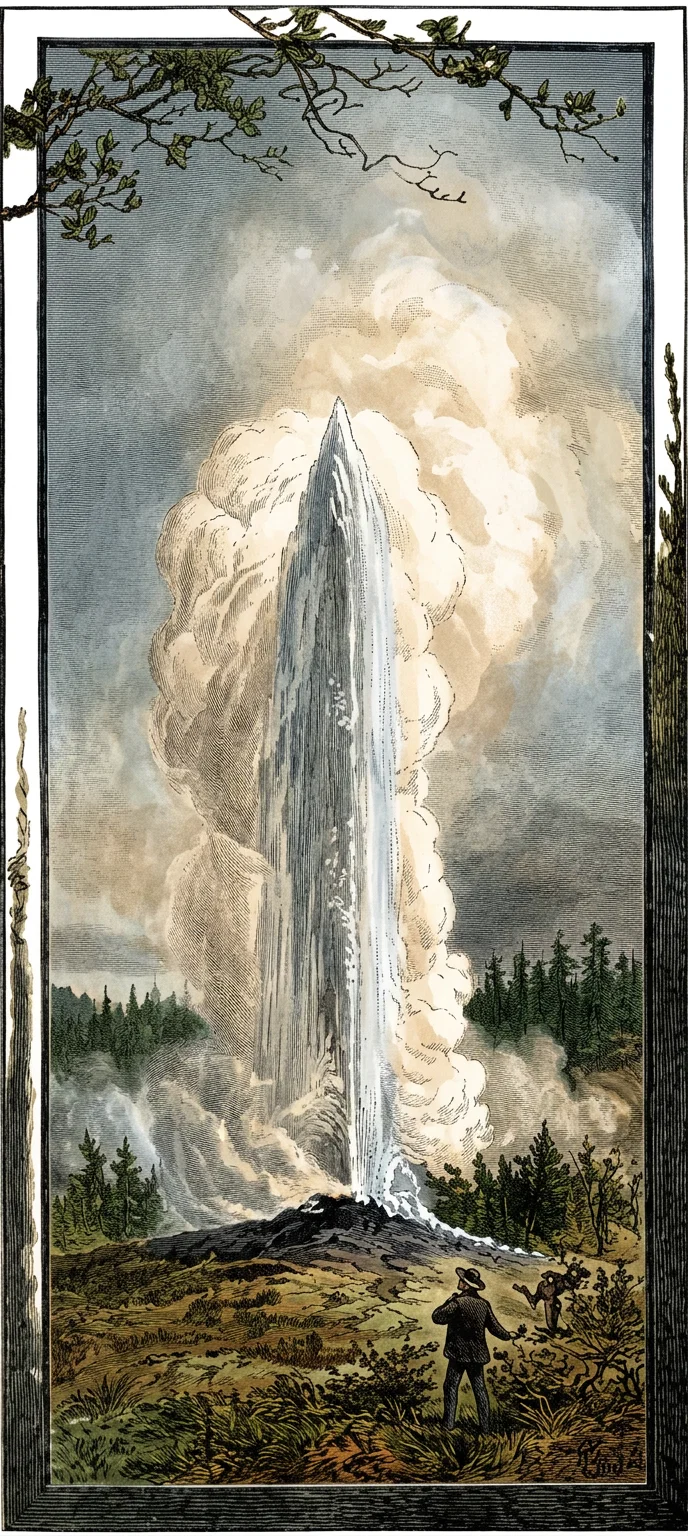
This is rightly named the Grand Geyser Region. At the head of this valley, on a mound thirty feet above the level of the surrounding country, a very interesting geyser seems to stand as guard. It has been named Old Faithful. In its description, you will readily detect the characteristic that suggested its name. We wish we had space for what explorers testify of this wonderfully formed mound from whence is discharged such marvels of varied beauty, but we can only give a description of the geyser’s appearance in times of spouting and resting.
The opening through which Old Faithful discharges water is said to be an irregular oval, three feet by seven in diameter. He has such an interesting way of entertaining visitors, that we will close the article with an extract from a description given of it by an eyewitness:—
“You hear Old Faithful splashing in the night, and, if you have kept your reckoning, can actually tell the hour, he is so regular in his action. Never was a geyser better named; for once every sixty minutes he asserts himself. You may walk up to his mouth and look down his throat, but you will see nothing but a passage full of water; you may drop in a handkerchief, only to see it become saturated and sink from view. If it is near the hour of eruption, your wisest way is to walk a few rods away and sit down under the bushes; not that there is any particular danger in delay, for even had Old Faithful begun operations, there would be time to run out of reach. But it is so pretty to watch him at a safe distance, and then it is only from a distance that one gets any idea of the height of the geyser column. With watch in hand you listen for the preliminary rumble—he does not vary ten minutes either way. There it is! a kind of choking sound in his throat, and a moaning as of intestinal disturbances, which is followed by a splutter and slopping over that is like a useless attempt.
“For a moment you lose confidence; you begin to fear that this eruption will prove a failure. His reputation is at stake, and he knows it; for after half a dozen discharges, abortive compared with what he has done and can do, he is off with a column of water that curls outward on every side in a magnificent capital and veils itself in clouds of whirling vapor. Higher and higher it climbs, as if he were endeavoring to outdo himself, until at last its topmost wave seems actually to catch an azure beauty from the sky, and to leave part of its diamond dust aloft, there to be absorbed by the sunshine. In five minutes he is satisfied; he has exhausted his enthusiasm and his resources at the same moment, and he quietly, but majestically, and with great dignity, subsides with an audible sigh. He steams vigorously for a little while, and pants as from sheer fatigue, but shortly he is as quiet as if he had never done anything out of the common, and he does it so easily and so naturally that it is hard to believe that he has.
“Just before the eruption, the water in Old Faithful’s throat stood at a temperature of 200 degrees Fahrenheit. Now it is down to 170 degrees Fahrenheit. That little freshet yonder is the surplus, the overflow from this small mouth, now hastening to the river in the head of the valley. Here is the handkerchief you dropped into the geyser before the eruption. It has been thrown thirty feet from the lips of the crater; had the wind been blowing, it might have lodged fifty or a hundred feet further yet away; it looks like a tangled skein; but for the knot you thoughtfully tied in it, perhaps there would not have been threads enough of it left together to warrant identification. Notwithstanding the regularity with which Old Faithful attends to his duties, he is seldom twice the same in appearance. The slightest wind sweeps the descending water to a considerable distance and spreads it in many a graceful and beautiful pattern, sometimes resembling a colossal ostrich plume of the most dazzling whiteness. The real feather is not lighter or more susceptible to the influence of the winds.” M. J. C.