NEW ZEALAND FLAX

10%

S. D. A. Publishing Association · Battle Creek, Mich. · Mar 23, 1887

FromThe Youth’s Instructor, Vol. 35, No. 12.

Read the full edition

NEW ZEALAND FLAX.

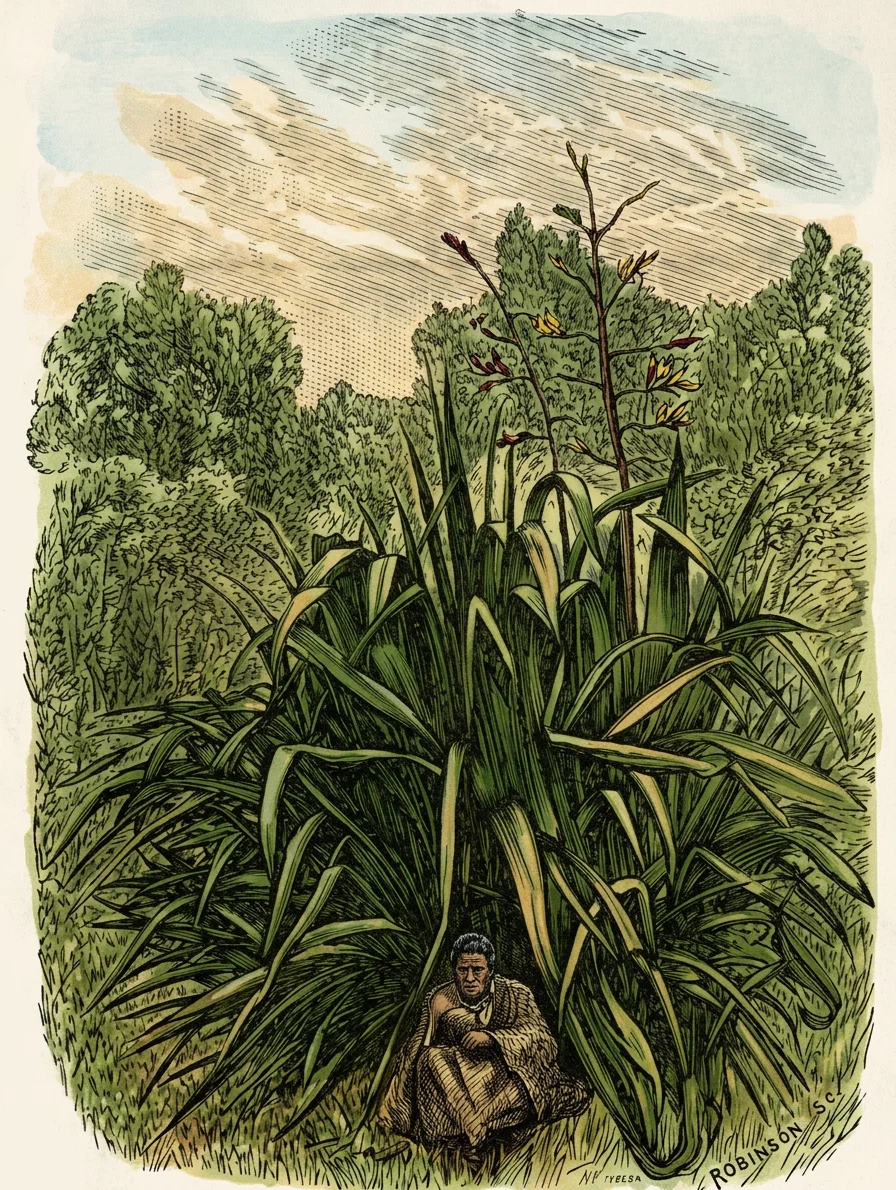
THIS week the artist has furnished us a picture of the Maori flax, which grows in low marshy land near the salt water, and attains a height of from ten to fifteen feet. The New Zealand flax is a natural product of the Colony, and it is the most valuable of all the plants which grow in that country. Its botanical name, Phormium Tenax, comes from two Greek words, phormos, meaning a basket, and tenax, meaning strong. It is sometimes called the lily flax.
The leaf varies in size from three to fourteen feet in length, and from one-half an inch to five inches in breadth. The plants grow in clusters; each shoot has five leaves, and there are on an average about ten of these shoots in one bunch. The leaves are perennial, hard, and sword-shaped. The flower stalk shoots up three or four feet above the leaves, and bears a profusion of yellow or sometimes red flowers, which are followed by triangular seed vessels filled with flat, thin, shining black seeds. It is said that in rich soil the flower stalk rises to the height of twenty feet. The plant becomes fully developed in three years, when it first flowers.
The plant is a native of the Norfolk Islands. It has also been carried to India and other countries, and it is said that it will grow on the Pacific Coast of the United States. It grows best in rich, moist, well-drained ground, and reaches great size on the banks of running streams.
When the leaves are full-grown, the natives gather them green, and separate the fibers. Four and a half tons of leaves yield about one ton of fiber. A full-grown plant will produce on an average about thirty-six leaves, and it takes about six leaves to yield an ounce of fiber. At this estimate, an acre of ground planted three feet apart, would yield about sixteen hundred weight of fiber; when cultivated, the yield is about two and one half tons per acre.
In some districts of New Zealand, flax forms the principal resource of the people, being exported in large quantities. Many men are employed in cutting and carting the raw material to the mills, where it goes through an operation of stripping, washing, and bleaching. This is done by men and boys who receive pay for their services at a certain rate per load. Those who prepare the flax for ropes receive wages at from $2.25 to $3.00 per week for boys, and from $3.50 to $4.50 per week for men, and these laborers furnish their own board and lodging. The preparation of the fiber and packing it for export is generally done by contract, and the ordinary price paid when the material is baled up and sent off, is $6.00 per ton.
The condition of the flax industry at present is not very satisfactory, for the English have discouraged the use of this flax in making their ropes, since it interfered with their home manufacture. But some mills have turned out a fiber which produces a very superior quality of rope. Oftentimes vessels are moored to the wharf by these ropes; and it is said that in a severe storm which occurred a few years since, all the vessels fastened to the wharf broke from their moorings except those secured by ropes made of this flax. New Zealand flax was generally supposed to be the strongest fiber in the world; but recent experiments with testing machines show that while it is double the strength of ordinary hemp, it is not so strong as silk. The table given is as follows: Silk bears a strain of 34 pounds; New Zealand flax, 23 pounds; European hemp, 16 pounds; European flax, 11 pounds.
Restored with AI
A very excellent paper may be made from this fiber. Those who are too poor to make their whares, or houses, of the sort described in the INSTRUCTOR a few weeks since, cover them with this flax. They do not prepare the flax in the least, but simply dry it and place it upon their houses. It also furnishes the walls of their whares; and when it is crowded together, even the air cannot penetrate it. The fiber is also used for clothing. It is slit up into fine shreds, and so woven together as to form a mat, and is made into long robes which are hung over the shoulder, covering a large portion of the body. These are very expensive. It is also used in the manufacture of baskets; and you often see the Maori children carrying their books to school in some not so very different from those used by some of the INSTRUCTOR family. The pulp of the stalk is used for food; so it can well be said that the flax furnishes them food, clothing, and a covering for their houses, besides rope and numerous other things. It is therefore a very useful plant among the Maoris, and the English people who live on the island. As will be seen by the picture, the phormium tenax, or flax plant of New Zealand, is very unlike the flax of this country. It is not so plentiful upon the island as it was formerly, but is still sufficient to supply the present demand.
S. N. HASKELL.