By looking at the map of New Zealand, it will be seen that Wellington, the capital city, is situated on the southern coast of the North Island. This city is second in size in the country, and contains about forty-five thousand inhabitants. It was in 1839, before New Zealand had become an independent colony, that the site for this city was selected, and in the following year a company of settlers arrived.
The citizens of Wellington are proud of their harbor, and perhaps justly, as it is a most magnificent one. Entered by a narrow but deep channel, it spreads out into a spacious sheet of water, where the largest ships can ride safely, and may advance to load or unload to the very streets of the town. The city is built along a strip of land lying on the bay, which has principally been reclaimed from the sea by the efforts of the citizens, thus gaining a level tract of ground upon which the business part of the city is located.
To get a good idea of the city, one should ascend the hills back of it, where a most excellent view of the city and the surrounding country may be obtained. In Wellington and its suburbs are many fine wooden buildings, as also at the present time many brick and stone structures, though the latter have been erected within a few years. The liability to earthquakes formerly deterred the people from making use of brick and stone; but as there have been no shocks for many years, an ordinance has been passed forbidding the erection of wooden houses within prescribed limits. The Government Offices comprise what is said to be the largest wooden building in the world. The Parliament Buildings are immense structures also. The large Museum will interest the lover of the curious. In this is a very large Maori house, built by a tribe renowned for their skill in carving, being a perfect specimen of the Maori art. The Botanical Gardens cover about a hundred acres back of the city, and are well stocked with the flora of New Zealand. In a little suburb called the Hutt, is another garden, which illustrates the facility with which plants from every latitude and longitude accommodate themselves to the genial New Zealand climate.
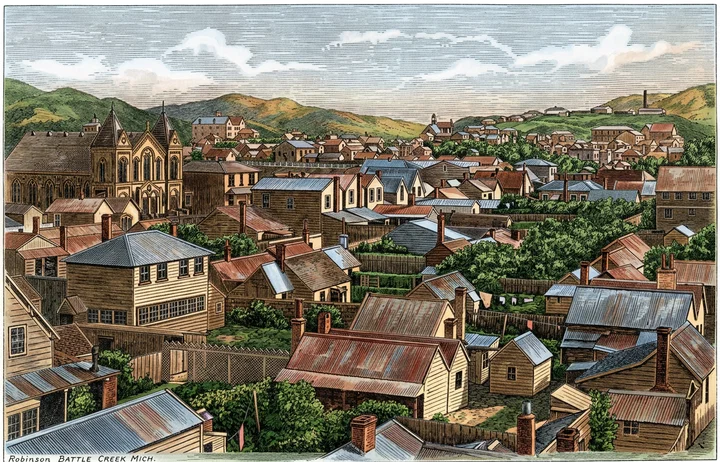
About sixty miles northwest of Wellington is Masterton, connected with the capital by a railroad which winds over mountains and through tunnels, the highest elevation being 2389 feet above the sea. Between two of these tunnels, is a space called “Siberia,” because of the severe gales which sweep through it. Sometimes the wind has thrown the cars from the track, but precautions have since been taken to render the road perfectly safe, although when riding, you are reminded of the place by the rattling of sand and pebbles, as they are driven by the wind against the windows. This railroad exhibits great engineering skill in its construction, and well pays the visitor for the time spent in making the trip.
Many spacious churches rear their heads above the town, the Catholic Cathedral being the largest. Extensive shipping trade is carried on, and the wharfs present a scene of activity, very commendatory to New Zealand enterprise.
To the student of New Zealand history, this locality has many interesting features, as the scene of numerous conflicts between the various tribes, and also between the natives and the early settlers. The entire province of Wellington covers an area of about seven and a quarter million acres, and abounds in rich pastures and valuable forests. S. N. HASKELL.