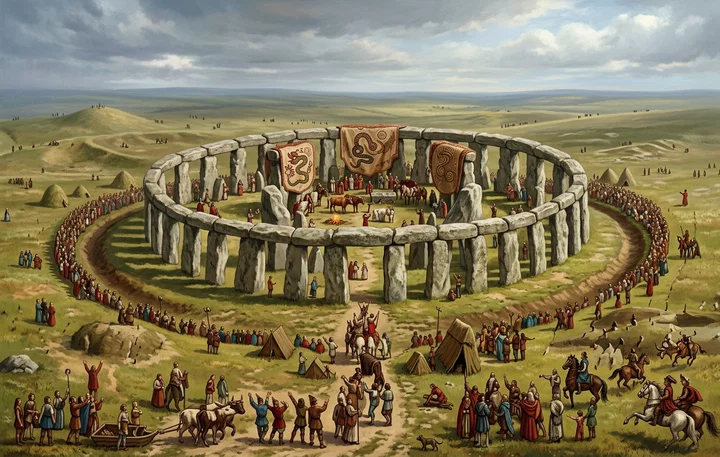
On Salisbury Plain, in Wiltshire, England, are to be found some interesting ruins. Scattered about over the plain are huge stones that appear from a distance like an irregular mass, but which, on closer inspection, we can see were once arranged in two ovals inside two circles. Mammoth great stones they are, of such weight that they could not possibly have been brought to this place and set up without the aid of some ingenious machine. The storms of many centuries have beaten upon them, yet some of their sharp angles, tenons, and mortises are well preserved. The ruins still go by their old Saxon name,—the Stonehenge, or “hanging-stones.”
As one views these immense stones brought together with a great outlay of mechanical skill and labor, he can but wonder what called forth the effort. Very probably they are the remains of an old temple of the Druids. The ancient Britons, who peopled these isles at the time they were visited by the ships of the Phœnicians many years before the birth of Christ, had a very strange and terrible religion, known as the religion of the Druids. Where they learned it, it is hard to find out, but it seems to have been brought from France. They worshiped the sun and moon and the serpent, and their rites were a strange mixture of the ceremonies performed to the gods and goddesses of other heathen people.
This religion was presided over by priests called the Druids, who kept many of their ceremonies a profound secret from the common people. Just what these ceremonies were we do not know, but it is certain that human sacrifices were often mingled with those of animals, and that on particular occasions both men and beasts were burned together alive in wicker cages! Suspected criminals were generally the ones offered in these sacrifices.
The priests held the oak in great veneration, and beneath its deep and sacred shades they instructed their pupils in their mysterious arts. As all the instruction was given orally, sometimes twenty years elapsed before a disciple finished his course. The Druids made and executed the laws, and were exempt from taxes; so it is not to be wondered at that the people readily believed that the more Druids there were, the better off the country would be, nor that their ranks were constantly replenished by the British youth.
The priests were better educated than the common people, and consequently exerted great influence. They prepared many remedies from plants, by which they healed the sick and wounded. And so miraculous seemed some of their cures, that they had no difficulty in making the people believe them to be enchanters and magicians. As the compounding of the medicines was a secret among the Druids, they did not run much risk of losing this reputation.
The mistletoe, a little plant with white berries, that grows on the oak, was considered very sacred by the Druids. When the little berries were fully ripe, the priests, dressed in white robes, ascended the oaks, and with solemn ceremonies cut off the mistletoe with a golden sickle.
But by and by people from other lands sailed in their little ships to the sea-girt isle, and settling among the Britons, taught them about the true God, and that to serve him as they ought they must love their neighbors as themselves, and do as they would be done by. The Druids lifted up hands of holy horror at this doctrine, and told the people that if they believed it, all manner of evil would befall them. They cursed the people heartily for listening to it. But when the people found out that they were none the worse for the curses of the Druids, and none the better for their blessings, they forsook their old religion, and from that time the ranks of the priesthood began to decline.
In our picture we see Stonehenge as it is supposed to have looked when the Druids worshiped there. At the present time there are not more than eight of the great stones left standing, but many fragments of others lie scattered about. Hillocks of earth here and there on the plain have been found to contain parts of altars, bones, and other remains that go to prove that here the Druids once offered sacrifice.
W. E. L.