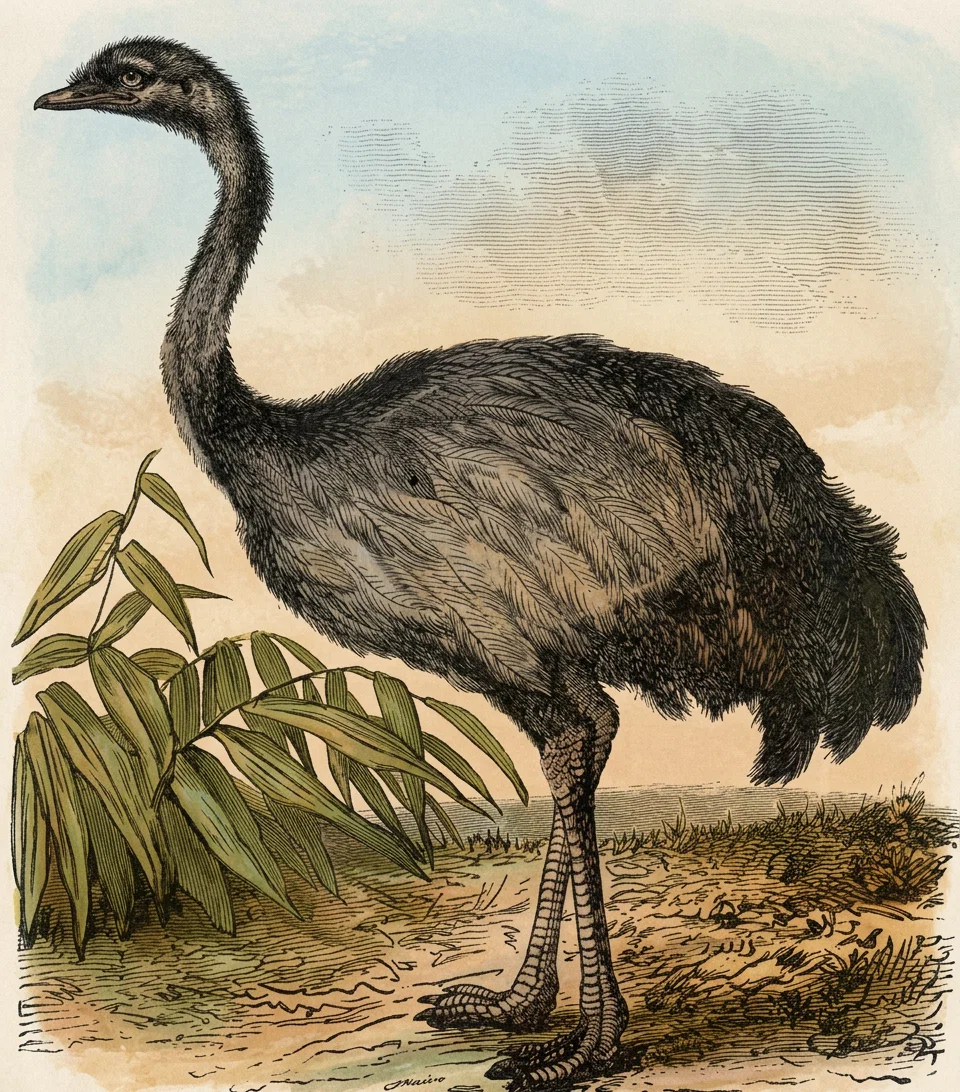
THE ostrich is a native of the sandy deserts of Africa and Arabia, and is the largest of birds, the male being about eight feet in height to the top of his head, and weighing some three hundred pounds. The plumage is glossy black in the male, and gray in the female; the wings are adorned with two rows of beautiful white feathers, and the tail feathers are also white. The muscles of the wings are very small and useless, but those of the legs are of prodigious strength, so that it not only “scorneth the horse and its rider,” but can strike a blow with its foot that often causes death.
The male in captivity is very ferocious, and many men have been killed by them. Some are so fierce that if they see a man in the distance, they will charge after him, and if they cannot get at him, will throw themselves on the ground and beat their heads about in paroxysms of fury. When wild, they are correspondingly as timid, and disappear on the approach of danger. The cry of the male exactly resembles the roaring of a lion, for which it is often mistaken. While bellowing, its neck swells to four times its ordinary size. It is an intensely stupid bird. Job 39:14-18 tells us more about the ostrich.
In South Africa the ostrich is raised for its feathers. The breeding birds are kept in small paddocks, generally a pair in each paddock. The eggs are taken away as soon as they are laid, and placed in incubators to be hatched out. The eggs are not left, because the hen does not pay much attention to them, except to tread on them occasionally. The cock bird does the sitting. In their wild state the hot sand and sun do much of the incubating, and the male bird sits on them through the night. The eggs weigh about three pounds, and are equal to three dozen hen’s eggs.
Every eight months the birds are ready to be plucked. A sack is thrown over their heads, and they are placed in a specially prepared box, and made fast. Then they are stripped of all their wing feathers, and their tail feathers are also dragged out. The operation is very painful, and the poor bird plunges and kicks at every pluck. When finished, the bird is a sorry sight. The large white plumes are cut; they are too large to pull, being as thick as a pencil and growing deep into the flesh. A week after, the stumps are pulled out with pincers. This is much the same as having a tooth out, and the birds bleed profusely.
Restored with AI
The feathers are then sorted, washed, and starched, and sent to London. Here they are sold by auction, and then sorted again and sold to the modistes, who prepare them for the fancy stores. The feather is again fixed up, and made to suit some young lady’s hat, who little knows all the suffering and labor her feather has cost. The feather undergoes a great change in its descent from the bird to the hat. One never sees a whole plume in a hat, but the supposed feather is one made up of a number of pieces stuck together and curled.
The ostrich farmer is at the mercy of the ladies; if they take a fancy for feathers, his business is good, but if, on the other hand, feathers are not fashionable, the poor farmer has a hard time.