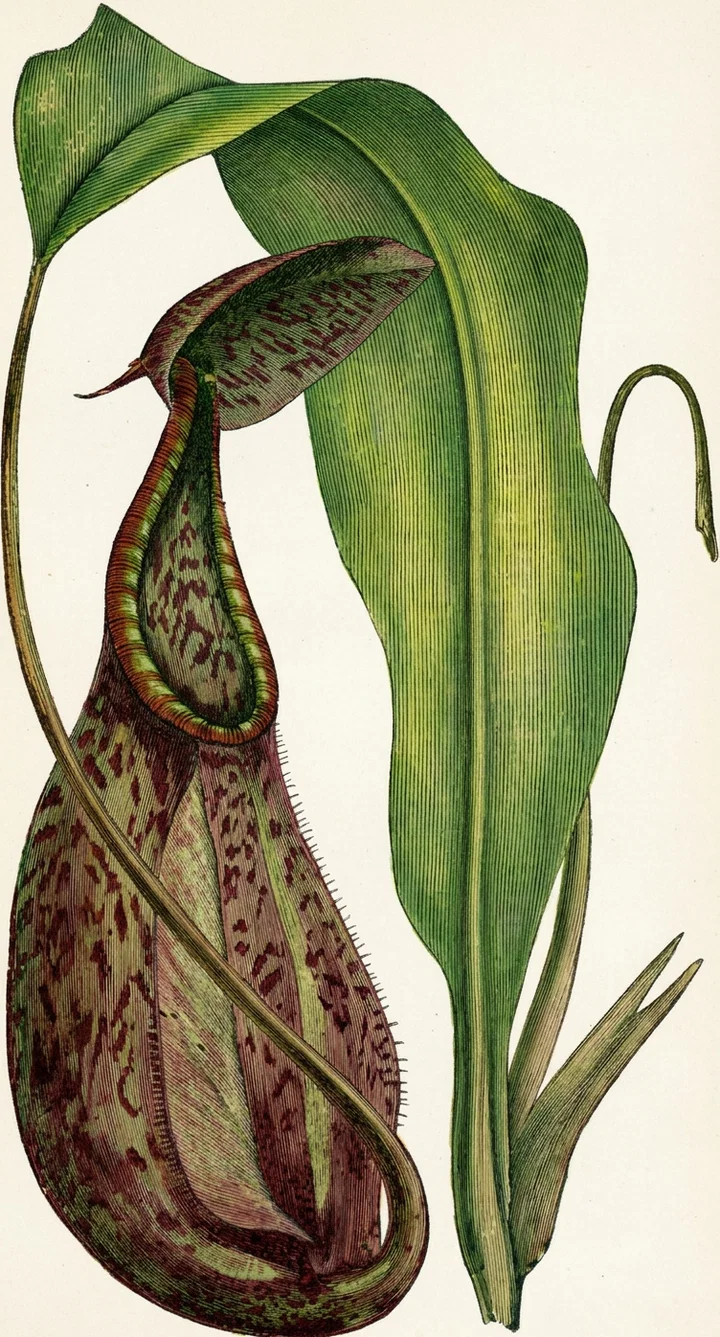
In some warm countries grows a plant with a very curious leaf. There shoots out from the stem a green blade, that looks like hundreds of other leaves; but at the top, the leaf runs out into a little tendril by which the plant clings around other objects to support itself; and from the end of the tendril grows—a little pitcher! And yet the whole is only a leaf.
The pitcher has a little lid that shuts down tight when the leaf is fully grown. If you were to lift up this lid, you would find the pitcher half full of the clearest water. It could not have been caught in a rain shower, because the lid was shut tight. It must have been made by the plant itself, and have oozed through the inside of the pitcher.
Some kind of pitcher plants do not have a lid. But near the top of the pitcher there are a few drops of sweet honey. It is a bait Dame Nature has spread to catch unwary insects. They fly to get the honey, and then fall into the half-filled pitcher, and are drowned. After a time these insects disappear from the inside of the pitcher. Where do they go? The plant must have eaten them up. It seems to need these insects to help make it grow.
In our own northern bogs there is a pitcher plant, called the Side-saddle Flower. It is not quite like the other ones. The whole leaf is a pitcher. It is always nearly full of water and dead insects. But what the plants want of a pitcher full of water it is hard to imagine, for in the bogs there is plenty of water around the roots.
In Ceylon one of the pitchers on these plants hold as much as a tumbler full of water. The monkeys sometimes lift the lids and drink the water. For this reason the plant is called Monkey-cup. W. E. L.