THE GARDENS OF MELBOURNE

10%

S. D. A. Publishing Association · Battle Creek, Mich. · May 11, 1887

FromThe Youth’s Instructor, Vol. 35, No. 19.

Read the full edition
Restored with AI

THE GARDENS OF MELBOURNE.

Just before leaving Australia for America, via New Zealand, I visited the Melbourne Botanical Gardens in company with a friend. These gardens are situated about a mile and a half from the center of the city, the River Yarra forming the northern boundary. The gardens comprise an area of eighty-three acres. They are located in the Government domain, which covers an area of about three hundred acres, and in which stands the Governor’s residence and Government buildings. The garden has been under cultivation for forty years, and has been brought to a remarkable state of perfection. Four green, undulating lawns meet the eye, stretching many acres away, and covered with different grasses, principally what is known as Buffalo grass. This is often cut, and being allowed to remain on the ground, it forms a solid mat some three inches deep.
Trees, flowers, shrubbery, and plants, are gathered here from all parts of the world, and diversely grouped in the most artistic manner. There are about two thousand species of plants represented. In one portion of the grounds are two thousand varieties of ferns. We passed through the fern ground by a winding pathway, nine hundred feet long. Here, along the water course, and lining the pathway on either side, are hundreds of native tree ferns. These, together with the thousands of smaller native ferns growing luxuriously among them, form beautiful vistas all along the pathway.
A lake covering an area of about eight acres, with its surrounding rockeries, rustic bridges, and numerous islands, is a pleasing and picturesque sight. The islands are planted with various specimens of native and imported vegetation. Here may be seen the English water lily, the papyrus from the Nile, and many aquatic plants, among which water fowl of various species may be seen gliding about.
In the gardens are represented various portions of the world,—the jungles of India, rocky elevations, and our own Western prairies. Plants from the tropical portions of the world are found in hot houses, while those of the temperate zone are so arranged that a cool breeze fans them into lively activity. We here saw the old New England pine, a familiar face, indeed, in a land of strangers. We were informed that in some portions of the gardens were banyan trees.
Three rustic summer houses, built principally with colonial woods, are placed in various parts of the grounds for the convenience of the public. These are very artistically designed, octagonal in shape, and having gable openings at intervals around the walls.
One hundred and seventy different species of plants are cultivated for medicinal purposes, each variety having a metallic label placed before it, with a description of the plant. Large quantities of the roots and leaves of these plants are often distributed among medical students for experimenting in the manufacture of medicinal remedies. The whole garden is kept in neat order, and everything presents a fine appearance. Notwithstanding many men are constantly employed, there are many acres in an uncultivated state. The garden is thronged with thousands of visitors on Sundays and holidays, the lawns being crowded with the public, for whose benefit the institution is maintained not only as a resort, but as a school for useful and scientific information.
There seemed to be but one thing lacking to render the scene perfect, and that was the singing of the beautiful birds which are found in this part of the world and in China. In Sydney there is a collection of birds from all parts of the world, and could these, with their plumage resplendent in the sunshine, have been loosed in the gardens and permitted to fly about among the trees, warbling the praise of God, it would have seemed the nearest approach to Eden possible upon a sin-cursed earth.
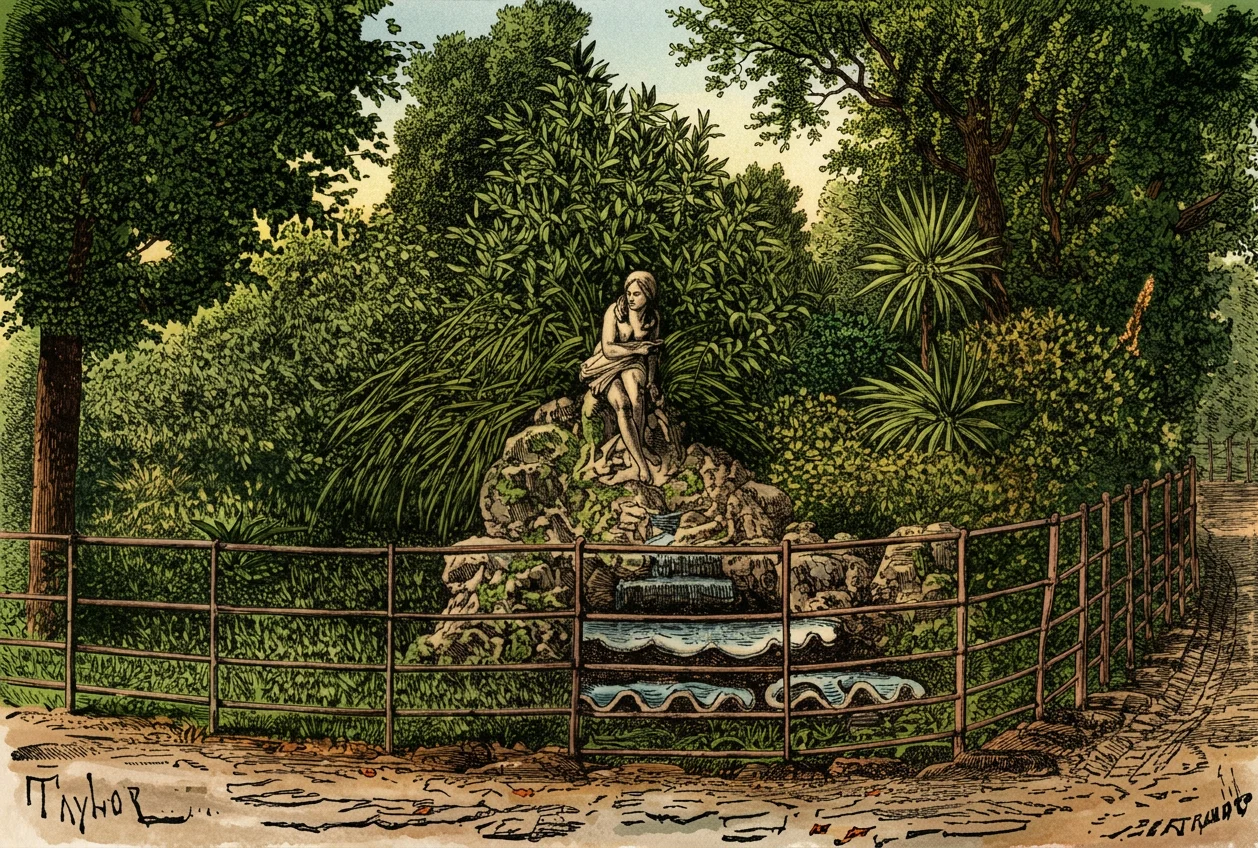
Melbourne has many other extensive parks and public gardens. Our picture gives a partial view of the Fitzroy gardens, which are “one dense network of avenues of oak, elm, and plane, with a ‘fern-tree gully’ in the middle. Casts of famous statues abound; ponds, fountains, rustic houses, and small buildings after the design of Greek temples give variety and beauty to the scene.” S. N. Haskell.