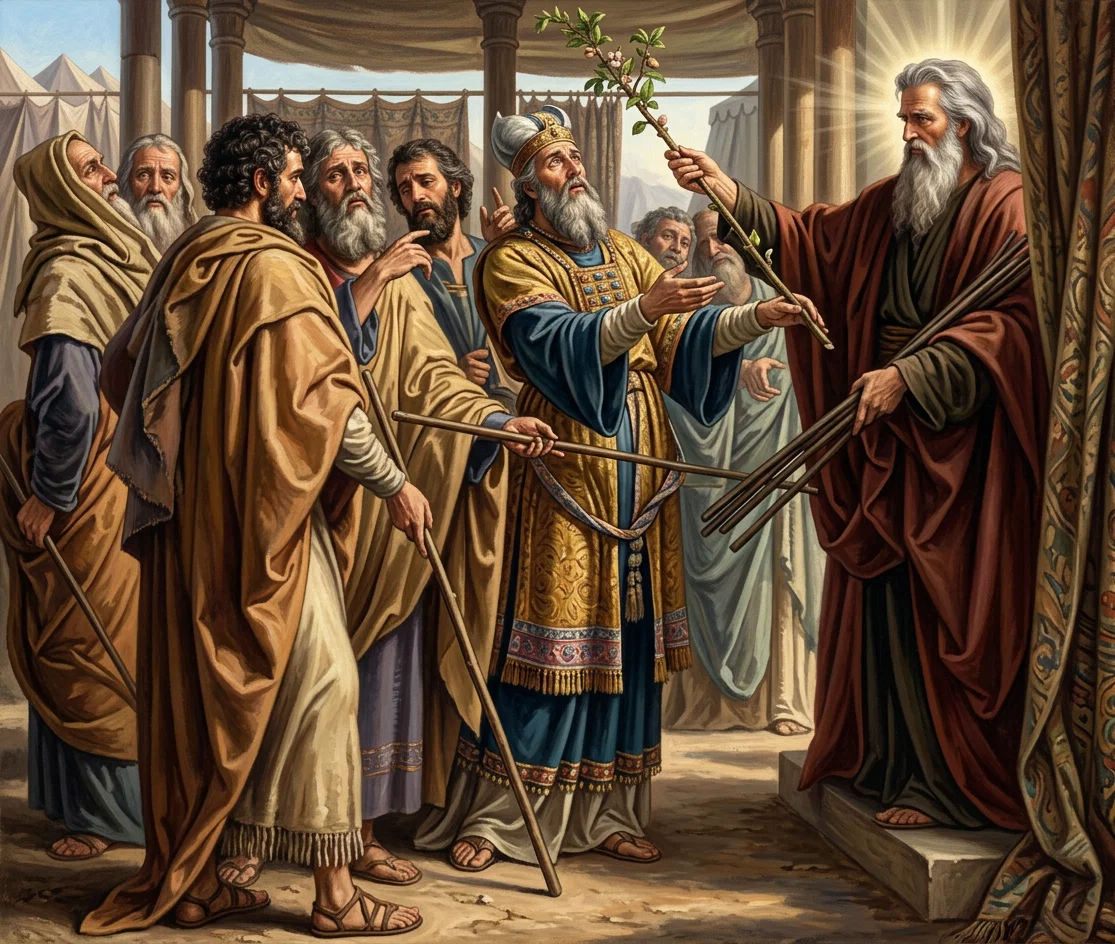
About twenty years after the children of Israel had left Egypt, while they were wandering in the wilderness, there arose a spirit of jealousy and murmuring about the priesthood. The Lord had long before settled this matter, and conferred the sacred office upon Aaron and his sons by “a statute forever.” But he again condescended to give the people another standing evidence that the priestly office was lastingly placed in the house of Aaron, and so cause all their murmurings about this matter to cease.
He therefore directed Moses that each tribe should take a rod, or scepter or staff, and write upon the rod the name of the house of their fathers. And the name of Aaron was to be written upon the rod of Levi. These twelve rods were then to be laid up over night in the great tabernacle of the congregation, before the ark containing the testimony, the ten commandments. And the Lord said that the man's rod whom he had chosen to minister in the priest's office, his rod should bear blossoms. “And it came to pass that on the morrow Moses went into the tabernacle of witness, and behold the rod of Aaron, for the house of Levi, was budded, and brought forth buds, and blossomed blossoms, and yielded almonds.” The Lord then directed his servant Moses to take the rod of Aaron, all filled with buds and blossoms and fruit, and lay it up near the ark as a memorial to take away murmuring and rebellion from the people.
In the illustration we see the miracle of the rod being placed before the head men of the tribes. Moses, with a nimbus of light about his head, is handing the wonderful rod to Aaron, who with delighted countenance is about taking it in his hands. The others, by their dejected looks, show their disappointment in the matter. Several have their rods; one has turned away to hide his mortification, and Moses has a number of rods still in his hand, which, as he returns them to the owners, will give the silent reproof that these persons are not the ones whom the Lord has chosen, and delights to honor.
In this miracle we may note several interesting things: 1. It is an honor even to great men to be employed in the service of God. 2. The Lord having previously wrought numerous miracles to punish sin, now works one more to prevent it. 3. When Moses was directed to prepare this test for the people, he did not object that the matter was already sufficiently settled, nor did he attempt to determine the controversy himself, but he did just as the Lord had bidden him. 4. The rod of Moses, with which he worked so many miracles, was not preserved, for the keeping of it would only serve to gratify men's curiosity. But the rod of Aaron, that which carried its miracle along with it, was carefully preserved, because that would be of standing use to convince men's consciences, to silence all disputes about the priesthood, and to confirm the faith of God's people in his institutions. 5. The Lord told Moses that the man's rod whom he had chosen “should blossom;” but lo! it did much more: it “brought forth buds, and blossomed blossoms, and yielded ripe almonds.” We may also note here that the buds of good desires, the blossoms of holy resolutions, and the ripe fruit of faith, love, and obedience, all spring from the priesthood of Christ the Lord.
It has been conjectured by learned men that the rods or scepters of all the tribes of Israel were made of the common almond tree, or amygdalæ communis. In favorable soil and climate this grows to some twenty feet in height, and is a beautiful appearing tree. The Jews still carry rods of almond blossoms to the synagogues on great festival occasions.
Restored with AI
Anciently it was customary to write inscriptions or names upon sticks or batons of office. Thus the prophet Ezekiel was directed to take two sticks, and write upon one the name of Judah and on the other the name of Ephraim. (Chap. 37:16.) A traveler in Sweden once saw several flat sticks, like straight swords, with Runic inscriptions on both sides. And the ancient Britons wrote verses on their staves or batons, which were made triangular or square according to the metre. It may also be interesting to add that the ancient heathens regarded it as totally impossible for a dry rod or stick to be endued again with life, and so they swore by their scepters, to confirm their oaths, after this manner:—
“But harken! I shall swear a solemn oath:
By this same scepter, which shall never bud
Nor boughs bring forth, as once; . . . .
And shall never grow again.”
This snatch of verse from the poet Homer dates as far back as King Solomon’s time.
Paul, in Hebrews 9:4, speaks of Aaron’s rod as being connected with the tabernacle. What became of this wonderful rod the Scriptures do not inform us. It may be that it was laid away with the sacred ark of ten commandments before the removal of the children of Israel down into the Babylonian captivity. But the history of this miracle will remain with the church94till time shall be no more. The Apostle Paul says “that the things written aforetime, are for our admonition and learning upon whom the ends of the world are come.”