It was so hard to be shut in through all the beautiful spring weather! That was what Annie thought, as she looked out of her open window, and saw all the world growing green in the bright May-time.
“O dear!” she said to herself, “I want to go out so much!” and the great tears rolled down her cheeks as she thought of the happy times she had had on other spring days. While she was crying and making herself a very miserable little girl, a gay little robin red breast hopped in at the window and sang, “Cheer up, deary; cheer up, cheer up.” At least, that was what Annie thought he must have said. She dried her tears to look at him.
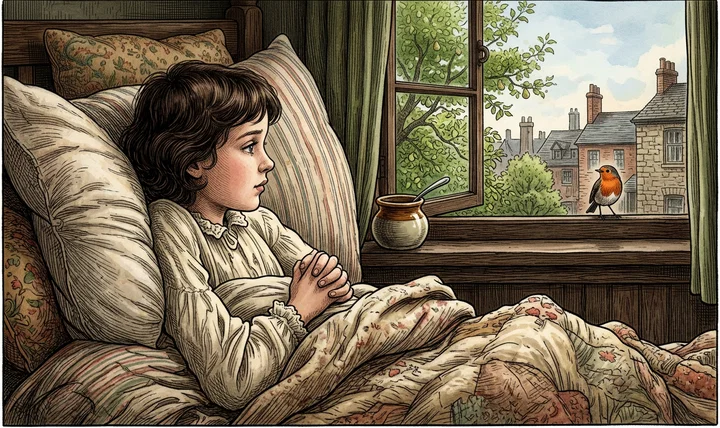
Robin turned his little head this way and that, and looked at Annie with his bonny black eyes. Then he flew down on the coverlet and began picking at the fringe. But as soon as Annie stirred, he was up and off. She saw him fly into the pear tree near her window.
Annie asked the hired girl to bring her some shreds and ravelings and some crumbs. She put these on the window sill, and then waited for robin to come again.
Next morning Annie was awakened by a loud, “Dearest, dearest; sweet, sweet,” and she saw robin and his mate breakfasting on the crumbs outside, and twittering earnestly over the bunch of ravelings. At last they took it to the tree. They were busy all day in bringing straw, dead grass, little sticks, and mud, with which to build their home.
“O mamma,” said Annie excitedly, “do come and see what the robins have done! They’ve put in a lot of white rags, and left the ends dangling in the wind.”
“I suppose the robins think it makes their home look more inviting,” said mamma, taking her sewing and coming across the room to sit by Annie.
“Why don’t they take more pains to weave in all the stuff?” asked Annie, after a pause.
“I don’t know, I’m sure,” her mamma replied. “It makes me think of a story I read when I was a little girl.”
“Do tell it!” said Annie, without taking her eyes from the nest.
“As the story goes, the birds at first did not know how to build nests; but at length a few birds that were quicker witted than the others contrived to make some. All the other birds admired them, and were anxious to find out how it was done. So the nest builders set a day for them all to come and be taught how to build a home. When the day arrived, there were robins and swallows, sand pipers, storks, eagles, crows, and every other bird you can think of.
“The magpie began by telling them how to choose a safe place in the top of a tall tree. But one little sand martin, who was a conceited fellow, wanted the other birds to think he knew without being told. So at every pause the magpie made, the sand martin piped in, ‘Certainly; of course—of course; anybody can see that!’ The jackdaw was troubled in a good deal the same way, and would echo what the martin said, adding, ‘I knew that before!’
“Some birds paid attention to the magpie, but the most of them grew so tired of the chatter of the sand martin and jackdaw, that the meeting broke up, and the birds all flew away. The sand martin had paid so little heed to the teaching that when he tried, he could not build a nest, and has always had to live in a hole in the sand. The foolish jackdaw can only throw a few loose sticks together; and most of the other birds have to live in houses without roofs, because they wouldn’t wait to find out how to put one on.
“Now,” continued mamma, “I must go and see to baby. In the story there is a nut to crack, but I shall leave you to find it for yourself.”
Annie knew mamma’s “nut to crack” always meant some moral or lesson for her to learn; and setting her wits to work, she soon found it. Can you tell what it was? W. E. L.