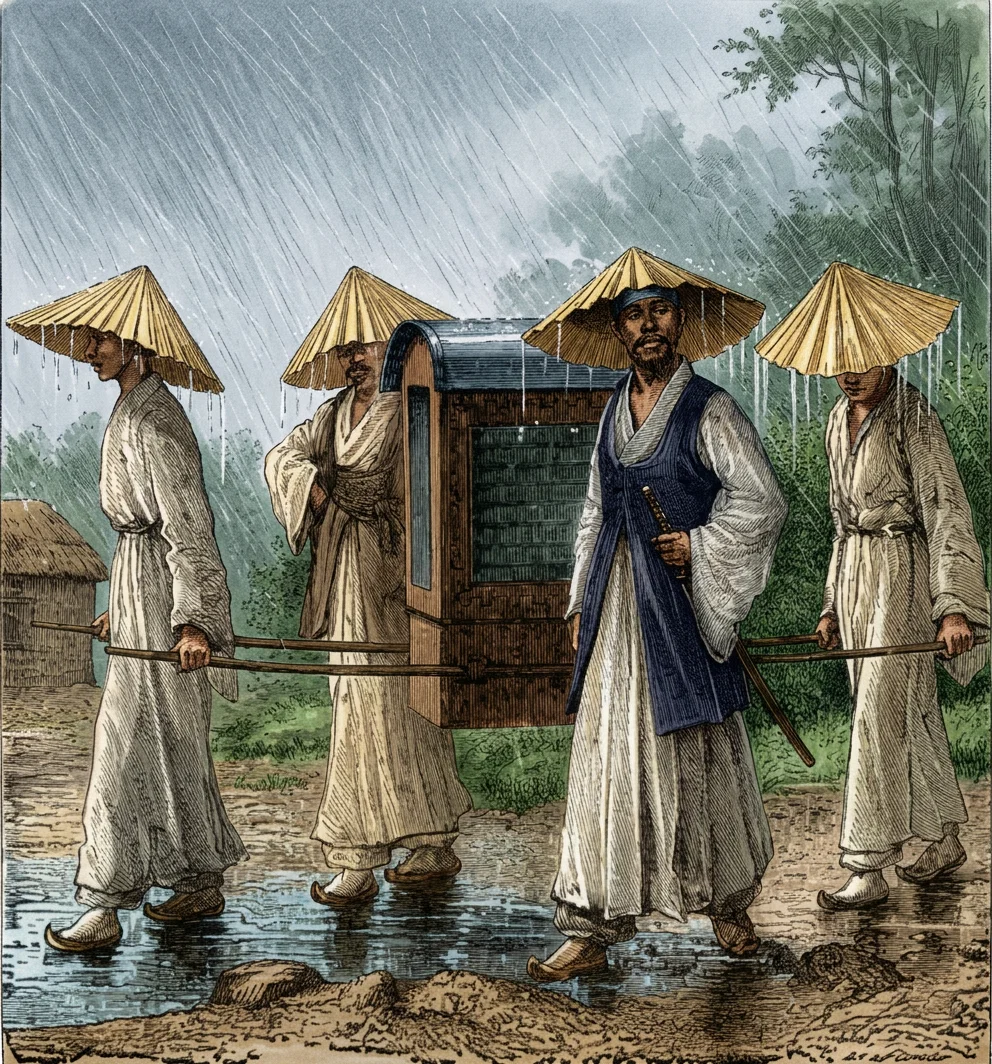
THE LAND OF HATS

6%

S. D. A. Publishing Association · Battle Creek, Mich. · Jun 8, 1887

FromThe Youth’s Instructor, Vol. 35, No. 23.

Read the full edition

THE LAND OF HATS.

“Oh dear!” sighed Lucy, as she came in from school one rainy day, with her dinner pail on one arm, her books slipping out from under the other, and her umbrella turned the wrong side out. She was a very bedraggled, discouraged-looking little girl.
“I do wish,” she said, as she gave her hat a little fling up on the hook, and went to hang up her rain cloak,—“I do wish somebody would make umbrellas to wear on the head.”
Lucy heard a low laugh, and turning quickly around, she saw her Uncle Hal sitting quietly in one corner of the room, watching her.
“I don’t care if you do laugh,” said Lucy, half-provoked; “you’d want an umbrella on your head, or something else, if you had had such a time as I have coming home from school. Just see the cover of my new reader; it’s all wet and spoiled, and I had taken so much pains to have my books look nice!”
Restored with AI
“It is too bad to get a new book spoiled in that way,” said Uncle Hal, looking sober. “I wasn’t laughing because you got wet; I was only thinking how queer you would look in one of the umbrella hats I have heard of.”
“An umbrella hat!” exclaimed Lucy, in open-eyed surprise. “I didn’t suppose anybody ever had such a thing.”
“Yes,” said Uncle Hal; “the Coreans wear umbrella hats. If you will bring me your geography, I will show you where they live.” So Lucy brought her geography, and helped Uncle Hal search for that unheard-of land.
“Ah, here it is,” said he, after letting Lucy hunt for it awhile. “A little peninsula in Eastern Asia, off the northern part of the Chinese Empire. It is often called the “Hermit Nation,” because the Coreans traveled nowhere themselves, and would let no one visit them. Seoul is its capital. Here it is,” said he.
“But about the hats,” interrupted Lucy.
“Oh, yes,” said Uncle Hal. “We may call Corea a land of hats. There are outdoor hats and indoor hats, wedding hats, and army hats, and hats for almost everything you can think of. Their rain hats are made of fine bamboo splints woven together with silk or horsehair. The rain runs down the drooping sides, and drips off as it would from a roof. But there is one bad thing about the hat,—it will leak. The rain beats through the bamboo; and when the sun comes out, it flickers through the poorly woven affair, and altogether gives the wearer considerable discomfort; so that it is not a very good umbrella hat after all. But since the Coreans do not have anything better, I suppose they are contented.
“But you would think the mourners had the queerest hats,” continued Uncle Hal. “These are braided out of straw, and are shaped like a huge round bowl. They are bright yellow, and come down over the head like a bushel basket, so that you can see nothing of the wearer’s face, as he solemnly paces down the street. The mourner’s clothes are made of a coarse, yellow-gray cloth. He often holds a piece of this cloth, stretched on bamboo sticks, before his face, so as to hide himself more completely.”
“I shouldn’t think that would be very pleasant,” said Lucy.
“No,” replied Uncle Hal; “but that isn’t the worst of it. For three whole years, he must wear ragged clothes; and he must not visit, or go about among his friends. In fact, he must make himself as nearly like a dead man as a living man can.”
“I do not see much sense to that,” said Lucy.
“I don’t suppose there is,” said Uncle Hal, rising as he heard the dinner bell ringing through the hall; “but the Coreans worship their dead relatives instead of the true God, and that, I presume, is why they are so careful about their mourning customs.”
“Well,” said Lucy, “if I should have to wear a ragged yellow dress for three whole years, I think I would rather stay in this country and carry an umbrella that turns wrong side out.” W. E. L.