One needs but to study the habits of the tiny ant, whose acts display a degree of intelligence unparalleled in the insect world, to understand that it would require an eternity of years to fathom the mysteries of God’s created works. In fact, the study of this one creature’s life seems, of itself, almost an inexhaustible theme.
Naturalists place the ant in the order Hymenoptera, which includes those insects having “four naked, membranous wings, lying, in repose, horizontally upon the body, and intersected by a net-work of nerves.” The name of the order is derived from two Greek words meaning a membrane and a wing. Among the principal families of the order may be found the bee, the humble bee, the wasp, etc., all known as our most industrious and intelligent insects. There are very many species, each one, in some respects, bearing a resemblance to the others, which makes them easily distinguished from all other insects. Like the bees, they form a republic, with three classes,—males, females, and neuters, or workers, each performing his duties with commendable faithfulness.
If you will examine an ant, you will observe that first upon the head are two horny jaws, or mandibles, serving as tools with which they perform their labor. Next beyond them is their antennæ, bent in the shape of an elbow. Everything they meet is examined by means of their antennæ, and it is supposed that by the use of these organs, they communicate with their kind. Each insect has also three pairs of legs, and, with the exception of the workers, two pairs of wings. Their legs are fringed with short hairs, which they use freely in the care of their young, brushing off any dirt, and keeping the skin in a healthy condition.
Like the bee, the ant is an architect from birth, some species being capable of constructing the most elaborate dwellings. All their homes are thronged with communities of social, law-abiding citizens. The nests of the various species differ both as to form and the materials of which they are composed; but they are principally made of leaves, earth, etc.
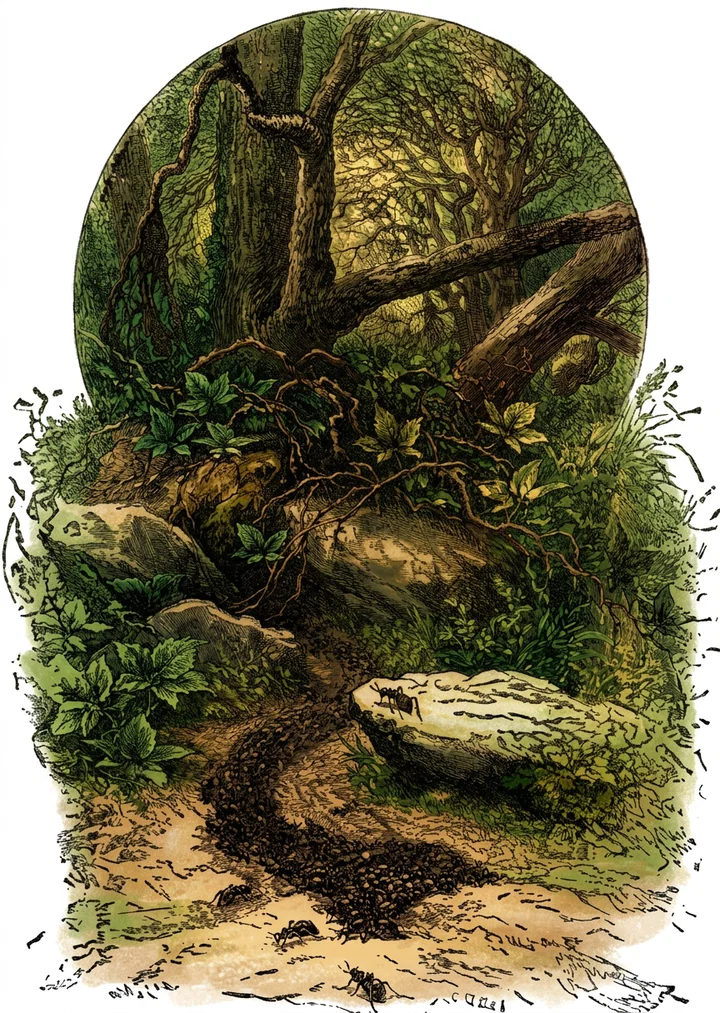
In the construction of its home, the common red ant of the woods first makes a slight hole in the ground, which is at once hidden by piling bits of leaves, earth, dead insects, and the like, over it. Afterward it proceeds to hollow out, beneath the surface, story after story of chambers, galleries, and spacious rooms, carrying the refuse outside, so that at the same time the inside of their house is being enlarged, the outside edifice is rising in equal proportion, sometimes to a height of fifteen inches above the ground. During the day, except upon rainy days, the entrances to their homes are left open; but at night they are carefully guarded against all intruders. The great ants of tropical countries build remarkable edifices on a more extended scale.
As a general rule, ants live very peaceably among themselves, setting us an example worthy of imitation in their kind care for each other, particularly for their young and the unfortunate. If but a raindrop falls upon the children, or a little too much heat from the sun, the whole family hasten to transfer their little ones to a more favorable location. Even the big children, which weigh as much as themselves, are carried from place to place with untiring devotion.
Ants will eat almost anything, but are particularly fond of sweets. Those of our temperate climate are not capable of making honey themselves, but they lick the sweets which ooze from the surface of certain grubs and lice. Find in your gardens vegetation which is covered with lice, and you will invariably discover ants busy at work on the plants. One might think they would injure the plant; but by close observation it can be seen that their business is with the lice. The microscope reveals them in the act of sucking honey from the lice, from which circumstance the lice are called the ants “cows.” The ants transfer these honey-producing grubs to a pasture, which they inclose with twigs and bits of earth, and ever after give them great care, feeding them with their favorite food. At regular intervals the ants may be seen, busy as a farmer, milking their herds.
Perhaps no creatures are more persevering than ants; and although in their endeavors to carry great objects they may stumble and fall, sometimes great distances, yet they cheerfully return to their tasks, which, it is said, they always accomplish. It is well to “consider the ant’s ways,” deriving all the good we can from them; but if, like human beings, they have some imperfections, we need not pattern after these. It is reported of some species that they keep slaves to do their drudgery; this certainly is not a very commendable characteristic in any of God’s creatures.
A celebrated naturalist describes a raid once made by a species of red ants upon a domicile of black ones, to subjugate them. The red ants performed their military operation with such strategy that the blacks were completely terrified, and in spite of their best efforts at self-defense, three hundred blacks were captured by five hundred red ants; and what is most surprising, the work was all accomplished and the theft made in less than ten minutes.
We haven’t space to make a beginning of what you would like to know of this family of insects. You should read books upon the subject, and learn of the ant to be wise and diligent. We will close the article with what a gentleman once observed of ant sagacity. It is recorded as follows:—“Dupont de Nemours relates in his Memoirs that, to guarantee his sugar-basin against the invasion of ants, he had found no better plan than to make it ‘an island,’ that is to say, to place it in the middle of a vessel full of water. He felt sure that he had made the fortress safe against any attack; but listen to the stratagem made use of by the besiegers. The ants climbed up the wall to the ceiling, exactly perpendicularly over the sugar-basin. From there they let themselves fall into the interior of the place, penetrating thus by main force, and without injuring any one, into the magazine. As the ceiling was very high, the draught caused them to deviate from the straight line, and thus a certain number fell into the fosse of the citadel, that is to say, into the water in the vessel. Their companions stationed on the bank made all efforts imaginable to fish out the drowning ants, but were afraid of taking to the water of such a large lake.p. 102 All that they could do was to stretch out their bodies as far as possible (keeping on the bank the while), to lend a helping hand to their drowning friends. Nevertheless, the salvage did not progress much; when the ants, which were getting very uneasy, conceived a happy thought. A few were seen to run to the ant-hill, and then to re-appear. They brought with them a squad of eight grenadiers, who threw themselves into the water without any hesitation, and who, swimming vigorously, seized with their pincers all the drowning ants, and brought them all on to terra firma. Eleven, half-dead, were thus brought to shore, that is, to the rim of the basin. They would probably all of them have succumbed, if their companions had not hastened to lend them assistance. They rolled them in the dust, they brushed them, they rubbed them, they stretched themselves on their dying companions to warm them; then they rolled them and rubbed them again. Four were restored to life. A fifth half recovered, and, still moving its legs and its antennæ a little, was taken home with all sorts of precautions. The six others were dead. They were carried into the ant-hill by their afflicted companions. It seems like a dream to read such things as this, and yet Dupont de Nemours tells us, ‘I have seen it!’”
M. J. C.