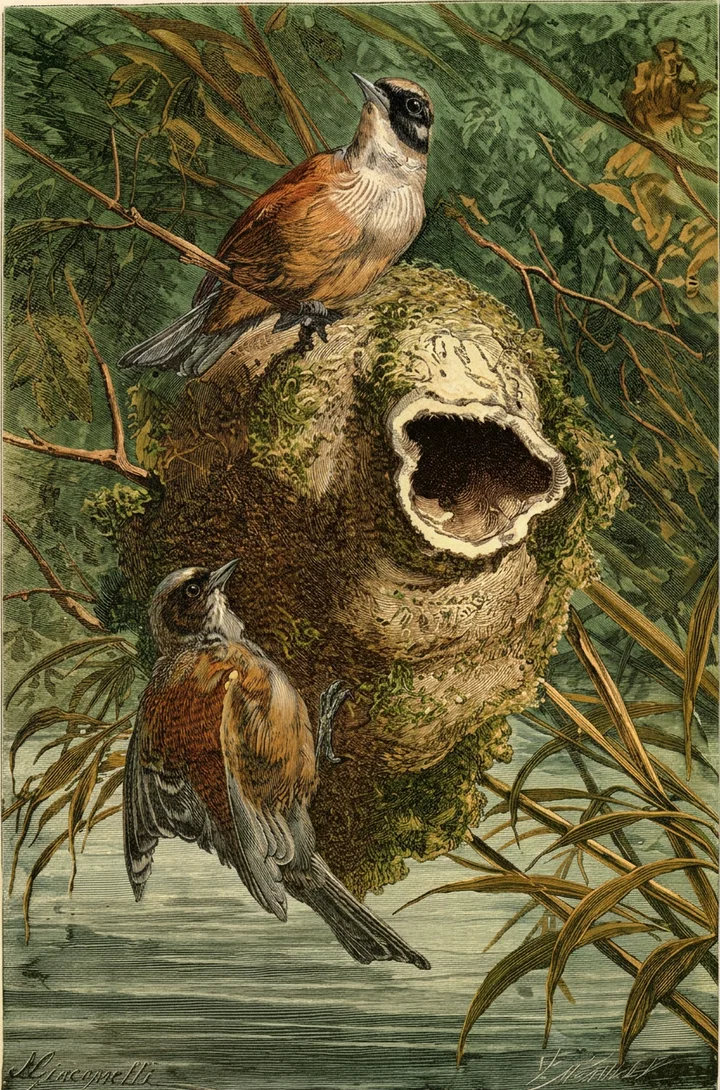
THIS familiar mite of bird life, more commonly known as the chickadee, is found throughout nearly the whole forest region of North America. Its relatives, the titmice, in general numbering over fifty species, are found in all parts of the world, South America and the islands of the South Pacific excepted. Those within the tropics are found mostly in cool mountainous districts. Our cut represents the penduline titmouse of Southern Europe, with its very ingenious nest, “which in form resembles a flask, and is generally at the end of a flexible twig, in a situation near to or overhanging water.”
All the birds of the order are small, yet bold and sprightly, flitting from branch to branch, running to their very extremities, chattering and tumbling in industrious search for insects and their larvæ. We do not know another bird so easily approached, within reach of one’s very breath even, as the black-capped titmouse during nine months of the year; yet throughout the nesting season it is more shy, retiring usually into the most secluded depths of the woodland. They are the constant companions of the lumbermen in the great pine woods, and make themselves familiar with all who work in the wintry woodland, as every country boy knows who has split wood or “rossed” stave bolts in winter.
They seem to prefer animal food; and after watching a trio of them for a few minutes, one would conclude that if any skulking thing was to be found anywhere, they would find it. Through and through the bristling brush heaps they flit, in and out of the loose piles of wood and staves, under every careless bark, and into every cavity that will admit their tiny, active bodies. No spot seems to escape the scrutiny of their searching dark eyes; and if they were a hundred times as large, it often seems that they could still live on the fruits of such persistent and long-continued plunder. A stark, corpse-like worm or larvæ about an inch in length seems to be the chief object of their search at such times, and they pull them forth from their lurking places with but little time for argument, and swallow them with a very evident relish. They do not scruple to search the lunch basket and try the sandwiches, and in one instance at least came so near at lunch time as to be struck dead with a table knife.
We recently had occasion, one early May morning, to walk past a thicket of prickly-ash and other shrubs bordered by an old lichen-covered fence; and though it was raining drearily, and most other birds were in safe retirement, we noticed a pair of these little black-capped fellows coursing along between the rails of the fence, eying every crevice, and peering under every splinter and loosened bark, yet in order to do so, they they often had to cling with heads downward to the rail above them. Though at times several yards distant from each other, they kept up a constant whispered conversation, varying it in loudness to suit the distance. They seemed, however, to find but little among the dry old rails to encourage them in their search, and would in spite of the rain fly out occasionally upon the neighboring bushes, shaking down a shower of raindrops in so doing; but they would as often return, for their search in the rain seemed almost fruitless. Finally, when separated at least a rod, one of them succeeded in pulling out one of those white larvæ so tempting to the chickadee’s palate; but instead of eating it himself, he carried it to his mate, who devoured it forthwith with a show of thankful pleasure such as only a bird can manifest.
Though the well known “chick-a-dee-dee” is its usual note, this bird produces a variety of sounds. It has a cry peculiar to the warmest, sunniest days of winter or early spring-time, which, transcribed into English, sounds like a long drawn Pee-dee or Tee-tee, with a circumflex. This from some high perch it repeats again and again with great resonance, and a musical, cheery call it is, always betokening the approach of May time.
While in the woods during their nesting season, we have heard this cry repeated responsively and with a most charming effect, the male, we suppose, uttering the call first, and the female, at a distance of a hundred yards or so, responding with such regularity as exactly to simulate an echo.
The untiring energy of the bird finds full exercise in the construction of a home and the care of eggs and young. Its nest, unlike that of the European species in the cut, is usually built in some hollowed stump or decayed tree previously used for a similar purpose by some other bird or a squirrel. It is said, however, that with great labor it sometimes excavates such ap. 122 nesting place for itself. The eggs are usually six in number, of the purest white, but flecked with minute specks of red. Two broods of young are produced each summer, the first about the beginning of June, the second toward the end of July.
Among those conversant with bird life, it is well known that the cow-pen bird, or cow bunting, never builds a nest of its own; but after stealthily depositing its eggs singly in the nests of smaller birds, it leaves them then wholly to their care. These buntings, we ought perhaps to add, are the brown or dingy black birds that associate with the red wings, but are not infrequently seen in company with herds of cattle or flocks of sheep, often perched upon the backs of the latter, and leisurely riding about. Once, by accident, we broke the top from a decayed stump, frightening therefrom a chickadee whose nest we had thus unintentionally broken up. Looking it over carefully, we found two unfledged chickadees and one unhatched egg; but in pulling the nest apart, we found the lower portion to be an exact counterpart of the upper, and containing the solitary, unhatched egg of a bunting, full twice the size, and differently marked, from that of the chickadee. Evidently the titmouse had built both nests; but on completing the first, and before depositing any eggs therein, the bunting had without invitation or assent of the chickadee, left the offending egg for the plucky little bird to care for. Right here she found her mistake, if indeed like most careless people she ever concerned herself about mistakes; for Mrs. Chickadee, uniting tact with her pluck, built nest number two right in the first and upon the offending egg, and thus saved all possible trouble with a young bunting,—trouble in which other birds with less brains but more feathers often find themselves involved.
“The Black-capped Titmouse,” says Wilson, “is five inches and a half in length, and six and a half in extent; throat and whole upper part of the head and ridge of the neck, black; between these lines a triangular patch of white, ending at the nostril; bill, black and short; tongue truncate; rest of the upper parts, lead colored or cinereous, slightly tinged with brown; wings edged with white; breast, yellowish white; legs light blue; eyes dark hazel. The male and female are nearly alike.” GEORGE R. AVERY.