HARRY was having a fight—a fight with himself. The good and the bad were fighting together for the mastery, and it was hard to tell which would come off conqueror.
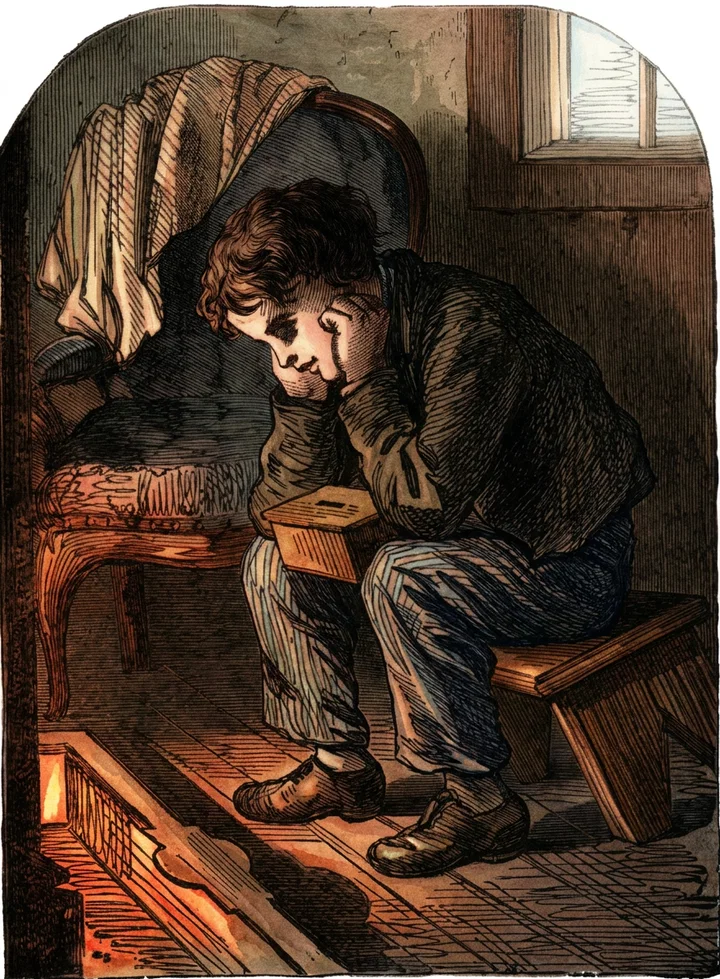
Harry sat before the open grate, in which a low fire was burning, and he held his money box on his knees. In the money box were bright pennies and nickles and dimes, that he had been saving for a long while. He liked to save his money; and, I am sorry to say, he was such a selfish little boy that it was very hard for him to give any of it away. Besides, he especially wanted to save it now, because he meant to buy a bat and ball, and he had almost money enough.
Harry hardly ever put more than a penny into the contribution envelope at Sabbath-school; sometimes he did not put in even that, though he often earned many pennies during the week.
Deep down in his pocket, under marbles, broken jack-knives, tops, and strings, lay a tarnished dime. It had had a hole drilled in it once, but this had been cleverly filled with lead; and now that the dime had lost its first brightness, this no longer showed. Like a great many other stingy people, Harry was anxious to be thought generous. When the rest of the boys gave their donations to the teacher, Harry imagined they laughed at him because his was no larger, though I don't suppose the boys thought anything about it.
“Now,” whispered the bad voice at Harry's elbow, “you needn't take any money out of your box. There's that dime in your pocket; just put that in. The boys won't be near enough to see the hole, and if they did, you could put your finger over it; and the teacher will never know, when she counts the money, which one gave it.”
“For shame!” cried the good voice on the other side. “It is wrong to give that which is of no use to you.”
“No one will know,” urged the bad voice.
“But you will know,” said the good voice. “You will know you cheated.”
“Pshaw! what of that,” replied the bad voice, “when you want that new bat and ball? May be they'll be gone before you can get enough money saved.”
“O dear!” sighed Harry. “I think I cannot take out any now. I'll put the box up till after supper.”
In Harry's home they were in the habit of reading a chapter from the Bible every evening, and they all took turns reading a verse or more apiece until the chapter was finished.
Grandpa took down the large family Bible this evening, and opened to the place; it happened to be the first chapter of Malachi. He talked some about the prophet and the people who lived when this book was written, so as to make it plain to Harry and the other children. Then they began reading. The eighth verse fell to Harry, and he read, very slowly, these words:—
“And if ye offer the blind for a sacrifice, is it not evil? and if ye offer the lame and the sick, is it not evil? offer it now unto thy governor; will he be pleased with thee, or accept thy person? saith the Lord of hosts.”
Then Harry thought again of the worthless dime. The bad voice was far away, and the good one whispered loudly in his ears, “It is a bad sacrifice; do not give it. The eyes of the Lord are in every place, beholding the evil and the good. He will see, if your teacher does not.”
And I am happy to say that Harry listened to the good voice; for the bad dime never went to Sabbath-school at all. Harry threw it so far away that he could not find it, and be tempted with it again; and in its stead a new, shiny one found its way into the contribution envelope.
Harry did not grow generous all at once. It took a long while for him to become willing to give; but I fancy he found it easier after he had had this battle with himself, and had conquered. And I wonder if there are not other boys and girls who would do well to remember that the Lord is displeased when we bring him lame sacrifices: but that when we give anything to him, it should be of the best we have.
W. E. L.