No more can the inhabitants of Jerusalem with pride exclaim, “Let us walk about Zion, and tell the towers thereof!” for the strength of the Holy City has departed; the joy of the whole earth is laid low. The temple no more glitters in the morning sun, with its clouds from the altar of burnt-offering and its fragrant incense ascending as a sweet savor to Heaven. The stately towers and bulwarks are crumbling to dust, and rubbish fills the streets.
“No rich local coloring,” says a traveler, “brightens the outward aspect of the Holy City. A ruddy gray stone is the material basis of wall and roof; for the upper rooms being vaulted and the covering flat, the housetops are composed of the same material as the upright shell. A gilt cross gleams from a church; a silver crescent sparkles on a mosque; a belt of white colonnades adorns the Temple hill; a parapet of red tiles surrounds some of the high roofs; here a patch of mosaic quickens into beauty a modest dome; and there a palm tree waves its elegant fans against the azure sky. But these specks of color on the prevailing ground only serve to set the landscape in a lower key. A sky of variable tone, Sicilian in its usual depth of blue, yet English in its occasional wealth of mist and cloud, hangs over this mass of limestone roof and wall.”
Though the general aspect of the city falls below the glowing colors with which, in spite of travelers’ descriptions, we still invest the Holy City, we shall find that the novel scene which greets us as we enter the city gate, in some measure compensates for the disappointment. Jerusalem is laid out with more regularity than many Eastern cities. Two long streets run through it, crossing each other at right angles, thus dividing it into four quarters occupied respectively by the Franks, the Armenians, the Jews, and the Mahometans.
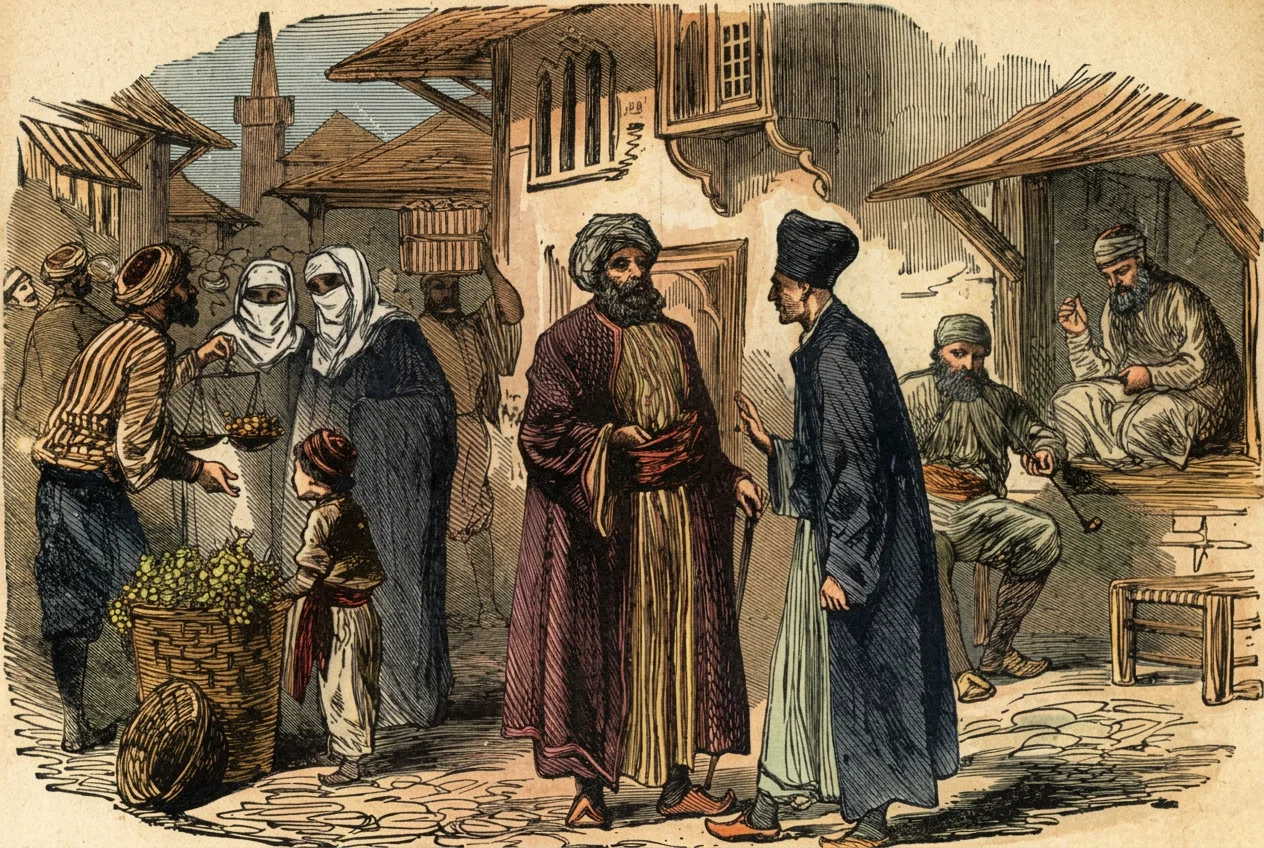
As we enter the walls from the East through the Jaffa Gate, the one through which travelers generally go, a strange scene greets the eye. We find ourselves in the midst of the chief market-place. Says an eye witness: “Dusky women of Bethany and Siloam, in long blue or white gowns, with bright colored kerchiefs tied round their heads, bring large baskets full of cucumbers, tomatoes and onions, and other garden produce; while from more distant villages, especially Bethlehem and Artas, troops of donkeys come laden with enormous cauliflowers and turnips, guided by boys in white shirts girdled with broad red leather belts. The pleasant-looking Bethlehem women, wearing crimson and yellow striped or blue gowns with long white linen vails, carry on their heads baskets of grapes, figs, prickly pears, pomegranates, and apricots, or whatever fruit is in season. Sometimes this market-place is almost blocked up with piles of melons, or with oranges and lemons from Jaffa, and in this early summer time roses are sold here by weight to the makers of conserves and attar of roses. Hotel-keepers and servants from the various convents come here to make their bargains, and turbaned green-grocers and itinerant venders of fruit come to buy their stock for the day. Soon the place is crowded, and the bustle of buying and selling begins. No purchase is effected without a considerable amount of contention. The seller does not usually price the goods, but waits for an offer. The first offer is always absurdly low. The seller then names an exorbitantly high price. For instance, a dignified shop-keeper, wearing a white turban, will offer three piasters for a large basket full of tomatoes. The girl in charge answers indignantly,—
“‘I will carry my tomatoes back to Siloam rather than take less than fifteen!’
“‘O thou most greedy of the greedy, I will give no more than six!’
“‘O possessor of a tightly closed hand, I will not take less than twelve! How shall I buy the rice for my mother if I give away the fruits of her garden?’ Finally she obtains seven and a half piasters, and goes away perfectly satisfied, having argued with pertinacity for the half piaster.
“In an hour or two the market people disperse and only a few retail sellers of fruit or of rude pottery remain. As soon as the market is over, the crowds increase in the bazaars.”
Restored with AI
“A turn eastward out of Christian Street leads through dirty crooked streets of stairs and arched passages, dark and dusty, to the most important of the bazaars and khans, which are in the center of the city. Here, under lofty arcades, the butchers’, fruiters’, oil, grain, and leather markets are held. The butchers call out loudly, ‘Oh, every one that hath money, let him come and buy!’ and ‘Oh, such a one, let him come and buy!’ The cry of the sellers of fruit appears to be more disinterested, for they often say to a passer-by, ‘Take of our fruit without money and without price!’ but immediately afterward they will ask him an exorbitant sum for it!”
The streets of Jerusalem, like those of other oriental cities, have no names, those by which they are known in books of travel being by common assent, given them by travelers merely for convenience in speaking of them afterward. The streets are execrably bad. They are narrow, and hemmed in on each side by grim, dark buildings. A gutter runs through the middle, and into it are cast all the filth and garbage of the town. The rounded stones with which they are paved adds to the general discomfort. Perhaps it were charity to draw a veil over these “foot-torturing, nose-offending streets,” which only serve to make the downfall of the Holy City more painfully apparent to the traveler.