WHEN night comes, many plants go to sleep, just as much as you do. If you look at the wood sorrel, or oxalis as it is called when set out in pots for house plants, you will see that about sunset the leaves all fold up and settle themselves for a comfortable night’s rest. They move very slowly, as if they did not want to go to bed. Indeed, you can hardly see them move, but by and by they are fast asleep. The locust trees shut up their leaves, too, some of them folding their leaflets back, and some standing them stiffly upright.
The sensitive plant goes to sleep more quickly than others,—so quickly that you can see the plant send each of its little leaflets off to bed. They go early, and are up in the morning before sunrise.
But not alone at night does the sensitive plant move. If its leaflets are touched in the day-time, they fold up suddenly, and the leaf droops down on to the plant stalk just as if in a fit of sulks.
Many of our common garden plants move during the day. The sunflower turns its great yellow face from the east to the west in the course of the day, and many other flowers do the same; but they do this so slowly that you cannot see them move.
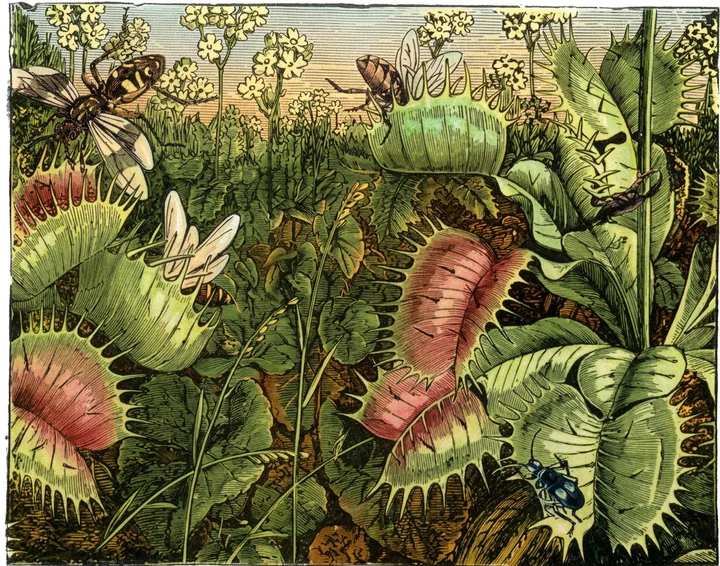
But there is one plant that acts almost as if it could think. At the end of the leaf is a curious little affair, looking almost like another leaf growing out of the end of the larger one. Long bristles cover its surface. When a fly brushes against one of these long hairs, the leaf shuts up suddenly, and holds the surprised fly a prisoner. It will do him no good to struggle to get away; for the more he tries, the tighter the leaf will close, until the poor fly is really crushed to death.
Then what do you suppose the leaf does? Instead of opening, and dropping the fly, it eats him! At any rate, when the leaf opens again, there is no fly to be seen. Sometimes the fly only brushes the hairs of this fly-trap, but does not get caught; then the leaf slowly opens again, ready for another victim.
It does not seem as if the plant really needed these flies for food, because it grows only in the rich bogs of North Carolina. It seems as if it must catch them for fun. Is it not wonderful that plants can move in this way? W. E. L.