It has been said that Californians are wont to do everything on a large scale. And it seems quite natural that it should be so. Nature planned everything on a large scale in California, and her enterprising people are only filling up the picture according to the outline presented to them. If other countries claim as beautiful scenery, as delightful climate, as lofty mountains, as extensive plains, she surely stands unrivaled in having the grandest valleys, the highest falls, and the largest trees in the world.
At the Centennial Exhibition in Philadelphia, in 1876, there was set up a section of a big tree which appeared so enormous that many queried whether it was genuine, or whether it was put together of sections of many trees for the occasion. In January 1877, in company with a friend who was on the ground when they were cutting down the “Centennial Big Tree,” I visited the spot where it stood. After an enjoyable camp in the frosty air at the foot of the mountain, we ascended some 5,000 or 6,000 feet in a wagon. We camped twice in the mountains before we reached the Big Tree grove. The wagon road leads to lumber mills which are far up the mountain. Leaving this road, we proceeded on horseback over a trail, sometimes steep, but not difficult.
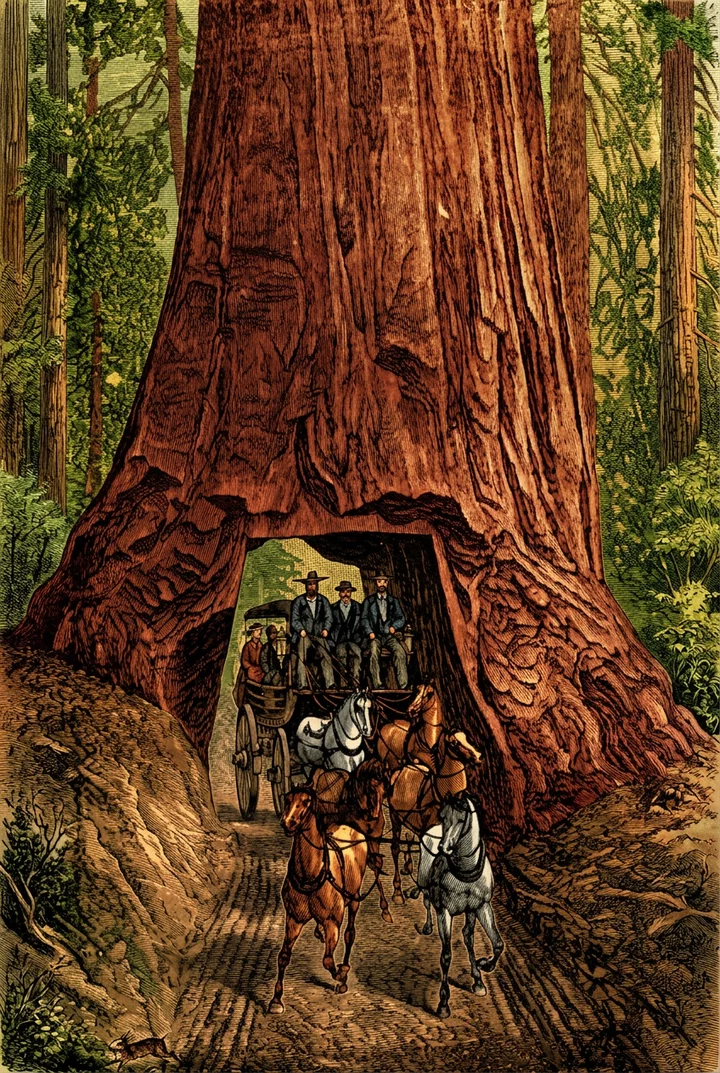
As we neared the redwood grove, the timber increased in size, especially the sugar pines, which were large in diameter, and very tall. At first we found the redwoods scattering, and of only medium size, and the great height of the pines rendered it difficult to form, by comparison, a just estimate of the height of the redwoods. As we neared the summit, we found them more numerous and larger, ranging from eighteen to twenty-five and even thirty feet in diameter. I made it a point to visit the stump of the tree which was exhibited at Philadelphia.
The tree was cut low to the ground, and a recent fire had destroyed the bark, and so marred the edges of the stump that it was not easy to determine its exact size. But from points clearly defined, I made ten steps on its surface, in a direct line across its center. Now let a man of medium size draw lines ten steps in length across a common center, and around the extreme points draw a rough circle, and you will have quite a correct diagram of that stump. My companion said that the bark was thirty-two inches thick when the tree was cut. That would increase the diameter of the stump fully five feet. But a difference of five feet in the diameter of a tree of that size appears inconsiderable to the eye.
To cut the tree in two after it was fallen, it was necessary to have a wide space in which to work. Accordingly two men commenced work on the top of the log, about eight feet apart, or far enough to cut out a length of fence posts; and as they cut in with saws and axes, they split out the length between them, and thus let themselves down until the tree was cut off. The section taken to the Centennial Exhibition was sixteen feet in length; the interior was split out, the outer shell only being taken. Of course it had to be split into many pieces, for no known means of transportation could take it in a few pieces. From the inside of this lower section, and from the length taken out in cutting off the log, the projector of the enterprise obtained two thousand fence posts! How many fence posts, railroad ties, or palings had been made from the tree I could not ascertain. About one hundred feet had been worked up when I was there.
It is difficult to form any just idea of the size of these trees in the midst of such surroundings. Every thing appears to be immense, and the eye, especially of the transient visitor, or one not acquainted with such scenes, fails to make a correct comparison. To realize their size, you must mount upon a tree as it lies upon the ground. A log sixteen feet in diameter does not appear to be very large there; but if you stand upon the top of one, as I did, it appears to be monstrous. And then you can but faintly realize the enormous size of one thirty feet in diameter.
Take this for an illustration. Look at a two-story house, the posts of which may be eighteen or twenty feet in length. Then imagine a log lying on the ground beside it, the top of which is even with the ridge of the house. You are almost startled at the thought. But this is not drawing upon the imagination at all. It is a fair representation of a fact. Such a log would hide any ordinary two-story house from sight...
The beauty of these trees cannot possibly be imagined by any one who has not seen them. They ascend with a perfect taper, with as much regularity and symmetry as the most skillfully constructed monument. They present very little of the variety of form found in other trees, but are uniform in their stateliness and grandeur, as if they realized the necessity of a true perpendicular for such immense bodies. The only divergence from a perpendicular that I observed, was in the case of two trees which rose from the same base, and separated above the ground. The limbs appear only at a considerable height.
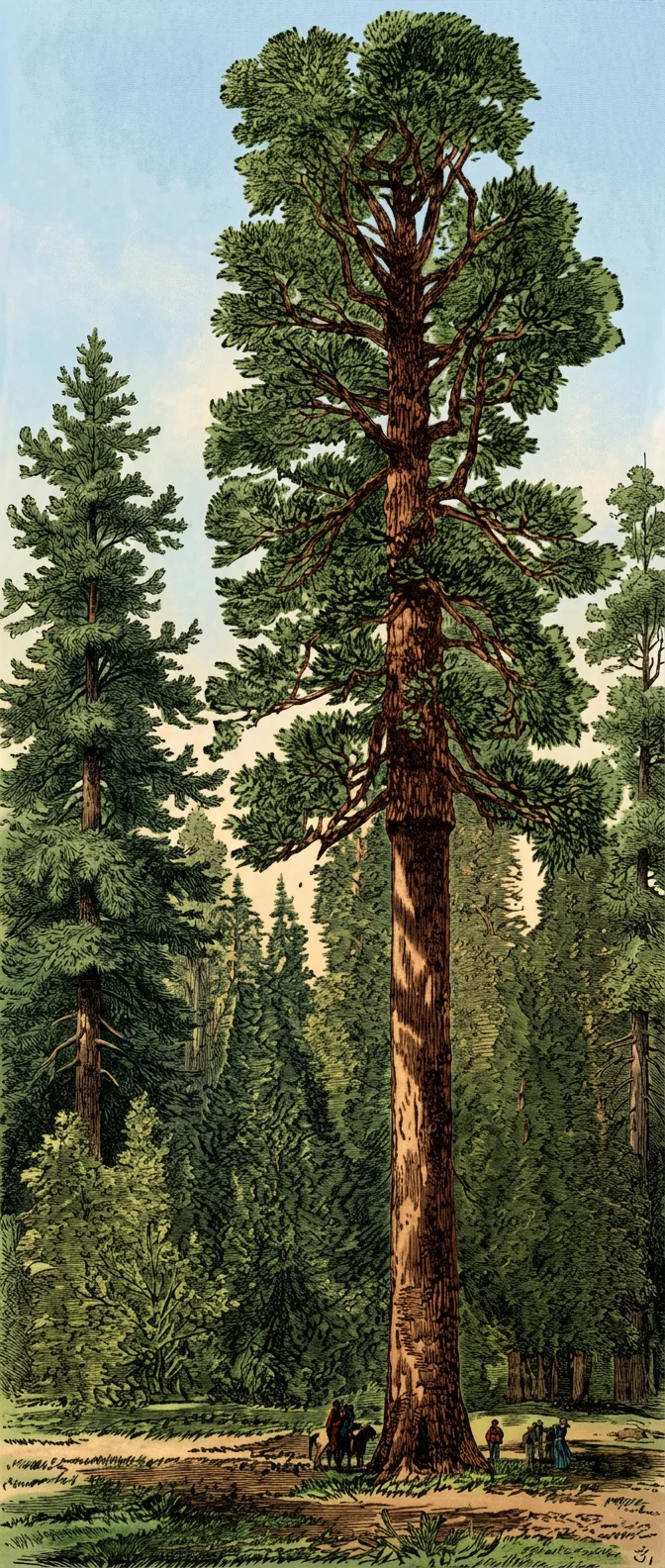
These immense trees seem to be a species by themselves, for the ordinary redwoods do not grow to such a size. I never saw in the woods where lumbering is carried on, a redwood over twelve feet through, except on the mountains where these groves of big trees are found. But the redwoods are all beautiful trees. A visitor to California once said that she should never be satisfied with any collection of curiosities that she could take home with her, because she could not take a redwood tree.—J. H. Waggoner, in Chips and Sticks.