The industry of mining dates back almost to the beginning of our earth's history; for we read in the Bible that almost 4,000 years before Christ, iron and brass were known and used for various purposes by the inhabitants of the earth. In Gen. 3:22 we learn that Tubal-cain was “an instructor of every artificer in brass and iron.” Thus we know that by some means these metals were mined from the earth, and converted into shape to be used in various ways, as they are today. Men had discovered their existence, and learned their value, and invented some method of utilizing them. No doubt their means and methods were exceedingly crude as compared with those employed at the present day.
In Job 28:1–11, is a very forcible picture of mining operations. Conant's translation of these verses is very striking: “For there is a vein for the silver, and a place for the gold, which they refine. Iron is taken out of the dust, and stone is fused into copper. He puts an end to the darkness; and he searches out to the very end, stones of thick darkness, and of death-shade. He drives a shaft away from man's abode; forgotten of the foot, they swing suspended, far from men! The earth, out of it goes forth bread; and under it is destroyed as with fire. A place of sapphires are its stones; and it has clods of gold. The path, no bird of prey has known it; nor the falcon's eye glanced upon it; nor proud beasts trodden it, nor roaring lion passed over it. Against the flinty rock he puts forth his hand; he overturns mountains from the base. In the rocks, he cleaves out rivers, and his eye sees every precious thing. He binds up streams that they drip not; and the hidden he brings out to light.” Certainly a most remarkable description, which gives evidence that the mining operations of those days were not wholly unlike those of the present, and that Job was familiar with them.
The Semitic desert contains the ruins of mining works, probably executed by the Egyptians. Abraham found gold and silver in use among them. And as we come down through history to still later years, we find that almost every nation, in nearly every country, has engaged more or less extensively in mining for the precious metals.
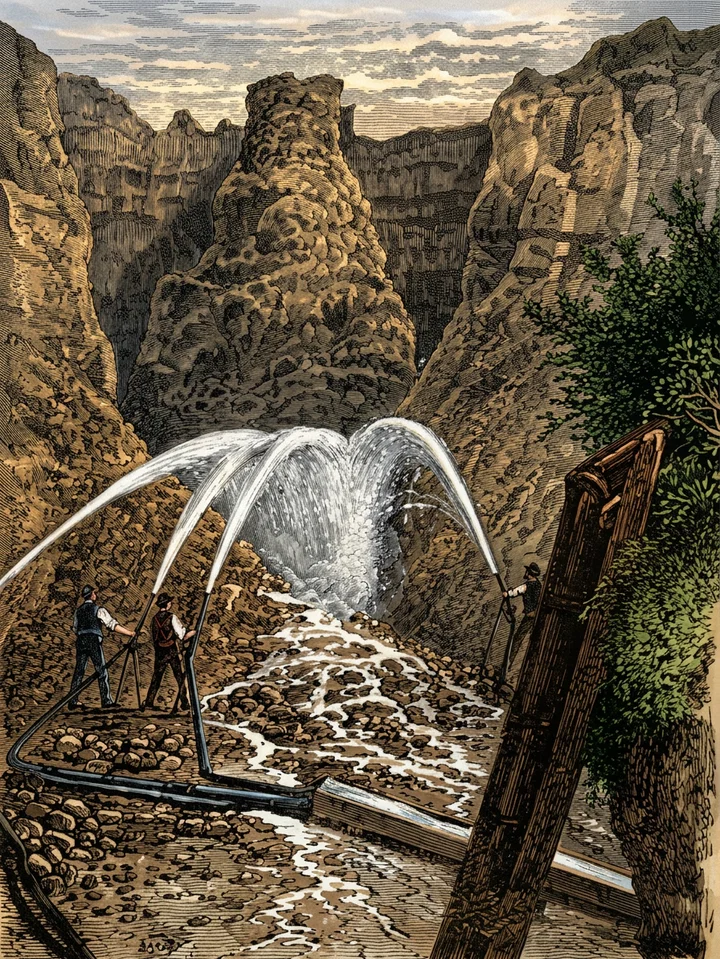
Mining is known under two heads, or kinds; viz., underground excavations, and open workings. Our illustration shows a scene in an open mine, where the earth and rocks have been loosened by blasting, and by the use of powerful streams of water are washed into the sluices prepared for them. This process is called hydraulic mining, and was invented in California in 1852. From a reservoir situated about forty feet above the mine, the water was drawn through a hose six inches in diameter, made of cowhide, and ending in a tin tube four feet long, the nozzle of which was an inch in diameter. This simple contrivance has long since given place to greatly improved methods of using the water, which have become of great value in aiding the miner in his operations. Water is conducted from the various streams high up in the mountains, into large reservoirs, and from thence to the mines through flumes and pipes; and by means of ingeniously contrived and regulated nozzles, streams six inches in diameter are discharged under pressure sometimes exceeding four hundred feet of hydraulic head, with a velocity of one hundred and forty feet and upward per second, delivering more than 1,600 lbs. of water in that time. The water issuing from the nozzle seems to the touch as hard as a bar of steel, and striking the bank in a solid, cylindrical shape, bores into it with immense power. The heavy boulders are thrown about like pebbles, and the earth, clay, and gravel are swept along into the system of sluices prepared for them.
While in every country on the face of the globe, mining is carried on more or less extensively, it is stated by competent authority that the United States exceeds every other country in the world in the extent of this industry, the estimate given for 1879–1880 being 360 million dollars, and that of Great Britain 325 million. Germany holds the third rank, followed by France and Russia. The United States produces 33 per cent of the gold yield of the whole world, 50 per cent of the silver, 22 per cent of the pig iron, 29 per cent of the steel, and about 25 per cent of the lead.
Not only has God's kind providence stored away in rich abundance, down deep in the bosom of our earth, these precious metals, so useful to man, and without which it would seem almost impossible to live, but he has also had thoughts for the comfort of his creatures, in providing for them other necessaries of life. And for these also the hardy miner toils by day and night, the same as for the gold and the silver. The words of a recent writer on this point are very forcible and beautiful:—
“Among the precious things of the lasting hills we may count the light which sheds its radiance upon us in the evening hours, and the warmth which cheers our homes when icy winter reigns through all the frozen North. The veins and beds of coal and the springs of oil which make our dwellings habitable, and keep all the fires of industry burning, were prepared in far-distant time against the day of need, and intrusted to the safe-keeping of the lasting hills. Down deep in the treasuries of the ancient hills God laid up of old, in black and solid mass, the bright effulgence which plays on the evening circle and kindles the classic page for the student's eye at the midnight hour.”
“In long-gone ages God made the mighty forests grow. He poured the sunshine upon the green leaves that every branch might treasure up a portion of embodied light. He sent forth great water-floods to sweep the fallen trunks of millions of trees into ravines and valleys between the hills. He covered them over and pressed them down with masses of sand and earth. He hardened the covering into stone, that the store-house might not be broken open till the time of need. In the process of ages the beneficent and divine Builder set his own hand beneath the hills and heaved up the rocky door. He opened the treasuries of darkness and the hidden riches of secret places, where light and warmth have been stored away in solid masses among the precious things of the lasting hills. Then the voice of his providence said to man, Behold the store-house which thy Father's hand hath prepared and filled of old for thee! Enter and possess thine own. And when the treasures of darkness fill thy homes and sanctuaries with light by night and warmth in winter, then offer thanksgiving to Him who thought of thee and provided for thy wants so long before the time of need came.
“Moses promised that the Lord God would bring the tribes of Israel into a land whose stones were iron. Speaking by divine inspiration, he recognized the mineral treasures of the earth as the means of spiritual blessing to man. And the coal and iron are among the most precious things which God hath stored up for us in the treasuries of the hills. More precious than fine gold and sparkling gems are the black coal and rusty iron that grime the face of the laborer with soot and sweat, and leave the signs of toil upon every hand that touches them. They keep all the wheels and hammers of industry in motion. They feed the hungry and clothe the naked and comfort the afflicted. They build houses for the homeless, they supply occupationp. 162 for the idle, they reward the industrious for their labor. They bridge our streams, build highways for travel, transport men and merchandise over land and sea with the speed of the wind and with the power of countless horses. They move the mightiest masses, and they finish the most delicate work. They hang the giddy track for the rushing train on the face of the mountain, and they stretch the connecting thread under all the waters of the great deep from continent to continent. They print our Bibles, give voice and melody to our songs of praise, and supply every comfort and convenience of public worship. If it were not for the treasures of coal and iron stored up of old by God's hand in the ancient hills, the grand march of science and social improvement, of civilization and Christianity, would be arrested, and the nations would go back to a state of utter ignorance and barbarism.”
J. W. B.