The roads of Palestine, like its springs, do not change their location. Where we tread them now we may be sure the actors in Holy Writ traveled thousands of years ago. Perhaps around no six miles of road do so many memories cluster as in those stretching between Jerusalem and Bethlehem. Over this road Abraham traveled; near the city Jacob buried his best-loved wife; on these plains the shepherd-king led his sheep; here the beautiful Ruth gleaned in the fields of Boaz; and here, outshining all other memories, the Saviour of the world was born.
As we approach the town, the first object that attracts the eye is the massive convent and church of the Nativity, less noticeable for its beauty than its strength. The courteous monks in charge of the convent will give us a hospitable greeting, and make us welcome to all their humble means afford. The old church, which forms the greater part of this pile of masonry, is one of the few places in the Holy Land to whose claims we may give credence. If it does not stand on the exact site of the old manger in which the Saviour was born, we may be sure it is not many yards from it.
Says a traveler: “The magnetic center of Bethlehem, around which cluster the churches and convents, is the grotto or cave which has been recognized since the second century as the scene of the Saviour’s birth. The Empress Helena, mother of Constantine, in the year 327 built over it the basilica which now covers it. Hence this is the oldest Christian church in the world. This venerable building, with its nave and pillared aisles that have echoed Christian worship for over fifteen hundred and fifty years, might well attract pilgrims; but the attraction lies in the grotto beneath its choir. This grotto is reached by either of two curving stone staircases, which enter it on the right and left of its most sacred shrine at its eastern end, and is known as the Chapel of the Nativity.
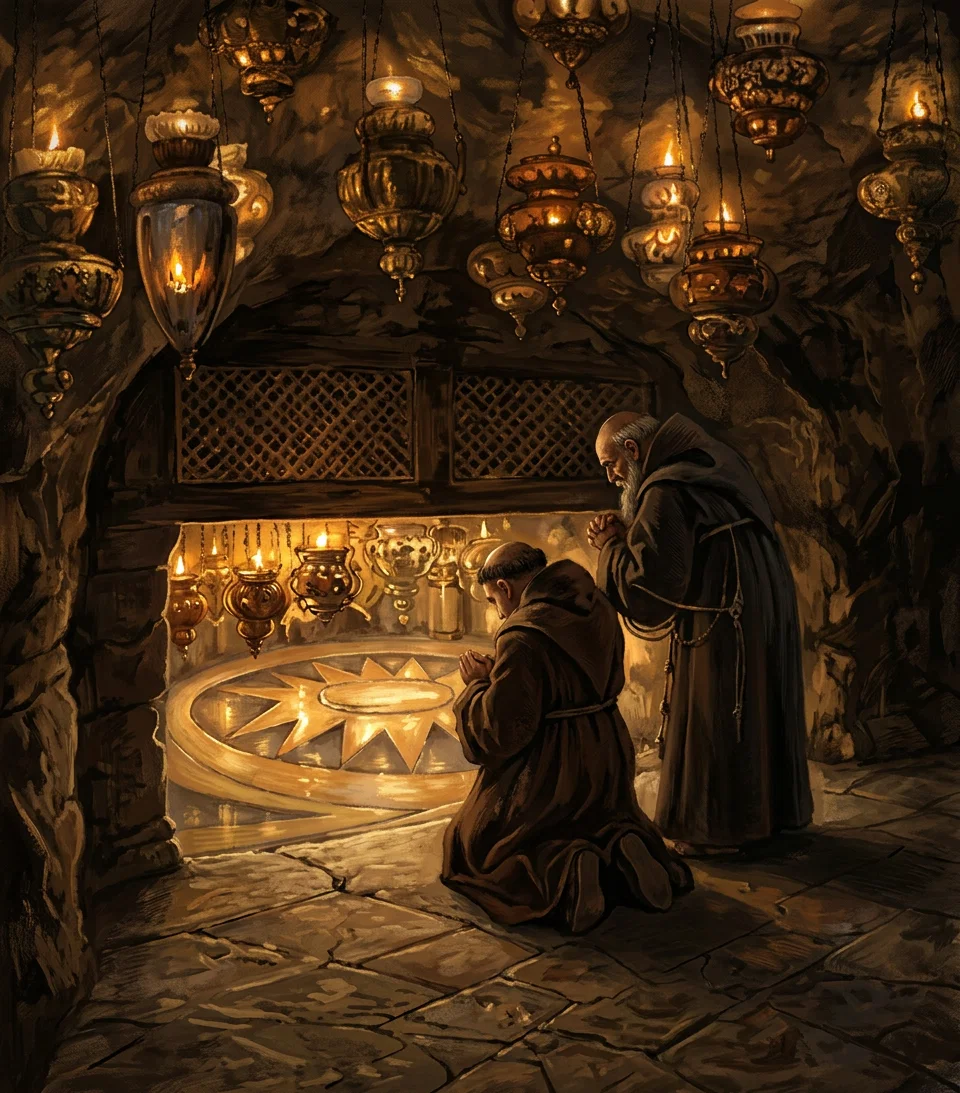
“It is a low vault in the solid rock, thirty-eight feet long and eleven wide. In a semi-circular recess at its eastern end a silver star is set into a marble slab in the pavement, on which are cut the words, ‘Hic de Virgine Maria Jesus Christus natus est,’—‘Here Jesus Christ was born of the Virgin Mary.’ (See cut on this page.)
“That this is literally true we may not assert, but we may believe that this church stands over the spot where stood the house in the stable of which was born the Saviour of men. Nor is it impossible that this grotto was the cave-stable of that house. A place more tenderly touching the heart of the Christian is not to be found the wide world over. . . .
“On one of our visits to the Grotto of the Nativity we were much interested in a group of pilgrims from Russia. The men were tall and powerful, with shocks of red hair parted in the middle, and clad in long coats belted about their waists. The women were sturdy, homely, and square. All were profoundly serious. And no wonder! Their simple faith had brought them all the long way from their homes in the distant North, sleeping and living on the unsheltered deck by sea and traveling on foot by land, to visit the places where Jesus was born and had died. And now they stood before the holy spot where their Redeemer first appeared to men. A Greek priest held a large volume of the Scriptures, which he rested upon the heads of the three kneeling pilgrims, and read to them the story of the nativity, to which they listened with solemn awe. The reading ended, the book was laid upon the head of each of the pilgrims; each kissed it and the hands of the priest; then, kneeling they pressed their lips to the silver star which marked the holy spot.”
Restored with AI
However questionable their adoration of the place may appear in our eyes, it certainly will do neither them nor us any harm to remember that for our sakes the Word was once made flesh and dwelt with men.