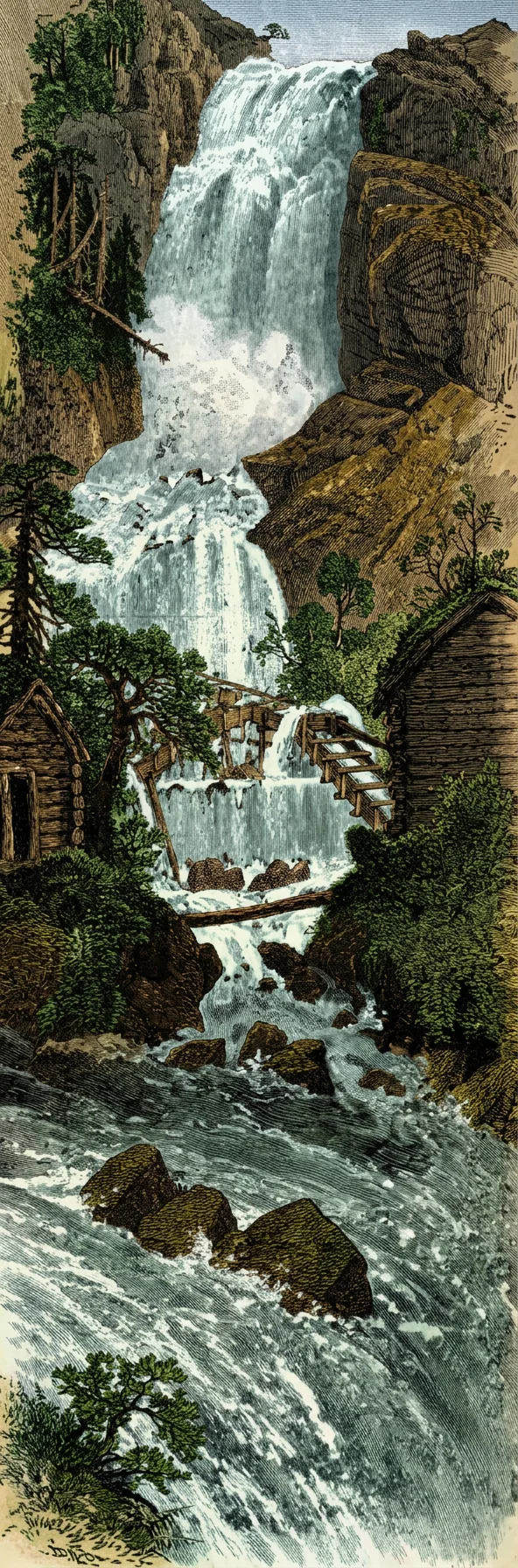
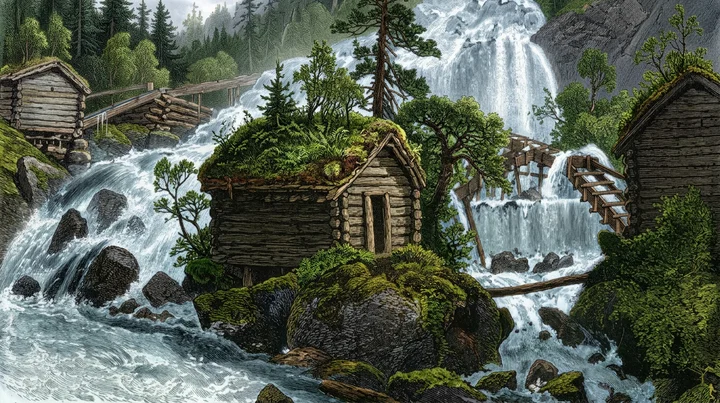
IN the illustration on this page, representing Jolster Cascade, in Norway, the artist has endeavored to picture one of the many beautiful and romantic scenes for which this country is noted. The natural scenery of Scandinavia, especially that of Norway and Sweden, is unique and varied. In this “Land of the Midnight Sun,” even the tourist who has traversed the great highways of the world can yet find “fresh fields and pastures new,” surpassing perhaps every other in Europe in their power to excite wonder and admiration.
In topographical respect, Sweden is naturally divided into three parts,—the Northern, or Alpine region, which rises gradually from the Gulf of Bothnia to the Kjolen range, belonging to the great Norwegian Fjeldmark, which constitutes the true watershed and natural boundary between Norway and Sweden; the central, or lake district, containing numerous fine lakes, of which the Vener, Mælar, and Vetter are the largest and most noted, and together with Hjelmar lake, nearly intersect the country from east to west; and the southern, or mining district. Nearly one-eighth of the entire country is covered by lakes. The rivers are generally short and rapid. South of the lakes we have named, the country is mostly level, though ranges of high ground and detached hills occur.
The waterways of Sweden are unique. By these we mean not only the fjords by which the coast is everywhere indented, and which, with their multitudes of rocky, pine-clad islands, present scenes of ever-varying delight to the tourist’s eye, but also the lakes, rivers, and canals, which afford facilities for inland navigation. One of the most delightful routes is that by steamboat across the country from the Baltic to the North Sea. A large part of the journey is made by the East and West Gæta canals, one of the greatest feats of engineering skill in the world. Starting from Stockholm, four or five hours on the fine Lake Mælar and as many more amid coast islands, bring us for one hour out on the open Baltic Sea; we then enter lakes and canals in frequent alternation, winding about through verdant fields, forests, and rocky hills, past historical castles, churches, and villages, for the most part of two days and nights,—if indeed that can be called night which in summer brings no darkness, but simply a dusky sky for three or four hours. While on Gæta canal, the boat passes Trollhetta Falls, and two hours are allowed the passengers to visit this celebrated cataract, which, in regard to volume, is greater than any in Europe, and in grandeur is equal to the most famous. The banks of Gæta River for fifty or sixty miles above the cataract present every variety of scenery,—now waste and dreary, now grand and elevating, and now beautiful and charming. Coming to the first of the cataracts of the Trollhetta, which, broken only by intervening eddying rapids, extend to the distance of nearly a mile below, the placid river all at once bounds over, in a broad, glossy sheet of water, to be broken at length by out-jutting rocks, and fall with uproar into a wild, seething, steaming abyss below. The stream is broken and narrowed by the interposition of several granite islands, forming small straits, down which the water dashes wilder and wilder. The scenery around and for twelve miles onward is romantic or grandly impressive. A road winds picturesquely all the way along the banks, now skirting the water’s edge, now rising steep up the mountain sides, from which are visible far-off reaches of the river, with ships wending to and fro over its peaceful bosom. Here and there in the woods are clearings, with broad lawns and blooming orchards, each ‘embosoming’ some stately mansion or tasteful villa, all contrasting beautifully with the somber tints and frowning heights around.
The falls themselves are four in number, aggregating 130 feet in height. The environment, the volume of water, the stillness of the current above and below, and the perceptible quaking of the rocks in their neighborhood, contribute to render them as impressive as any cataracts in the world.
The impression on the mind, particularly in calm weather, and still more by moonlight than by daylight, is so unique that you linger under the spell, and ever after are unable either to forget it yourself or to render an account of it to another.
An old geographer makes this startling description: “A few leagues from Gottenburg there is a hideous precipice, down which a dreadful cataract rushes with such impetuosity from the height into so deep a bed of water, that large masts and other bodies of timber precipitated down disappear, some for half an hour, and others for an hour, before they are recovered. The bottom of this bed has never been found, though sounded by lines of several hundred fathoms.”
There are many other beautiful and interesting places in the northern part of Sweden, but, as these are similar to those in Norway, we will now turn our attention to the natural attractions of this country. Here it may be said that every square mile possesses its water-fall, valley, or glacier, the whole comprising a continuous series of fjords, isles, mountains, and forests, Alps and glaciers.
Travelers regard it as a “stupendous museum, where the Creator has crowded together all the wildest and most beautiful effects of his power.”
On the steep slopes, nature seems to have delightedp. 170 herself in heaping together the sharpest rocks. Here in all their majestic grandeur and solemnity the mountains rise around and before you. The only sound that breaks the stillness is the roar of rushing rivers; and as the traveler ascends higher, the mighty rivers narrow into murmuring streams, falling down steeper and steeper precipices, till transformed at last into babbling brooks, they leap from stone to stone, plunging from steep to steep, twisting their silvery beds into the most fantastic curves. “The skies above, and the earth and waters below, will conspire to open in his soul fountains of novel and exquisite delight. Delicious bits of landscape, emerald valleys, waterfalls of every size, from trickling rills where a panting deer could scarcely slake his thirst, to roaring rivers leaping sheer down a thousand feet; limpid lakes with all conceivable shapes and settings, from mountain mirrors to inland seas; lofty peaks; bald, solemn headlands; islands studded by bays winding in and out with all conceivable and inconceivable lines of beauty; placid fjords (or inlets) cut by the keels of many nations, and skirted by jagged cliffs and somber pines and fishermen’s villages and peasants’ huts,—and all these to be seen in the changing and multitudinous lights of a far Northern summer, which range from the severe splendor of high noon to the weird loveliness of a daylight midnight—but words fail, and I pause.”
When we stand in the midst of such a panorama, who can but lift his thoughts to that great Being who is infinitely more wonderful than all we admire in nature? Well may we say, If the works be so beautiful and grand, what must their Creator be? Said King Oscar, the ruler of Scandinavia, when speaking of a trip up the mountains of Norway: “I seemed but a speck in the great universe; almost lost in infinity. . . . Here, away from the crowd of humanity, I am only a mere grain of dust upon the deep snowdrift.”
If the wonders and beauties of this sin-cursed world can so fill us with delight and admiration, what will be the feelings of the saints when they view the new earth restored to its Edenic beauty? When they shall have the privilege of contemplating, with expanded powers of comprehension and appreciation, not only the wonders of this renewed earth, but of other larger, and if possible, more wonderful worlds in the boundless universe of God? Will this be your privilege and mine? A. SWEDBERG.