It may be you have seen the little poem which names some of the blessings of each season in the year, and then asks, “Which season would you rather be without?” What answer would you give to the question? We think you like all the seasons; for each one has some charms that the others have not. You love the winter for the coasting and skating it brings; and so you can name some pleasures that only the spring and the fall bring about.
But do you not think the summer is a little the finest season of all the year? Or rather, do you not think the loss of the “growing season” would be most felt? It has so many pleasures and blessings that the others have not, and more than can be named.
The lovely woods, the singing birds, the green fields, the babbling brooks, the fragrant flowers, the bright sunshine, and, in turn, the gentle shower; oh, who could spare any of these? Who is not glad when summer comes, and sorry when Jack Frost spoils its beauty, even though it is followed by the next season’s treasures? Can we help but feel sad when we see the signs hung out that the summer must die?—the time when—
“By the lengthening twilight hours; By the chill and frequent showers; By the flowerets pale and faded; By the leaves with russet shaded; By the gray and clouded morn; By the drooping ears of corn; By the meadows, overspread By the spider’s wavy thread By the soft and shadowy sky; By the thousand tears that lie Every weeping bough beneath,— Summer, we perceive thy death?”
But as long as time lasts, the seasons will change in this way, so the next best thing we can do is to make summer and sunshine in the home. Little boys and girls in the poorest homes can do this if only they have sunny spirits shining out of their hearts. The brightest and best of the seasons do not make sour spirits glad. Love is the root of happiness, and upon this foundation you can build a little paradise.
You can be neat, orderly, and helpful, and thus save mother and the other home friends a great deal of care. You can be cheerful and obliging, giving others a chance to reflect good traits of character.
The Lord told our first parents to “dress and keep” their home; and so he expects we will do,—make our homes pleasant and inviting to friends and strangers. With a few flowers in the summer season one can make a very plain home charming as a palace. And so, in the winter time, one tiny plant, in a cheap pot, will add a charm which hardly anything else will, and make the heart cheery as you watch its growth, its buds and blossoms. Have you ever tried it?
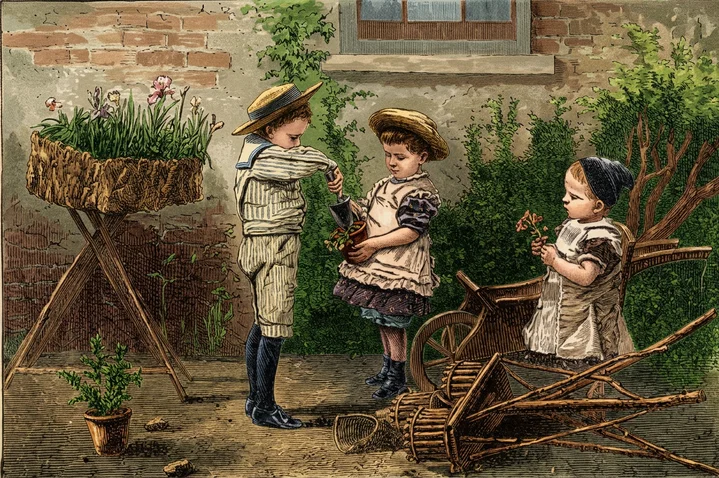
In the picture on this page, some little people are preparing their winter garden, may be on a larger plan than many of you can. They have, all ready for the window, a stand on which is a box full of growing plants, and they are filling pots besides. Even the youngest child has his plant ready to be set out. May be this little fellow upset the plant-stand, and broke his pot; but they will not refuse to give him something in which to place his plant.
By lining a box with old zinc or tin, so that it will not leak, and then filling it with good earth and a few plants, one can, with no expense but a little time, have a small flower garden in the house. On dark days it will drive dull care away, and it will give us some of God’s works to admire every day.
Some may not be able to have even this; but any one can have as much as one plant to look at, even if it is set out in a broken mug or dish. One plant can be easily protected from the cold, for, when the nights are very severe, it will not be much trouble to carry it to the cellar. If the weather is not too cold, you can save the plants from the frost, by pinning paper, one or more thicknesses, around them.
What if you do fail the first time, and do not keep your flowers through the long, cold winter? They will be a comfort while they last, and pay you well. Please tell us if this is not so. M. J. C.