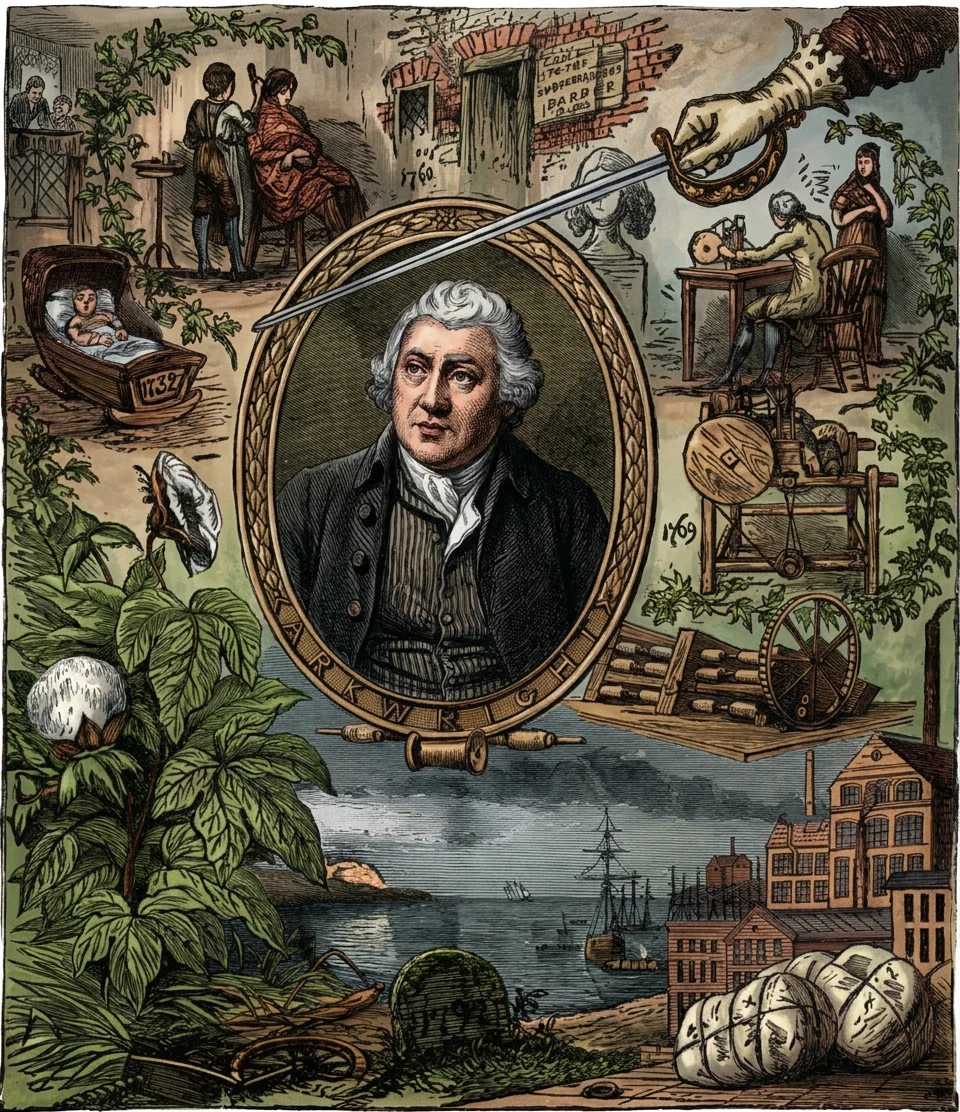
ONE of the most prosperous and busy towns in the great manufacturing region in northern England is Bolton. A hundred and thirty years ago it was a much smaller town than now, but it had then the reputation of being one of England's most thriving industrial centers. At that time Bolton was a queer, struggling place, with many old grimy houses, and many narrow lanes and alleys branching off from the streets. One of these alleys conducted the wayfarer to an ancient, cozy inn, the Old Millstone. If you had been walking in this alley about the year 1750, you would have seen a rude sign hanging over a cellar on one side, bearing these words: “Come to the under-ground Barber! He shaves for a penny!” Descending into the cellar, you would have seen the barber, a bright-eyed, active, keen-looking young man about twenty-one years of age, standing ready in his shirt-sleeves to shave the next customer. Nor would he have to wait long; for the cheap rates brought an almost continual succession of artisans from the neighboring machine-shops to his dark little cellar.
This lively barber, besides being very expert at his trade, was, like many another barber before him and since, a great talker. Everybody who came under the swift sweep of his razor had to pay his contribution of chatter. The barber asked his customers about their various trades, and he was always especially eager to learn what anybody would tell him about machinery. He loved to hear all about the new machines which now and then were introduced into the shops and factories—how they were made, how they worked, how much labor they saved, and what kind of goods they made.
Restored with AI
The name of this barber was Richard Arkwright. His childhood and boyhood had not been very pleasant. His father was a very poor man, and had thirteen children. Of course, as there were then no free schools in England, he could not hope to give this large family a good education. The result was that Richard grew up without learning much of anything, and just as soon as he was strong enough to work, he was set about it. Yet Richard was a youth of a very persevering, determined spirit. He had a manly independence about him, and a cheerful courage, which enabled him to bear bravely whatever hardships came upon him, and to carry on sturdily his struggles with the world. While he was shaving for a penny, he was always dreaming of something better and more profitable. He knew that he had a good deal of mechanical ingenuity, and he resolved to put it to use as soon as he could. He spent the little leisure time he had in studying machinery, and in trying to invent something. By the time he was thirty, Richard made up his mind that he had had quite enough of the shaving business. He worked hard, yet he only made enough to keep body and soul together; he was laying up nothing for the future.
So throwing aside the razor, he took up the trade of a dealer in hair. He wandered about the country, buying the hair of rustic young girls, making it up into wigs, and selling them to the old people. Meanwhile he invented a new way of dying hair, which brought him in a brisk trade. He thrived so well in his new business that he laid up quite a little sum of money, and falling in love with a farmer's daughter, he married her.
One day he was in a manufacturing town, and heard some weavers talking about the threads used in weaving cloth. The cloth they made consisted of linen thread woven with cotton. But it was hard, they said, to get enough cotton thread to form what was called the “weft” of the cloth. A machine for spinning cotton thread had already been invented by a poor weaver named James Hargreaves, to whom his invention had been nothing but a misfortune, since he had been persecuted and driven from place to place, because the spinners thought that his “spinning-jenny” would deprive them of work. But the spinning-jenny did not produce enough thread for the demand, nor was its thread fine and close enough for the weft.
Richard Arkwright listened intently to all that the weavers were saying. He plied them with questions. He found one of Hargreaves's spinning-jennies, and examined closely its every part. From that time he had but one idea—to invent a machine which would spin thread faster and finer than the spinning-jenny. And now, like many inventors who absorb themselves in their one idea, Richard began to neglect his regular business. His young wife saw with anger that he was daily growing poorer and poorer, and that instead of saving money, he did not now earn enough to give them the common comforts of life. Instead of going up and down the country for his stock of maidens' tresses, he stayed at home, making models of machines, and brooding over them by the hour together. One day he would feel sure that the model he had just made would answer the purpose, and bring fame and fortune at last; the next, he would discover some fatal defect, would throw the model aside, and begin on a new one. They finally grew so poor that it was with difficulty230they could procure enough to eat from day to day.
Richard's wife, who was a young woman of rather violent temper, was always upbraiding him for what she thought his idleness, and crying out to him that his attempts to invent a spinning-machine were all nonsense. At last her patience gave way entirely, and one day she seized the last model which he had carefully and laboriously made, and in a fit of rage threw it violently on to the floor. Richard could not stand this. He was infuriated to see his pretty model lying on the floor in twenty pieces, and told his wife to leave forever. She obeyed him, going away from their humble home never to return.
After several years of great poverty and suffering, during which he met and overcame many obstacles, Richard at last completed the machine which has made his name immortal in the annals of invention. The old days of want vanished forever after Arkwright had at last introduced his spinning-frame. This machine produced a cotton thread fit not only for the “weft,” but also for the “warp” of the cloth, so that the cloth could now be woven wholly of cotton.
In a few years the beautiful vale of the River Derwent, in the center of England, revealed to the eye several large mills busily at work with Arkwright's machines, and not far from them rose a stately country house, with parks and lawns, known as Willersley Castle. Both the mills and the castle belonged to Richard Arkwright, become rich and prosperous, and growing richer every day. He who had once been a humble barber in a dingy cellar, shaving workmen for a penny apiece, was now one of the chief men of his neighborhood, and one of the most famous in all England. He was made high sheriff of his county, which in England is a high honor; and once, when King George the Third paid a visit to his locality, Arkwright, as sheriff, presented the monarch with an address of welcome. For this slight deed, and not because he was the inventor of one of the most useful machines ever made, the king made Arkwright a knight, so that he rose from his knees with the title of Sir Richard Arkwright. Thus titled, rich, and renowned, the inventor lived to a good old age, happy in the respect of all men.—Harper's Young People.